
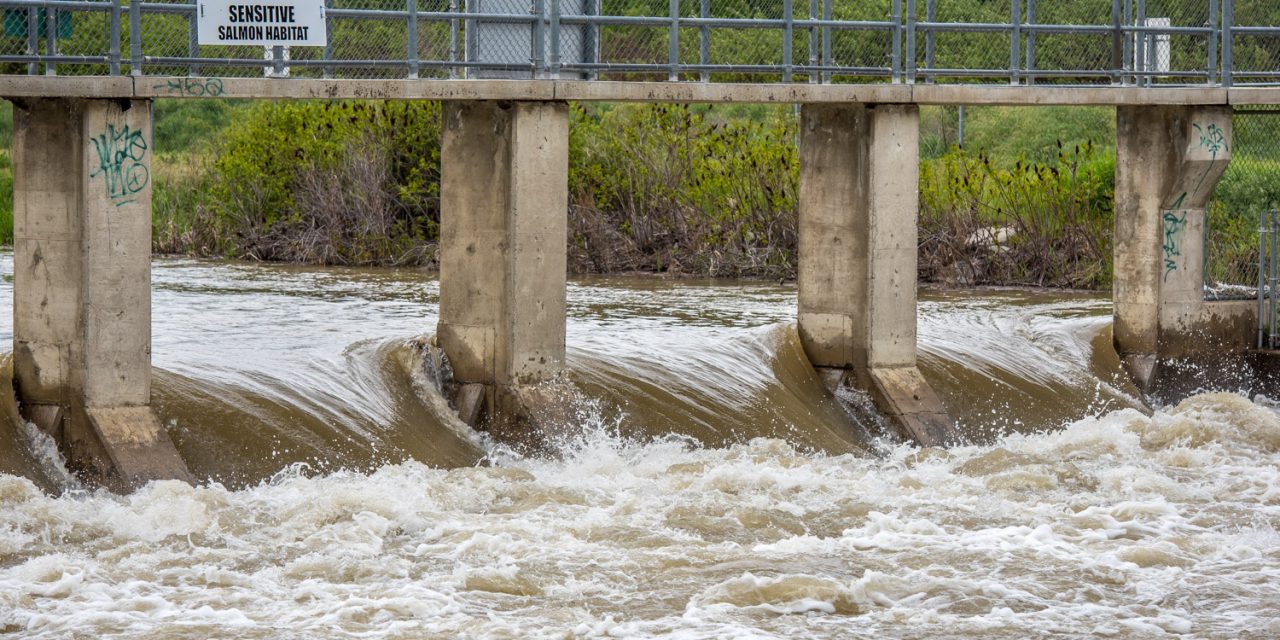
This year, a cold winter and cool wet spring were followed by floods in the Okanagan and in other parts of Canada.
Two years ago, drought and heat contributed to a rash of wildfires.
Wacky weather dates back to the legendary flood that led Noah to build his ark and beyond, so meteorologists usually avoid attributing specific weather events to global climate change.
But scientists overwhelmingly agree that global climate change is occurring and its cause is the sharp rise in greenhouse gases, most notably carbon dioxide, due to the burning of fossil fuels.
Climate change doesn’t affect all parts of the globe equally. By far the biggest impact is at the poles, where temperatures have increased drastically, melting icepacks and raising ocean levels.
The warmer polar regions reduce the temperature differential between the poles and the equator, sometimes causing the jet stream to change its course and sometimes causing it to “block” – holding the same weather in place for days and weeks.
We experienced that with this winter’s cold spells and spring rains.
If, as is likely, the polar ice caps continue to melt, oceans will rise and many coastal and island regions will be submerged. We’re not just talking about the Seychelles or Tuvalu. Much of Florida’s coastline is vulnerable.
The prospect of millions of climate refugees threatens global stability.
Scientists believe that a rise in global temperatures of two degrees Celsius from pre-industrial times represents a crucial tipping point. We are already halfway there.
In recent decades, the international community has tried to reach agreements on slowing and reversing the rise in greenhouse gases.
The Kyoto Protocol adopted in 1997 was one such effort. The problem has always been that different countries are at different stages of industrial development and some rely more than others on fossil fuels. Competing short-term national interests have trumped the long-term global interest of human survival.
The Paris Climate Accord adopted in 2015 has been the most successful yet at winning international agreement. It lacks the teeth to compel nations to act, but it is a starting point that holds nations to account to report on their efforts to reduce greenhouse gases.
Until last week, only two nations in the world – Nicaragua and Syria – refused to sign on.
Then, last Thursday, in a rant full of outright untruths and distortions, U.S. President Donald Trump announced he was pulling his country, the world’s second-largest producer of greenhouse gases, out of the Paris Agreement.
It was a speech that portrayed the world in zero-sum terms, with the rest of the world being out to strangle America’s coal industry. Many saw it as a sign that the U.S. has now abandoned its global leadership of more than a century.
When Trump talked about putting “Pittsburgh before Paris,” Pittsburgh Mayor Bill Peduto repudiated him, supporting the accord.
There lies the reason for optimism. Led by forward-looking governors in states like Washington, California and New York, numerous U.S mayors and business leaders, Americans are showing that on climate change, Trump doesn’t speak for them.
Our best hope though is that the shift to an economy based on renewables has already come too far to turn back the clock.

