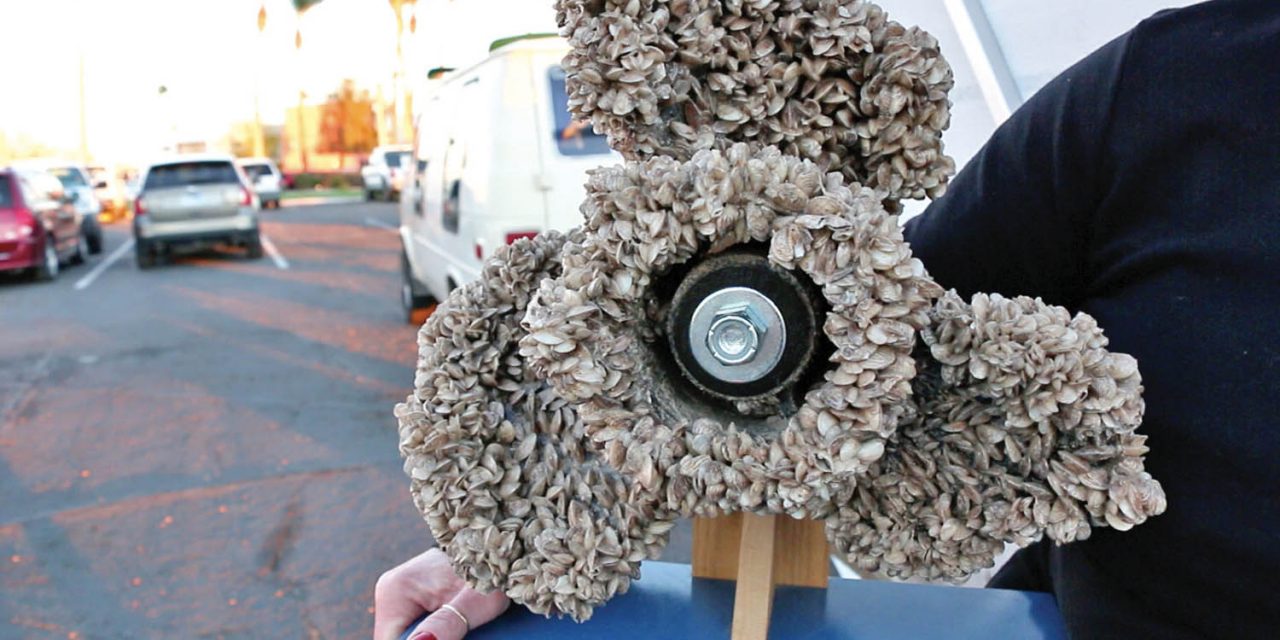
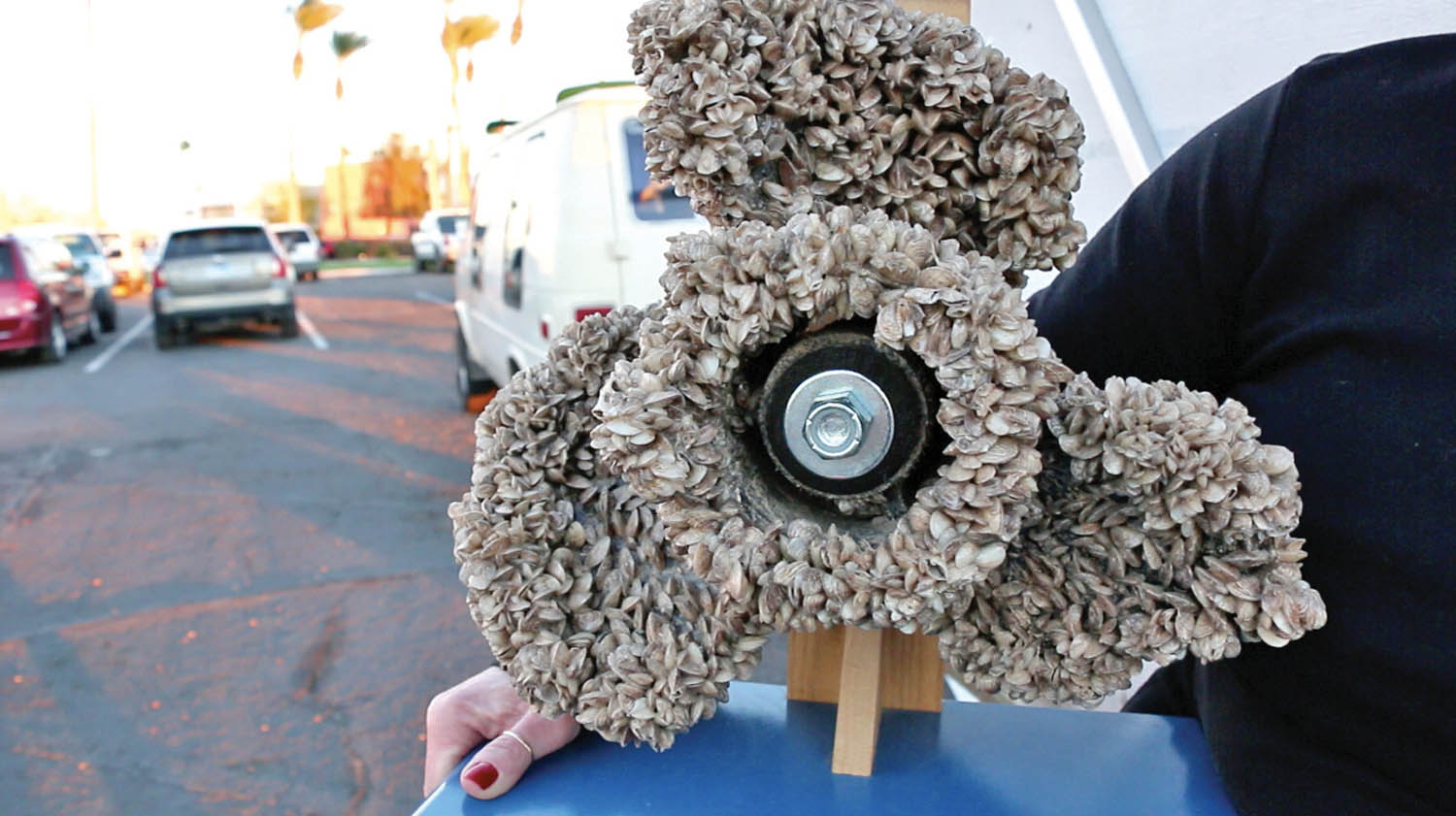
A boat propeller covered in invasive mussels is shown in this still shot from Brynne Morrice’s short documentary Mussel Threat. Once mussels get into a waterway, they are almost impossible to get rid of and they proliferate to cover every surface. Their razor-sharp shells ruin beaches. (Photo supplied)
Invasive mussels have been intercepted on boats coming into B.C. from outside the province this summer.
The provincial government announced last week that 26 watercraft requiring decontamination were identified and addressed, either by provincial inspection crews or through decontamination orders provided to vessel owners.
Four boats required a 30-day quarantine period in addition to the decontamination, the Ministry of Environment said in a news release.
These are the first decontamination and quarantine orders issued under the provincial controlled alien species regulation.
Invasive zebra mussels have spread west in Canada as far as Manitoba and quagga mussels have reached the southwest United States.
These mussels coat themselves and their sharp shells over any surface in waterways, carpeting lake bottoms, piers, boats, water intakes and other surfaces.
The Okanagan Basin Water Board (OBWB) says the annual cost to mitigate an invasion of mussels in the Okanagan lake system would be $43 million a year.
In March, the province announced $575,000 in 2015-16 to help fight the mussels. Most of this funding is going to three roving inspection crews with two conservation officers each.
Another three roving teams were announced in July, thanks to funding from Columbia Basin Trust.
Among the mussels intercepted were some discovered on a boat at a workshop in Kelowna in August that was organized by the OBWB in partnership with the B.C. Ministry of Environment.
“It was an incredible opportunity to view the actual mussels on a boat first hand and then discover just how hard it is to detect them,” said James Littley, OBWB operations and project manager.
The boat, owned by an Ontario couple moving to the Lower Mainland, had been moored in the zebra-mussel-infested Rideau Canal for a couple months before being transported.
The owner inspected it in Ontario before leaving the province. Alberta inspectors then stopped the boat and when mussels were found on it, despite the owner’s inspection, it was decontaminated.
Alberta followed up and called B.C. conservation office officials to inform them the boat was on its way and the boater was ordered to come to Kelowna for a follow-up inspection.
The boat pulled into the parking lot where the training was taking place and within a few minutes, B.C. inspectors detected several sand-grain-sized mussels around the boat’s legs, trim tabs and props, the OBWB said.
“The fact that this boat had to go through two inspections and decontaminations shows how difficult it is to fight this,” said Doug Findlater, chair of the OBWB. “If we are going to be successful in keeping these mussels out of our waters, it will take serious vigilance.”
While the OBWB supports the roving inspection stations, it has been calling for permanent and mandatory stations, as has been done in Alberta and many U.S. jurisdictions.
In particular, the OBWB has called for stations at the five main highway entry points on the B.C.-Alberta border.
Last year the province estimated an effective inspection program would cost about $2.4 million per year with 15 stations at a cost of $60,000 to $160,000 per year.
“We know the cost of prevention is much less than the cost if the mussels get in,” said Findlater, pointing to the OBWB’s $43-million-per-year estimate for the Okanagan alone. “We are looking forward to talking with the province at the Union of B.C. Municipalities convention in September, pushing for better funding and stronger action.”
While boats remain the most common way the mussels hitchhike and infest new water bodies, they will attach to any hard surface including paddleboards, kayaks, fishing gear, and lifejackets.
It is a ticketable offence to fail to report at watercraft inspection stations. Vehicles transporting smaller watercraft such as kayaks, canoes and car toppers are not exempt.
Since May, inspection teams have examined more than 3,200 boats and inspections have taken place in 19 communities from the Lower Mainland to Valemount, including Osoyoos.
While subsequent testing has confirmed that mussels found in inspections were no longer living, some boats have been quarantined to ensure they were out of the water and dry for 30 days.
Several fines have been issued, including for failure to stop at an inspection station.
RICHARD McGUIRE
Osoyoos Times