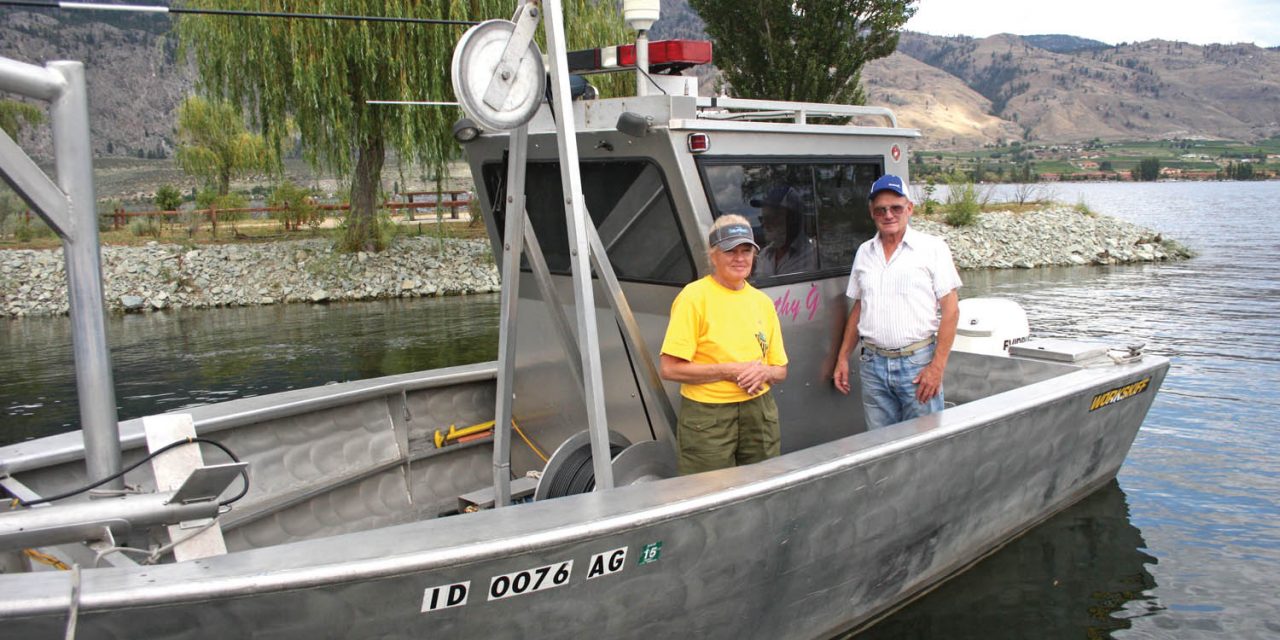

Sandy and Gene Ralston have made the trip from southwestern Idaho to Osoyoos Lake to lend their expertise and equipment in the search for a man reported missing after a boat accident on Osoyoos Lake in late June. The man is believed to have drowned. The couple has helped to recover nearly 100 bodies over the past 15 years. (Keith Lacey photo)
An Idaho couple who have gained worldwide attention for their commitment to recovering the bodies of drowning victims are using their expertise to try and find the body of a B.C. man reported missing in Osoyoos Lake more than two weeks ago.
Gene and Sandy Ralston made the long trip from southwestern Idaho – they live near the state capital in Boise – to Osoyoos last week and have spent the past week using their sophisticated “side-scan sonar” to try and recover the body of the man reported missing on Osoyoos Lake after he fell off his jet ski in late June.
The Ralstons, along with longtime friend and deckhand John Zeman, have gained national and international notoriety as they have travelled across North America and around the world helping grieving families to recover the bodies of drowning victims.
As of late Monday afternoon, they had been unsuccessful in recovering the body from Osoyoos Lake, but they plan on staying for several more days as the search continues.
“We basically stay until we feel that all possible avenues have been exhausted,” said Gene Ralston, who has been married to Sandy since 1972.
Over the past decade, the Ralstons have recovered 99 bodies using what they call their “underwater robot”, which allows them to search in waters as deep as 850 feet.
Six weeks ago, the Ralstons and Zeman found the
body of a drowning victim from Kalum Lake in northern B.C.
Last year, they played a key role in helping recover the bodies of four teenagers reported missing following a tragic canoeing trip in New Denver, B.C.
The Ralstons played a key role in the high-profile American murder case where they helped find the body of Laci Peterson, who was killed by her husband.
The Ralstons renamed their vessel “Kathy G” after Kathy Garrigan, a dedicated search and rescue volunteer from Illinois, who the Ralstons searched for and recovered in Alaska.
The Ralstons have given generously of their time for more than a decade as they spend between 100 to 200 days per year away from their home and family to conduct searches and offer training to search and rescue operators across the United States, Canada, Mexico and other countries around the world.
Gene Ralston said his passion for this kind of work came out of the blue way back in 1985.
He was working in the environmental protection business conducting water sampling and other services across the Pacific Northwest when a search and rescue unit asked to use one of the 14-foot fiberglass jet boats his company owned.
“They used one of my boats in a rescue on the Boise River and I helped out and I found it all a bit overwhelming,” he said. “There are a lot of drowning victims … and when I saw the reaction of the family in this incident, it really affected me.”
When he talked about this incident with his wife, they started volunteering to help find other drowning victims.
At first they used their own personal boat, dogs and GPS co-ordinate systems and were successful in finding several victims.
Fifteen years ago in 2000, they were both hooked and decided to make an investment to buy a larger vessel and purchase sophisticated side-scan sonar equipment.
Helping grieving families recover the bodies of drowning victims has become their passion ever since.
“Since we purchased the equipment back in 2000 … we haven’t looked back,” said Gene.
The body they recovered in Kalum Lake six weeks ago was their 99th rescue mission in the past 15 years.
The Ralstons have recovered bodies in every Canadian province except Manitoba and Quebec.
They have made the very long trek to Newfoundland on three occasions and have travelled to Alaska on three other occasions to help recover bodies.
The reason they do this is very simple, said Gene.
“It’s our way of making a difference,” he said.
It’s emotionally devastating for family members and friends to cope with the loss of loved ones who have drowned, but those emotions are made every more painful when the body hasn’t been recovered, he said.
“These people are devastated and heartbroken knowing they’ve lost a loved one, but they can’t move on without recovery of the body,” he said. “We have the technology and equipment to find these bodies and put ourselves in a position to help and these families really appreciate it.
“The response from the families is overwhelmingly positive and they are so grateful when the bodies are recovered … that’s why we do it.”
The sonar equipment they own is the best in the business and they have become experts in using the information provided by the technology to help locate bodies, often at incredible depths when no other recovery was possible, he said.
Because they have become so well known, the Ralstons basically return home from a recovery mission and wait for another call, which is exactly what happened with the incident in Osoyoos.
“We got the call from the family and confirmed that the RCMP had exhausted all of their resources and made the commitment to come up to Osoyoos,” he said.
Sandy made it clear not every rescue mission is successful.
“There are some places where the equipment just doesn’t work well,” she said. “There are places like the Fraser River where there is too much current and sediment … where we haven’t had much success at all.”
While they don’t like to talk about how much they have invested in their vessel and equipment, Gene did say a search and rescue team from Newfoundland purchased similar equipment to what they own earlier this year and spent close to $300,000.
The Ralstons offer their recovery services free of charge, but they do charge “about a dollar a mile” to help pay for the costs of owning and operating a large RV, their vessel and equipment.
“We basically try and cover our expenses,” he said. “We have a large motorhome and there’s gas and campground fees, although a lot of people, like the ones here in Osoyoos, let us park our vehicle at their place.
“This isn’t about money for us at all, but trying to help families during a very difficult time.”
They always gather as much information from police and search and rescue operations and witnesses as possible before beginning a search.
In Osoyoos, veteran Cpl. Jason Bayda has gone above and beyone the call of duty in this particular recovery mission, said Gene.
“Police are always more than willing to help, but Jason has been an incredible help,” he said. “He came and helped us during his two days off and had to cancel a family camping trip because of it.
“He has been a tremendous help from the second we arrived.”
Zeman met the Ralstons several years ago in California during a recovery mission and was so impressed with them that he asked to become part of their team and they welcomed him with open arms.
“I was working as part of an FBI homicide investigation … and was so impressed with what they were doing, that I had to get involved,” he said. “They have such compassion and help so many people … I just wanted to be part of it.”
Recovering bodies that have often been submerged under water for days and week is gruesome, but part of the services they offer.
“It’s not something we enjoy, but it is part of what we do and we’ve learned how to deal with it,” said Gene. “We’ve seen some of the goriest stuff you can imagine, but you do it and you move on.”
They often guard against having family members on board when they believe they have found a body, but they will allow them if they insist they want to be there, she said.
The Ralstons have discussed permanent retirement, but don’t plan on it any time soon.
“Years ago, I told my wife we would quit when we turn 100 or after we recover our 100th body,” said Gene. “Well, we’re almost at 100 recoveries now and we have no intention of quitting yet.
“We still get tremendous satisfaction out of recovering these bodies and helping families during very traumatic and difficult times.”
KEITH LACEY
Osoyoos Times