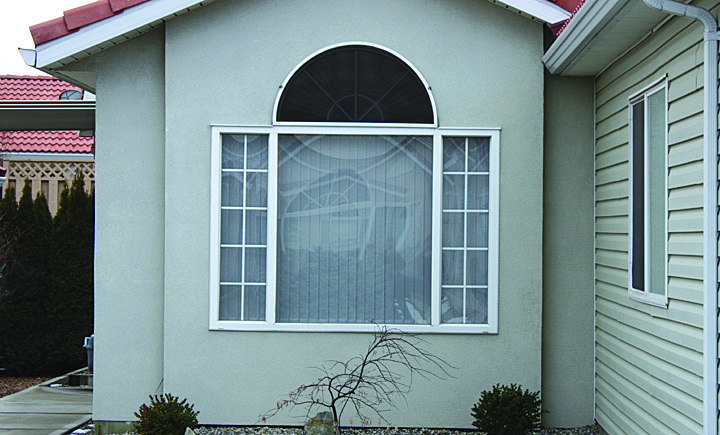
A solar screen installed on this window at the home of Mick and Naomi Shannon in the Casitas Del Sol development off of 115th Street was the focal point of a B.C. Human Rights Tribunal hearing which took place last summer. Photo by Paul Everest - Click on picture for larger image
OSOYOOS TIMES-January 6, 2010
By Paul Everest – Osoyoos Times
The B.C. Human Rights Tribunal has found that the Casitas Del Sol strata council discriminated against a physically disabled resident of the manufactured home community by not allowing him to keep a solar screen installed on one of his home’s windows.
A hearing on the matter took place from July 28 to 30, 2009, and was overseen by tribunal member Lindsay Lyster, who also found that the strata’s property manager, Brian Amos, was responsible for the intentional introduction of inaccurate evidence during the hearing.
According to a tribunal decision issued Dec. 22, Mick Shannon, a retired train engineer in his 60s who suffers from a type of lung disease known as chronic obstructive pulmonary disease (COPD), installed a solar screen on the exterior of the front window of his house in June of 2008.
Since his COPD symptoms, including chronic coughing and breathing difficulties, are exacerbated by continuous exposure to in-home air conditioning, Shannon installed the screen to help cool his home and minimize the need for air conditioning in Osoyoos’s hot climate.
Evidence contained in the decision states that the screen, installed by Alberto’s Decorating Centre in Oliver, blocks up to 90 per cent of the sun’s heat.
The strata council received a complaint about the screen from another home owner in the community, however, and advised Shannon that the installation of the screen went against strata bylaws and must be removed.
Although Shannon and his wife Naomi sought permission to keep the screen on the window, the strata council refused, arguing that the Shannons installed the screen without its blessing in contradiction of strata bylaws.
While the Shannons did not seek council approval before installing the screen, Shannon testified that after reading the strata bylaws, he did not consider that the screen was an alteration needing council approval.
The Shannons removed the screen in November, 2008, and Shannon said during the hearings that in the summer of 2009, the increased use of air conditioning meant he had to sleep in a chair because laying down caused fits of coughing.
Sleeping upright caused Shannon’s feet to swell which made walking difficult.
The strata council argued that Shannon went against a bylaw that states that owners in the development must seek the written consent of the council before making any changes or alterations to the exterior of a home and that any alterations must conform to the strata council’s design guidelines.
Shannon offered to provide the council with a letter from his physician, Dr. Clifford Shaw, which confirmed that prolonged exposure to air conditioning aggravated his symptoms, and install white mullions to make the screen match the pattern of the original window.
The council refused these offers and repeatedly stood by its original decision.
It responded to Shannon by saying it was charged with maintaining the design consistency of the development and allowing for the screen would go against this consistency and could create a precedent.
It suggested that Shannon install the screen on the interior of the window or seek out other alternatives to limit the use of air conditioning which would not violate the strata bylaws.
Shannon told the council he viewed its refusal to keep the screen in place as discrimination contrary to the Human Rights Code and he would be filing a complaint with the tribunal if the council did not give its consent to the screen.
The complaint was filed in October, 2008.
At a special general meeting in April, 2009, strata members voted on a question of whether to “succumb” to the Shannons’ demand for the screen or to allow the complaint to move forward to the tribunal.
Out of 42 voting members present, 40 voted for the complaint to proceed to the tribunal.
In her decision, Lyster found that the council’s actions were discriminatory against Shannon as they had an adverse effect on him because of his physical disability.
“Overall, the Strata Council seems not have appreciated that it was under a duty to accommodate Mr. Shannon’s disability to the point of undue hardship,” she wrote.
She said that while she accepted the council acted in “good faith” to maintain design consistency in the development, “the screen the Shannons installed did not represent a radical departure from the design prevailing in the development.”
Since the exact same kind of screen is allowed on palladium windows above front windows on homes in the development, as well as on side windows, “the screens are neither inherently unattractive nor inconsistent with the developer’s designs,” Lyster added.
While she agreed that the Shannons had failed to comply with strata bylaws by not seeking the council’s approval for the screen, Lyster said “this failure was explained by the Shannons as early as August 2008, when they explained that they had not realized they were required to seek approval, and sought to do so retroactively.
“I conclude that, had the Shannons believed that prior approval was necessary, they would have sought it.”
Lyster also said that allowing for the screen to stay in place on medical grounds would not set a precedent.
“Council’s fear of setting a precedent prevented it from giving Mr. Shannon’s request to retain the screen the consideration it deserved.”
As for alternatives to the solar screen, Lyster said the council failed to establish any “reasonable” options and evidence brought forth during the hearing revealed that there was no proof installing the screen on the window’s interior would provide the same level of heat reduction.
Lyster issued an order entitling Shannon to reinstall the screen on his home’s front window and ordered the council to pay Shannon’s legal expenses as well as $2,500 as compensation for injury to his dignity.
The issue of the introduction of inaccurate evidence during the hearing resulted in Lyster ruling that the strata council engaged in improper conduct.
Amos did not testify at the hearing, but Maureen Poucher, who became the council’s president in June, 2009, acted as the council’s sole witness.
Poucher provided evidence that the council had considered Internet documents about COPD relating to alternatives to the screen in September, 2008.
The consideration of these documents was a central part of the council’s case that it had looked at some of these alternatives in making its decision about the Shannons’ request to keep the screen on the window.
It was revealed through cross-examination, however, that such documents could not have been considered at that time as they were not printed until March 30, 2009.
“While I do not find that the Strata Council acted in bad faith, its conduct, as described, had a significant impact on the integrity of the Tribunal’s processes, including a significant prejudicial impact on Mr. Shannon, and constitutes improper conduct,” Lyster wrote.
When reached for comment, Amos, who was asked to speak on the council’s behalf at the hearing, said although the tribunal’s decision has been reported in the media, neither he nor the council has received official documentation on the decision from the tribunal and he was therefore not in a position to comment.
The Shannons could not be reached for comment before press time.
[email protected]