Following a particularly brutal fire season with over 1,590 wildfires in B.C. this year, the impact is all-encompassing. Adding to a long list of environmental effects, the biologists at the Nk’Mip Cultural Centre are starting to look into how the rattlesnake population of the area has been impacted by the Nk’Mip Creek wildfire.
Though it’s too early to actually collect, compare, and study the data on this topic (which will most likely start next year), the Nk’Mip Cultural Centre’s snake biologist Chloe Howarth said that the early signs of what her team has seen is promising.
“The overall impact of the fire was maybe slightly less than I thought before going back. But I mean I didn’t really know exactly what to expect. But I guess I’ve been pleasantly surprised by the number of snakes that we’re still seeing,” said Howarth.
“A lot of people think snakes have always been living in grasslands and this kind of habitat where fire is pretty natural. But a pretty big difference is that now we’re having these really high intensity, less frequent fires, versus what would’ve been more natural in grasslands would be lower intensity, more frequent fires,” explained Howarth.
“The other big difference is when those natural fires have been occurring, there would have been a lot more available habitat for snakes, whereas snakes have a lot of their habitat taken away from them already through development or agriculture. So now when a big fire like this happens in snake habitat, it probably is having a much larger effect than fires in the past would have,” she added.
Though much of the area impacted by the Nk’Mip Creek wildfire was still under an area restriction, Howarth’s team was given special access permission since they have animals they were tracking that needed to be checked on.
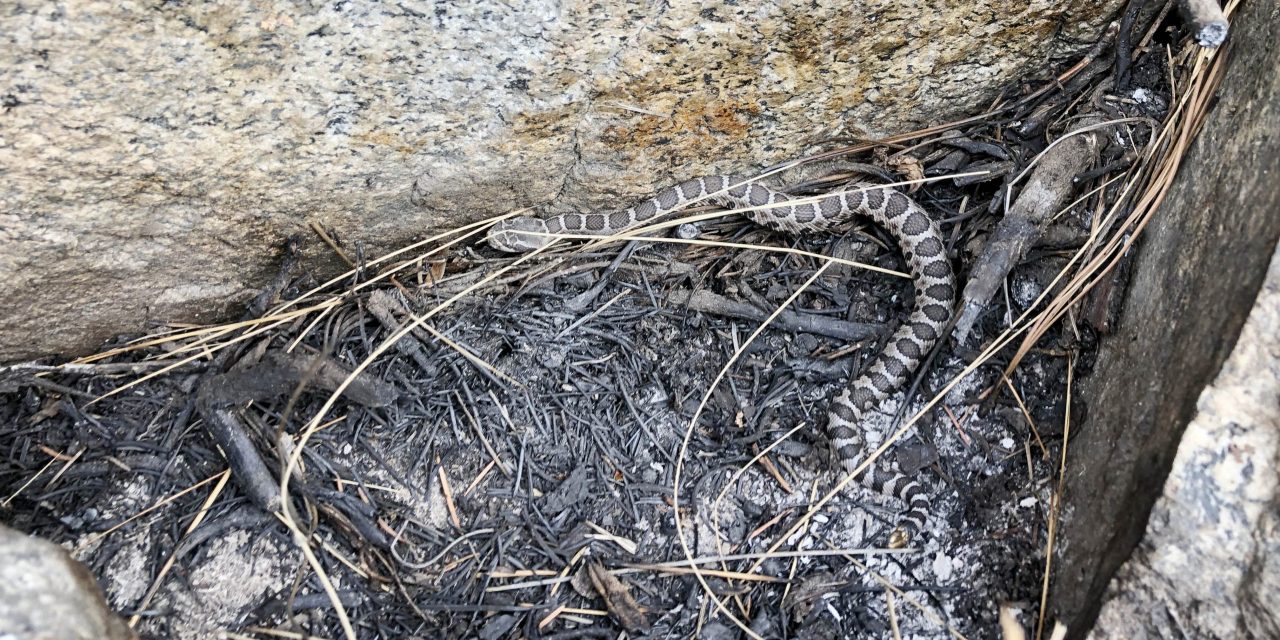
When Howarth’s team went into the recently burnt landscape, they saw a number of promising signs. They noted a number of snakes in those burnt areas, as well as newborns were safe there too. Howarth stated that many snakes were able to get far enough underground to survive the fire.
“Snakes don’t really have that mental capacity to plan; so if they see a fire coming, they’re not really going to be able to think about what direction the fire is coming from, where they should move to,” said Howarth who added that snakes will feel their body overheating and only know that they need to get somewhere cooler, which would be underground in a lot of cases.
Being cold blooded, their sensitivity to heat makes snakes much better equipped to handle fires than mammals, said Howarth. Instead of trying to flee, their instinct is to go underground helps them survive in areas through which the fire may have burned.
“In a lot of ways where the fire burned was probably kind of a blessing because a lot of snakes aren’t going to be or wouldn’t be at their dens in the middle of the summer; they would be kind of further down towards the lake. And a lot of those areas were spared. And I think that was really lucky,” said Howarth.
At this time of year, however, snakes do head back to their dens. Early August through to early September is when the snakes give birth. Female rattlesnakes usually give birth fairly close to their dens which is along the hillside – much of this habitat which was burned by the fire.
“So in a way that kind of shows us that probably a lot of snakes that were in those areas which were burned did survive because the females would have already been in that area, and she was still able to give birth. So that’s a good sign. But there’s only so much we can really tell at this time,” she said.
On another note, the fire did cause immediate habitat change for the rattlesnake population as it burned through a lot of the shrubs that snakes use as cover objects, protecting them both from heat and predators.
“When you look at a lot of the [burnt] areas, it’s just this kind of a sea of sand. Knowing how snakes usually move, they would kind of go from different cover objects to different cover objects . . . so that’s definitely kind of the immediate effect,” said Howarth.
However, she also added that this kind of habitat loss is short term (unlike long-term loss from development) because the grasses and bushes in those areas should start growing back pretty quickly.
One positive thing out of this situation, Howarth said, is that their team has almost 20 years of rattlesnake population data at this site which will be an incredible resource to research how wildfires like Nk’Mip Creek impact the area’s snake population.
“If any kind of rattlesnake habitat was gonna burn, it’s kind of nice that it’s somewhere where we can hopefully do this kind of comparison,” she said.
Over the next couple of years there will be a focus on marking as many snakes as possible in order to do a population estimate for survival. Through doing this, the team will be able to see what proportion of snakes would have made it after the wildfire compared to what is usually expected for survivorship in a normal year.