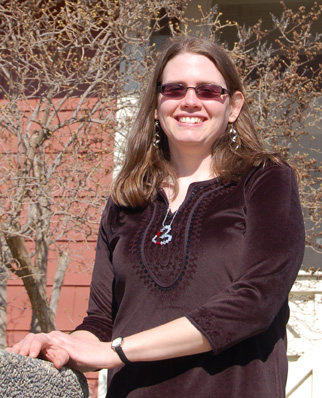

Pam Woolner
Erin Christie phto
Artifacts of an Oliver long gone may be as close as your computer one day.
The staff of the Oliver Museum have begun the process of digitizing the museum’s archives collection. Sue Morhun, president of the Oliver and District Heritage Society, made the announcement during the society’s annual general meeting at the Quail’s Nest Arts Centre on April 16.
Morhun said the move will ensure the collection’s survival and allow access for future generations.
Encompassing information from the early 1920s to recent years, the archives include records of local individuals, families and businesses, including letters, diaries, manuscripts, genealogical information and oral/video interviews.
The collection also contains a number of maps, plans, architectural drawings, as well as a photograph collection that consists of roughly 7000 images.
Community heritage manager Pam Woolner said the project will eventually allow most of this history and research to be available to the public online. But that is “a long way off,” she noted.
For now, the focus is on making records accessible to museum staff.
Though digitization in a museum context is complex and time-consuming (it’s not just scanning an object and uploading it to the web), Woolner pointed out it is cost effective, good for research, and it stimulates collaboration.
Woolner explained that the use of computer systems in museums and libraries are now considered to be essential for several operational aspects including collections management, administrative databases, exhibit planning and the management of loaned objects.
“Having easy access to our collection definitely affects how the museum is run,” Woolner said, adding that better organization will enable staff to create better, more “robust” exhibits.
“We obviously want to create exhibits that tell a story, and that bring alive to viewers the layers of history in each piece.”
She said the importance of her mission is also to preserve cultural artifacts from the distant past lest they be destroyed.
“You never know what can happen so you want to make sure you at least have some kind of digital record. You want some evidence of these documents. These things tell the stories that are part of Oliver’s cultural heritage.”
In order to expedite the digitization project the society is hoping to enlist computer savvy volunteers to help upload information into Past Perfect, a comprehensive museum collection and contract management system. After the items are properly catalogued they are either used in a display or allocated a spot in a permanent storage facility where they are stored under the appropriate conditions.
Woolner said the museum has roughly 8,500 records stored in Past Perfect but that’s “barely the tip of the iceberg.”
“That’s about 15 per cent of the collection so this will be a lengthy process, but totally worth it.”
If you aren’t technologically inclined Woolner said the museum staff could still use your help.
“There are always opportunities to volunteer,” she said. “We really could use a hand uploading information into Past Perfect. It definitely helps if people that are comfortable with computers can help with that, but if anyone wants to volunteer and is willing to learn we’d appreciate their time.”
To find out more or to become a volunteer call 250-498-4027.
Erin Christie
Oliver Chronicle