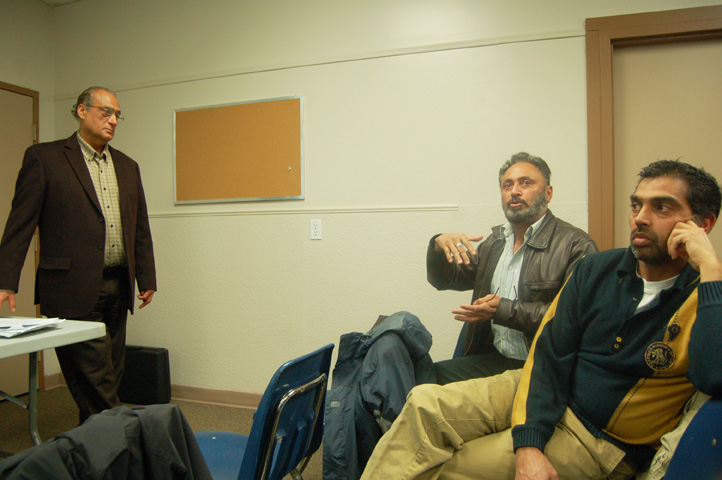

Osoyoos orchardist Ranbir Kambo asks a question about the proposed Apple Research and Promotion Agency. Looking on are BCFGA president Jeet Dukhia (left) and vice-president Pinder Dhaliwal.
Lyonel Doherty photo
Not all growers support a proposed new levy on apples, but the BC Fruit Growers’ Association believes it will reap benefits for the industry.
An association meeting in Oliver last week prompted a lot of discussion about the Apple Research and Promotion Agency (ARPA) that the BCFGA wants to establish. They also call it the Apple Industry Development Council.
The proposal is to collect a non-refundable tax ($0.002 per pound) from apple producers at the first point of sale. This levy will be used to promote the apple industry and provide funds for horticultural research.
Glen Lucas, general manager of the BCFGA, said the big benefit he sees is research on apple storage, specifically preventing spoilage.
He noted if a grower can save a bin of apples from spoiling, that’s money in his pocket.
The levy will also be used to research better ways of thinning, which will mean better apples for marketing, Lucas pointed out.
But one orchardist at the meeting called the proposal “negative billing” and questioned why the BCFGA is forcing apple producers to pay the new tax. He also raised a concern about growers not being well informed about the proposal and not having much time to vote on it.
However, meeting chairman David Machial said they will ensure that all growers are informed.
The voting deadline is February 15, the date of the BCFGA’s annual convention.
Osoyoos orchardist Ranbir Kambo said if he drops a quarter in the levy bucket and sees a dollar in return, he’ll be happy. He noted the levy should benefit growers in the long run.
Allan Patton, a director on the Sterile Insect Release board, said he can see the advantages where research is concerned. But as an apple grower, he’s not too sure, saying the levy is an added cost on top of all the other costs that orchardists must bear.
The levy works out to eight cents per box (40 pounds) or $1.60 per bin. It will also apply to apples being shipped for processing, and those entering the United States.
It was noted that the existing levy on Ambrosia apples will be deducted so that producers won’t be paying twice.
Machial noted that a lot of BC fruit enters the United States.
Citing statistics, the BCFGA says that an alarming trend is happening – Canada’s share of the domestic market has declined from 80 per cent to 65 per cent over the last decade, while imports have increased. Furthermore, Canada’s exports of fresh apples have decreased by more than 50 per cent.
The BCFGA says more funds are required for research and promotion. It reports that an Apple Research and Promotion Agency will lead to more funds to support development, expanded domestic market demand, increased profitability, reduced spoilage and improved quality.
The levy will be collected at the first point of sale, or the grower will remit the levy if he/she ships directly.
The plebiscite asks growers (who produce over two acres) if they support the plan to establish an Apple Industry Development Council for BC apple producers.
Approval is defined as 40 per cent returned by apple producers, with at least 65 per cent of those voting yes.
Growers can vote by mail-in ballot or at the annual convention on February 15.
Jeet Dukhia, BCFGA president, said they want growers to become informed about the proposal and vote.
“We are confident that if growers take initiative to vote, the outcome will be positive.”
All registered voters will receive an information package and mail-in ballot this month.
If approved, growers and industry leaders will run the non-profit agency consisting of a board of directors comprised of up to five voting members.
Lyonel Doherty
Oliver Chronicle