By Sebastian Kanally, Times Chronicle
David Gogo hopes you are ready for a night of dancing and good music as he and his band will be bringing the boogie to Osoyoos for a dance on January 21 at the Sonora Community Centre.
The veteran Canadian bluesman spoke with the Times Chronicle from his home in Nanaimo expressing his excitement about the upcoming show. “This is going to be a band show, a dance, a boogie, so it should be fun,” he said.
Gogo performs as a solo artist and other times plays with his band which he said are two totally different shows. He is particularly excited about the upcoming show in Osoyoos because it will be the first time in a while that he can jam with a band, so he is “looking forward to getting up there and laying down the boogie.”
An icon of the Canadian blues scene, he has 16 full-length albums, six Juno nominations and has been named guitarist of the year three times at Maple Blues Awards. Gogo has also been honoured with musician of the year at West Coast Music Awards, Blues recording of the year, and the Great Canadian Blues Award for his lifelong contribution to the blues in Canada.
Music is simply his passion and it shines through in conversation with him. He received his first guitar at the age of five, he met the legendary Stevie Ray Vaughn backstage at the Royal Theatre Victoria at the age of 15, and he has been playing professionally since the young age of 16.
The show on January 21 is being put on by the Osoyoos & District Arts Council as part of the Osoyoos Performing Arts Concert Series and it will be the third time Gogo will be in Osoyoos since 2017.
Gogo said he really enjoys bringing music to the smaller markets and that is one reason he really appreciates working with Earl Krushelnicki, Chair of the Osoyoos Performing Arts Council.
Krushelnicki “brings quality music to smaller markets that sometimes wouldn’t get to certain entertainers, because there is not really a facility. Or someone isn’t willing to take the risk of bringing them in. And I love it, you know I was born and raised in Vancouver Island, but I love British Columbia and I love playing Osoyoos, and I love playing, you know, these little places. It’s fun.”
When Gogo was younger he was drawn to his fathers blues records, such as B.B King, Otis Redding, Canned Heat, and Albert Collins. In his teenage years he began listening to the rock and roll of England scene, bands like the Rolling Stones, the Kinks, Cream, and Jimmy Hendrix. But he always had a particular affinity for rock inspired by the blues. Which is exactly where Gogo would find his own unique style.
Gogo has played large and small venues. He reminisced, “last summer was funny, I played for the first time in Las Vegas the Big Blues Bender, which is probably the biggest blues event in North America, or one of them at least, and the next gig I played was just outside my home town of Nanaimo BC, in a little tiny hamlet, an old coal mining hamlet, called Extension.”
“From Las Vegas to Extension,” he laughed.
“My thing is ‘just play the best you can no matter the venue’. I was going to open for the Rolling Stones next year, and that would be the same energy, the same effort, as playing in Osoyoos in January.”
It is difficult these days to have a conversation with an artist without talking about the impact of the pandemic. So I asked him about the fundamental rupture in the music business, and how he dealt with his own challenges.
“During the pandemic it was very difficult. This is what I do for a living and all of a sudden it was like I was unable to do that. There were some glimmers of hope, but I had several times where we had shows booked and I was like ‘wow okay great, I can finally play, I can finally make some money to pay some bills’, and days before the show they went back to the restrictions. So it was very difficult.”
But he was quick to mention that he survived and could get by, but it was not harsh “just for the musicians but for the venues, and the venue owners, and the staff, the technical people, the sound people, the lighting people, it was devastating.”
This entire situation led to Gogo not wanting to draw attention to the pandemic in his music. He did not put out any albums or songs about the pandemic, not wanting to write the “pandemic blues”. But the pandemic did fuel some artistic inspiration, releasing things that may have stayed dormant otherwise. The title song on his newest album “Silver Cup” is one of those.
“If I had been living my normal life on the road I wouldn’t have been able to spend that much time researching.” He also noted that he finally had the time to go through all the interesting stuff he has gathered over the years of being on the road.
“I had a great great, great uncle, my grandmother passed away and I was bequeathed this old silver cup that belonged to a guy named James McKay, so sort of looking up the history of him, cause I was just sort of holding this cup, and I could just feel this heaviness. And I ordered a book online about his life, and you know that inspired the title track.”
“I wouldn’t have done that if I wasn’t forced to stay home,” he added.
The conversation with Gogo then turned towards the emotional nature of the blues. The Blues for him are very emotional and he is known to be a great live performer because of it.
“Guitar, especially blues and blues rock guitar is very emotional. I have had times in my life when I am going through a stressful situation, or maybe a breakup or something, and I am able to play those emotions out through the guitar.
The song Shake My Head, off his 2018 “17 Vultures” album, is one song where Gogo really expresses that side of his music. The song is about addiction and losing people to it.
“You know when I wrote that song I have never spent so much time writing and rewriting a song in my life. I really wanted it to be the best it could be, it’s about a heavy subject as you know.”
Gogo said he worked on recording the various parts of the song, but when it came to the main guitar in the solo he just could not find the head space to record it. Then one day he was in the studio with the guy he was recording the song with and said:
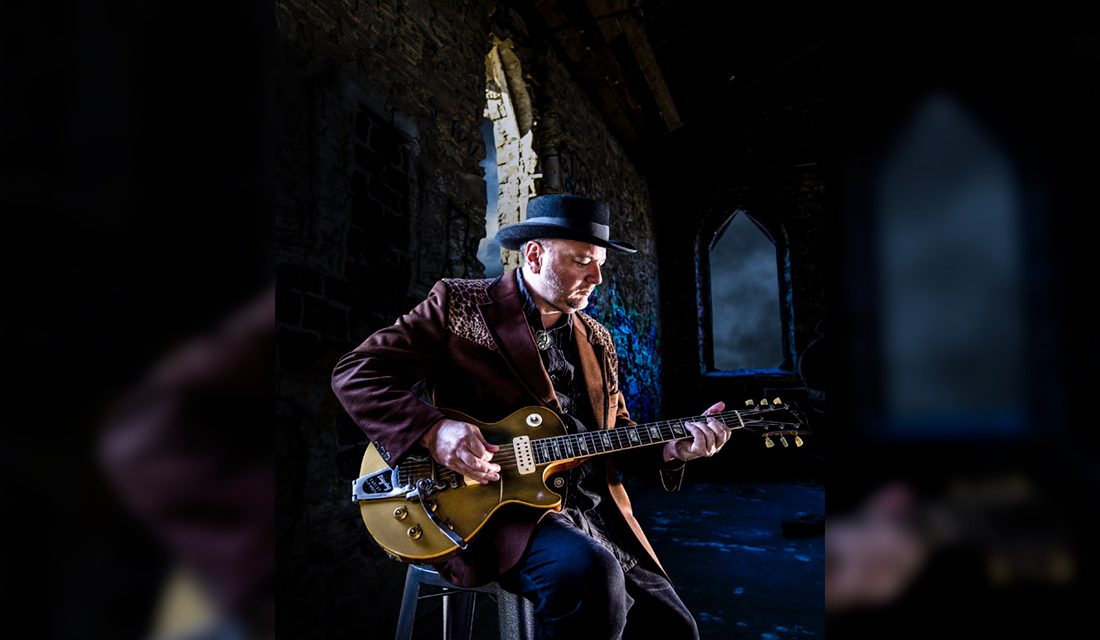
David Gogo has received numerous honours in his career including being named guitarist of the year three times at Maple Blues Awards. Photo by Sheri Jackson Photography – Cordova Bay Records.
“Okay, I’m ready, I want you to roll the song from the very beginning to the very end. Do not stop recording! Whatever happens do not stop recording, I don’t care if there is a technical glitch, we can look at that later, and I basically closed my eyes, and the lead guitar on that is one take from beginning to end.”
“I remember when the song ended, the engineer looked at me and he goes, ‘well that’s done’,” Gogo recalled while laughing at the memory. “And that’s what it was, it was me having to get into a certain head space and do it.”
In response to the question “what does the blues mean to you?” Gogo responded “it’s just something that is in me. That music just speaks to me, I dont know what it is . . . it must just be the emotion and the realness of the playing and the singing.”
If you are interested in hearing more about Gogo, his travels, stories, and philosophy of music he has his Soul Bender podcast that he began during the pandemic where he has conversations with all sorts of people about music and his various travels. In addition to that Gogo has preliminary plans to write a book about “all the cool shit I have done”.
David Gogo will be performing at Sonora Community Centre on Sat. Jan. 21, at 7:00 p.m. Tickets cost $25 and can be purchased on the Osoyoos & District Arts Council website or in person at the Osoyoos & District Arts Council Hub located at 8716 Main St. Osoyoos, Wed. to Sat. 10 a.m. to 2 p.m.