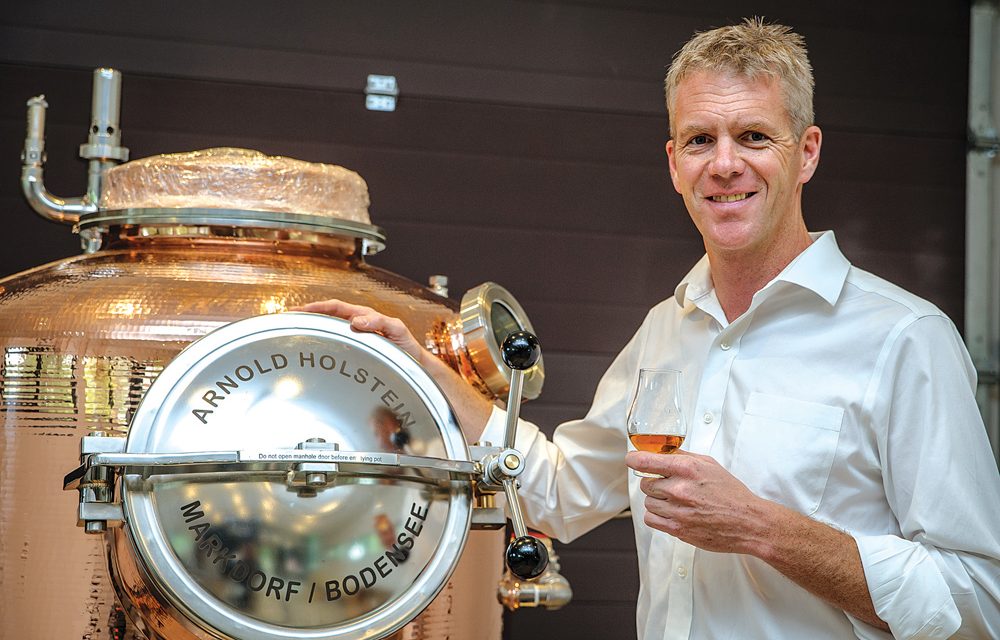
 Grant Stevely is passionate about whiskey and his dream is to produce a uniquely Canadian single malt at a new distillery at Gallagher Lake.
Before he can realize his dream though, the aspiring craft distiller will need to produce gin.
That’s because it takes at least three years for whiskey to mature, while gin can be produced much more quickly.
And Stevely needs the cash flow from the gin to get his Dubh Glas Distillery off the ground.
When Stevely appeared as guest speaker at a recent lunch meeting of the Rotary Club of Osoyoos, he showed off the new labeling for his noteworthy premium gin, which should appear in private liquor stores later this year.
The gin is flavoured with locally grown botanicals.
Stevely devoted most of his talk to his passion – the techniques for producing single malt whiskey. It’s a craft he learned by visiting distilleries throughout Scotland before apprenticing at two craft distilleries in Arizona.
Stevely likes his whiskey neat so he can appreciate its taste. And he likes to share a quality spirit with friends.
“We would sit and enjoy it as opposed to getting drunk like a teenage kid,” he said.
Dubh Glas is the Scottish Gaelic for “from the dark water,” and it reflects the importance of Okanagan waters in making fine spirits.
It is pronounced like “Douglas,” which is Stevely’s middle name and reflective of his Scottish heritage.
While workers add finishing touches to the distillery building next to Highway 97, Stevely shows off a shiny new copper still that he’s imported from Germany. This Holstein 300-litre still will be at the heart of all the spirits that Dubh Glas produces.
He has had to scale back his plans for a larger building, opting instead to expand the building at a later stage.
Visitors, however, will be able to see all aspects of production when they visit the distillery.
Stevely had hoped to open July 1, but it’s taken longer than he hoped to be up and running and now he’s missed the 2014 tourist season.
Still, when you hear Stevely’s passion and his attention to detail, it’s hard to imagine the project not being successful.
Originally from Cranbrook, Stevely worked for 18 years at Sunshine Village near Banff, much of that time in emergency services.
Still in his early 40s, his goal was to start his own business. Only recently did he decide upon his passion for whiskey production as the basis for a business.
Compared to wine and beer, craft distilleries are a relatively new phenomenon in Canada. In fact, as Stevely explained to the Rotarians, only a few Canadian provinces have legislation allowing them.
The few other distilleries operating in the South Okanagan – in Vernon, Penticton and Naramata – mostly produce spirits from Okanagan fruit.
Stevely’s whiskey will be produced from barley grown at Armstrong. It will be matured in exported Jack Daniels bourbon barrels from the US initially before being transferred into Canadian wine barrels to complete the maturation process.
As Stevely explained to the Rotarians, the wood from the barrels imparts a flavour to the whiskey as it matures.
Stevely will be adopting less conventional approaches, using smaller barrels that have been remade from larger ones.
His still will also allow other unconventional techniques, including multiple distills.
Some of his techniques are sure to earn the scorn of Scottish traditionalists.
“We can respect tradition, but we’re not bound by it,” said Stevely. “Respecting tradition means respecting the techniques and the raw materials that are used, but we can be a little bit more creative with what we’re doing.”
The use of Canadian wine barrels, for example, ties the product to the Okanagan region, he said.
The end result won’t be Scotch, but rather a premium Canadian single malt whiskey.
Why would a whiskey drinker choose Dubh Glas over a traditional Scotch?
“Excellent question,” said Stevely. “I think in the world of whiskey that people are coming to appreciate handcrafted, quality products. People are willing to pay for that, not that we’re going to be super expensive, because a good whiskey doesn’t need to be expensive.”
One of the things adding to the price of whiskey is the storage during aging. But Stevely insists that older whiskey is not necessarily better, even though it costs more.
The warmer Okanagan climate will actually accelerate maturation, he suggests.
Unlike the major distilleries, which blend thousands or tens of thousands of barrels together to create a uniform signature product, every barrel of Dubh Glas whiskey will be unique.
“There’s some exclusivity,” he said. “To have something unique and to share it with friends and say ‘this is bottle 16 of 250 and I got it at the distillery.’”
Stevely acknowledges that craft distillers can never compete with major distilleries on price, but they can compete on quality of the product and what he calls “the story.”
“(Visitors) can come to the distillery where I’m passionate about what I do here,” he said. “If we’re running a still, people can smell the new-made spirit. We can open a barrel and show them that barrel. If you went to Scotland, you’d just see warehouse number one and it’s got 10,000 barrels in it. We’re providing more of a personalized experience when people come to our location.”
Stevely believes his distillery is complementary to the local wine industry, both for its use of wine barrels and because it offers a different experience to wine tourists.
He insists that whether he makes spirits at a profit or loss, high quality will always be his primary objective.
“I’m paranoid about quality,” Stevely said.
Richard McGuire
Special to the Chronicle