By Hannah Mondiwa, Local Journalism Initiative Reporter
“It’s funny how it all ties together, like the whole theme of the Dude’s Club is vulnerability and trying to get men, especially Indigenous older men, to open up. And that’s kind of also been my own personal journey. I’ve found you can’t really heal unless you’re willing to be vulnerable and to show your flaws.”
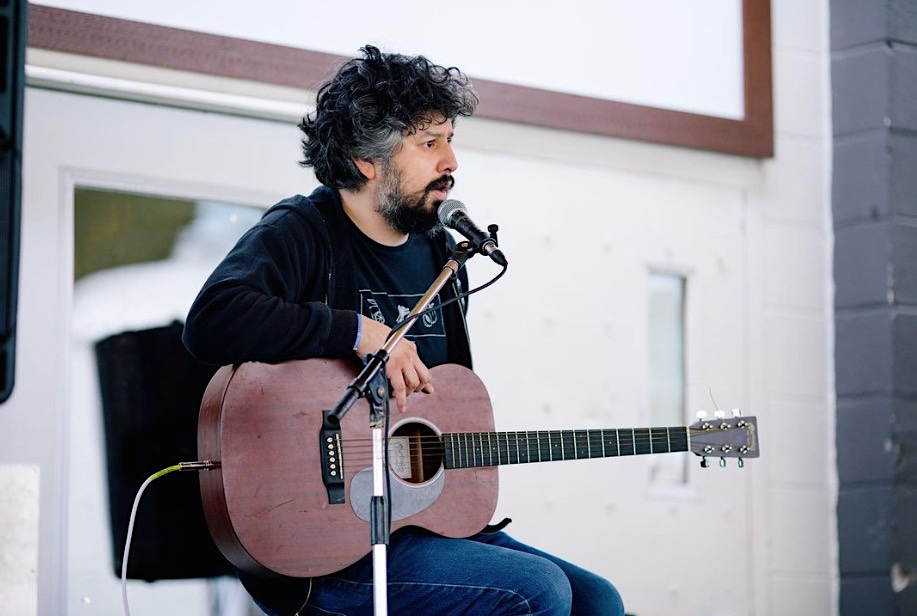
This is how Indigenous musician Francis Baptiste began our conversation, by naming the thread that runs through nearly every part of his life: vulnerability. It’s a value that shapes his third full-length album, his sobriety, his relationship to his culture and the work he does every day.
Baptiste is the social media specialist at The DUDES Club, an Indigenous men’s wellness program founded in Vancouver’s Downtown Eastside in 2010.
Now operating across B.C., the organization creates culturally safe spaces where men can connect, open up and rebuild a sense of pride and community, prioritizing an Indigenous worldview. The club’s emphasis on honesty and healing mirrors the path Baptiste has been walking himself.
“2025 has been a really successful year for sobriety for me. I feel like this album… is the most focused I’ve ever been. And everything kind of feels like it’s clicking, which is nice.”
His latest album, Lived Experience in East Vancouver, carries that clarity.
Baptiste is from the Osoyoos Indian Band, and he embraces all the parts of who he is: a father, a musician, a recovering addict. One of his deepest questions has always been how to raise his son with a strong sense of being Syilx, especially while living away from his community. That question sharpened into urgency at his grandmother’s funeral.
“My grandmother knew the language. When she died, it was a big theme at her funeral. It kept coming up; people would come up to share memories about her. And one thing that all the Elders would continually bring up [was] that she was one of the last language speakers for our community. And being there and hearing that turned a light on in my head, and I realized how important language is to culture and to community, and how close we are as a people to losing this pivotal part.”
Learning Syilx (nsyilxcən) has been both grounding and difficult.
“It’s very difficult, and especially difficult because now I’m older and people always say it’s hard to learn a language the older you get. But also there aren’t a lot of resources and there aren’t a lot of people who speak this language.
“The numbers seem to be changing every year. It’s an endangered language. So when I first started learning it, I think the number was around like 60 people who could speak it. And now I think it’s up to around 100..”
Language threads through Baptiste’s creative work too, becoming a way to teach, remember and reconnect.
“In the first album, I had a couple songs that were fully in Syilx, and I found it’s easier when you just take a few words. Like on the second album, we have songs where I just put little bits of vocabulary into songs. Instead of throwing a whole wall of words at somebody, then like here, this is a song, Speplina, means rabbit, and now it’s more digestible. Now you know that, now you teach it. Now my son remembers these words, right?”
Yet this newest project turns its focus more sharply toward addiction, fatherhood, and the struggle toward sobriety.
“A lot of that album is about coping with being an addict and being a father and trying to get sober, trying to do the right thing for your son, trying to teach him about his family and his heritage and his culture, and pass down some of that culture, but also at the same time being a very flawed person and how painful that fight is, because it’s hard to just suddenly have to be ‘good’ all the time.”
The neighbourhood where he works plays a role in the album too. The Downtown Eastside, often reduced to stereotypes, holds its own culture of care.
“The first song on the album is called Kid on the Block, which was inspired by that sense of community in the Downtown Eastside. I’d always bring my son to work and any time you walk with a kid in the Downtown Eastside, people would yell out ‘kid on the block’ to let other people down the street know that you’re walking with a child.
“It’s just a signal so that people put away their needles, put away their pipes, or be on their best behaviour because a child is coming and you don’t want to expose them to what you’re going through.”
Baptiste’s work, whether at The DUDES Club, in his music, or during the moments raising his nine-year-old son, is ultimately about creating space — for honesty, culture and healing, and for future generations to stand more confidently in who they are.
“One of my main goals in the last couple of years has been sharing my story and I think any artist really, it’s really about sharing your experiences and hopes that either other people can relate to them. Or the opposite, you don’t relate to it, but you learn about it, educationally,” says Baptiste.
“I hope that it’s either something you can relate to or something you can learn from.”
This article first appeared in Megaphone Magazine