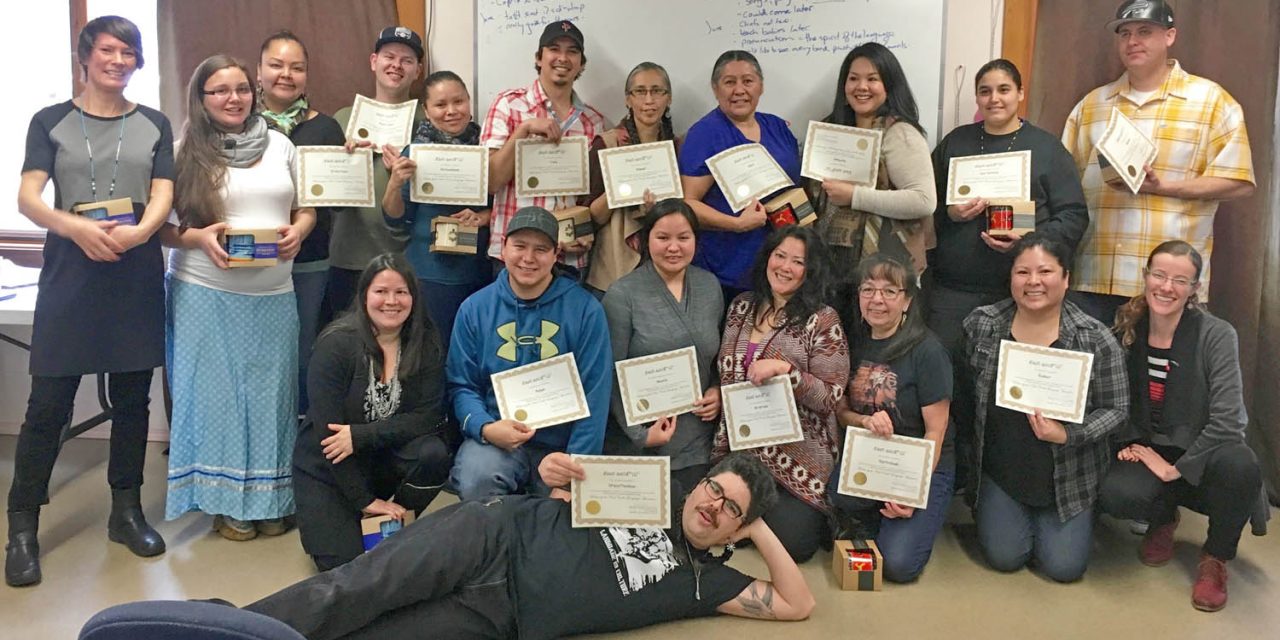
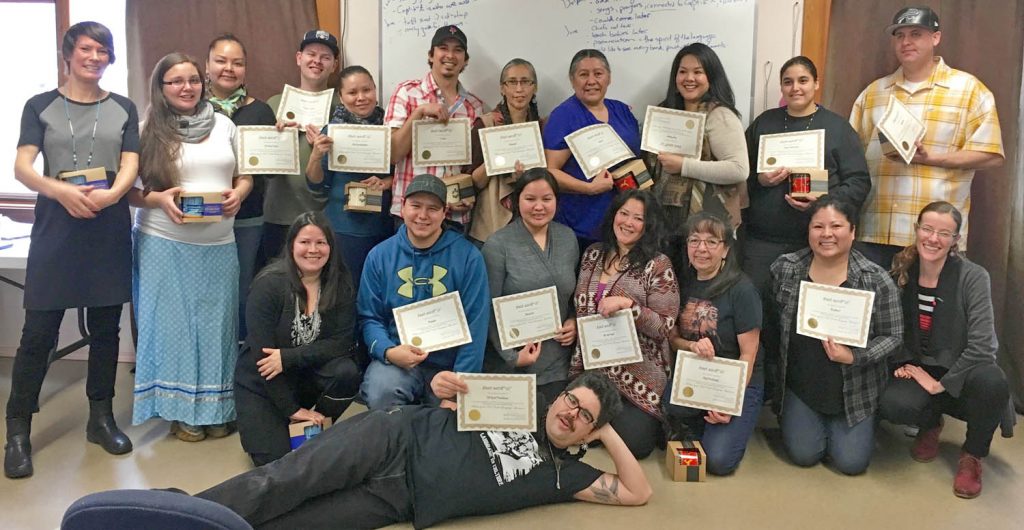
Students at Syilx Language House are proud of their accomplishments in learning their traditional language. (Contributed photo)
Three First Nation bands from the South Okanagan are working together to ensure that the critically endangered Syilx language will be around for hundreds of years to come.
A total of 13 students and five “co-leaders and instructors” have accepted the challenge to spend four years learning the Syilx language in a program called the Sylix Language House, said Michele Johnson, program co-ordinator and the lead teacher in the group.
The group recently finished their first year of studies.
The Osoyoos Indian Band, Penticton Indian Band and Westbank Indian Band all provided significant funding to ensure this program would take place, said Johnson.
“Our language is deeply connected to who we are and to the health and well-being of our communities,” said Johnson, who is a member of the Okanagan Indian Band near Vernon. “
The students and five teachers started training the last week in September and continue to meet twice a week in a meeting room donated by the Penticton Indian Band in Penticton, said Johnson.
The Syilx Language House Association was formed in 2015 with two main goals: to train new Nsyilxcn speakers and record elders. They are responding to the urgent needs expressed by Syilx elders and communities to revitalize the language.
They gratefully acknowledge financial support from Penticton Indian Band, Osoyoos Indian Band, Westbank First Nation, First Peoples grants, Simon Fraser University and sponsorship from several employers for their employees to attend class two days a week.
Students travel from across the Syilx Nation to attend this pilot project in Penticton. Seventeen adult students successfully completed the first year, over 350 hours of intensive instruction.
Classes started on September 30, 2015. Students will study 2,000 hours over four years and emerge mid-intermediate speakers.
Syilx Leadership and MP Richard Cannings congratulated students and teachers on their achievement at a June ceremony and wished for all success.
Johnson said the support of regional First Nation bands was crucial.
“The PIB gave us access to this beautiful log building, which creates the perfect setting for our classroom,” she said. “Without the assistance of the PIB, Osoyoos Indian Band and Westbank First Nation, this project would never have come together as it has.”
Like most Okanagan languages, the Sylix (pronounced Seemlaw) language is in danger of disappearing and that’s why the commitment to restoring and preserving the language is so important, said Johnson.
The Syilx language has been spoken amongst First Nation people across the Okanagan Valley, ranging as far northeast as Revelstoke, north to Merritt, across the South Okanagan and into northern Washington, said Johnson.
“There are fewer than 100 fluent elders remaining and no new speakers have been created in Canada in over 60 years,” she said. “This is a language that has been with my people for thousands of years. There have been attempts at trying to restore the language in the past, but they have proven unsuccessful.
“But with this program and the commitment of the three First Nation bands and a firm commitment to provide 2,000 hours of instruction and intense learning over the next four years for the 18 students and five teacher leaders, we truly believe we can be successful.”
The Syilx Language House Association was formed to reverse this trend, a vision Johnson has been working towards for six years.
She began by completing her PhD in language revitalization at UBC-Okanagan.
“I decided to take on the challenge of creating 10 new speakers,” she said. “I wanted to learn how to do that.”
She found her answers with the Paul Creek curriculum, cleverly designed so beginners can learn while teaching.
“We are so lucky to have this; it gives us the opportunity to raise each other up,” she says of the six cutting-edge textbooks co-written in Keremeos by Chris Parkin, LaRae Wiley and Sarah Peterson.
When asked if young people really want to learn, Johnson answers, “there are several young people in each community that are passionate about learning the language – that are taking it on as a role and responsibility to their communities.”
Although most Indigenous languages are critically endangered, people want them back, she said.
The other teachers assisting Johnson at the Syilx Language House are Hailey Causton, Monika Alexis, Dawn Machin and Jolene Michel.
There’s also a plan for Brandi Baptiste from the Osoyoos Indian Band to join the program as she is completing language house studies in Washington State, said Johnson.
A quick Google search shows that First Nations language programs across Canada are springing up to reverse language decline.
In fact, Syilx community members and elders stress that language and culture are of paramount importance.
“In our Comprehensive Community Plan, language and healing were our top priorities,” says Chief Jonathan Kruger of the Penticton Indian Band.
“Chief Clarence Louie of the Osoyoos Indian Band challenged all the chiefs to do more language. Our council heard Paul Creek was the best model and language houses were having success. We wanted to bring it here. The chiefs were all talking about it and I said, ‘I’m going to invest in it and build a language house.’”
The PIB was the first to invest core funding and to provide a classroom location, followed by support from Osoyoos Indian Band and Westbank First Nation. Each band sponsored employees to attend two days a week for four years and provided core funding.
The program has 13 beginners, five co-teachers (also students), and four Elders from across the Syilx territory, which includes Penticton, Osoyoos, Keremeos, Westbank, Vernon, and the Okanagan Nation Alliance.
After four years, Johnson promises intermediate speakers will have a strong grasp of the language and be able to pass on their knowledge to others.
“It really is the first time we have attempted to create new Nsyilxcn speakers—research shows that it takes 2,000 hours of study to create a high-intermediate speaker.”
Over the course of the program, Johnson and her staff will also record elders, publish language books and CDs, and host open-house community events.
Johnson said she’s honoured and proud to be part of this unique project.
“I’ve found getting heavily involved with my ancestral language to be a transformative personal experience,” she said. “I think all of the students and my fellow teachers feel the same way. Reconnecting with our language has touched our individual communities in a deep and personal way and all of us involved in this training are really looking forward to the challenge over the next four years.”
The Syilx Language House Association is fundraising for next year’s operating budget and welcomes community visits, donations, and volunteers from the community.
For more information, you can visit the association’s website at www.thelanguagehouse.ca.
You can also contact Johnson at [email protected]
KEITH LACEY
Osoyoos Times