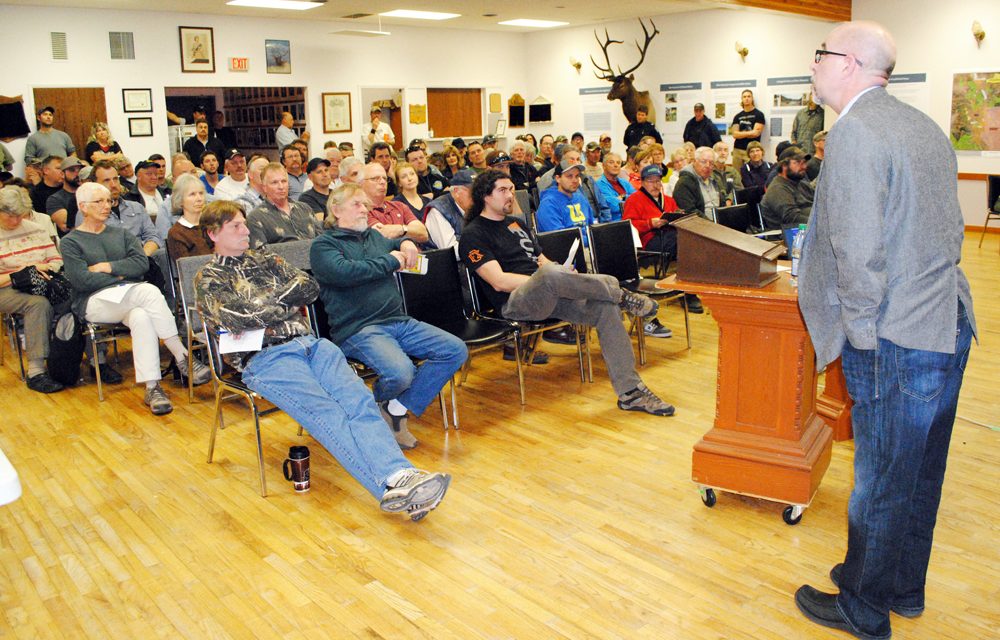

Meetings were held last year regarding the issue of off-road vehicle use in the Oliver area.
A proposal by the provincial government for an off-road vehicle recreation area on Oliver Mountain has irked both environmental advocates and the off-road vehicle community.
The Oliver Mountain Off Road Vehicle Management Strategy proposes closing down most of Oliver Mountain to off-road vehicle traffic, leaving two small high-use areas for a designated recreation site.
The proposal is the result of a public consultation process that began last spring with open meetings in Oliver and Osoyoos, and continued through the summer when a small “advisory group,” consisting of ORV riders and environmental advocates, was appointed to hash out a plan for the area.
After months of silence, the plan appeared on the Ministry of Forests, Lands and Natural Resource Operations’ web page at the end of January, and most who’ve seen it are not impressed.
Peter Woods, of the Canadian Parks and Wilderness Society, says the organization has real “concerns” about allowing an ORV park in an area that’s already been set aside for conservation through the Okanagan-Shuswap Land and Resource Management Plan.
“We’re kind of concerned that something like this can override consensus decisions that were made through a multi-stakeholder process,” he said.
The LRMP is a broad land use strategy for the Okanagan-Shuswap, created through a years-long public consultation process. It sets aside the Oliver Mountain area as a “Goal 2” protected area, which should be preserved because of the rare species that inhabit it.
The area is listed as critical habitat for the struggling Behr’s Hairstreak butterfly, and as a candidate for critical habitat for Lewis’s Woodpecker. According to information from the proposed strategy, 17 federal and 14 provincially listed species and ecosystems at risk, including two globally imperilled plant communities, have been identified on the site.
“We really get concerned where species are getting put at risk, because it very well could be that this is some of the last habitat remaining,” Woods explained. “The nature of that area is so microscopic in terms of what habitat actually exists to support [these species] . . . it really could be localized to this one little mountain.”
Options disappearing for ORV community
Nathan Ondrus is the president of the South Okanagan Off-Road Club. He didn’t mince words when expressing his frustration with the proposed plan.
“They’re screwing us over,” he said.
“BC is supposed to be for everybody, and they’re basically limiting it to a few groups,” he added, pointing to what he sees as an increasing number of closures that are limiting his ability to ride in the area.
He believes that if ORV riders stick to the trails they won’t harm sensitive species, and said closing off hundreds of hectares of land to save a few highly localized species doesn’t make sense.
“If they just taught people better about endangered species,” and fenced off areas where they are living, those species wouldn’t be in danger, he said.
He admitted there will be some bad apples who continue to disrespect the environment, but that is going to happen no matter what closures are put into place.
Ondrus said while he doesn’t completely buy the environmental arguments for closing most of the mountain, his frustrations stem mostly from the fact that it doesn’t feel like the provincial government respects, or is willing to listen to, the ORV community.
A ‘big compromise’
Grant Furness, the ecosystem section lead with the Ministry of Forests, Lands and Natural Resource Operations, says the government’s proposal was the best solution for protecting Oliver Mountain while staying true to the LRMP.
He pointed out that the LRMP is a consensus document that all parties involved agreed to at its completion. That document clearly states that the ORV community’s acceptance of Oliver Mountain as a Goal 2 area is contingent upon the government finding a suitable alternate site for them to ride.
Furness said the government searched for years for an appropriate site, but they never found a place that met the intent of that original agreement. So after last year’s public consultation “they went back and they looked at [the Oliver Mountain area], and said ‘you know what, this area’s heavily used, it’s fairly small, let’s try and contain [ORV riders] in there.”
He said the small area proposed for the ORV riders is already impacted, and while further use will “likely” cause some further impact to the environment, cordoning off the much larger area “is going to definitely reduce impact.”
He said the government plans to work with environmental groups to help make sure the impacts to sensitive species in the area doesn’t get any worse.
He said from a conservation perspective a big chunk of the area will likely be closed off, and from the ORV community’s perspective they will still be able to use the most popular spots on Oliver Mountain.
“Nobody got really what they wanted. So it’s a big compromise, right? And government’s right smack dab in the middle trying to make a decision,” he said.
At the end of the day, however, the “government made a commitment,” and it had to stay true to that commitment.
Woods pointed out that even activity limited to the small proposed recreational area has the potential to impact fragile species like Lewis’s Woodpecker. He urged the government to put the decision “on pause,” and consider other recreation sites.
He noted the decision to allow unrestricted ORV use on Oliver Mountain is an “irreversible” one, and that once sensitive habitat is destroyed at the site there’s no option to turn back and re-consider the consequences.
“I actually think there’s a way to please everybody here [and] there’s no reason to destroy this habitat,” he said.
Furness said the final decision on the site will be made by the minister, and that public feedback gathered online this month will be considered as that decision is made.
By Trevor Nichols