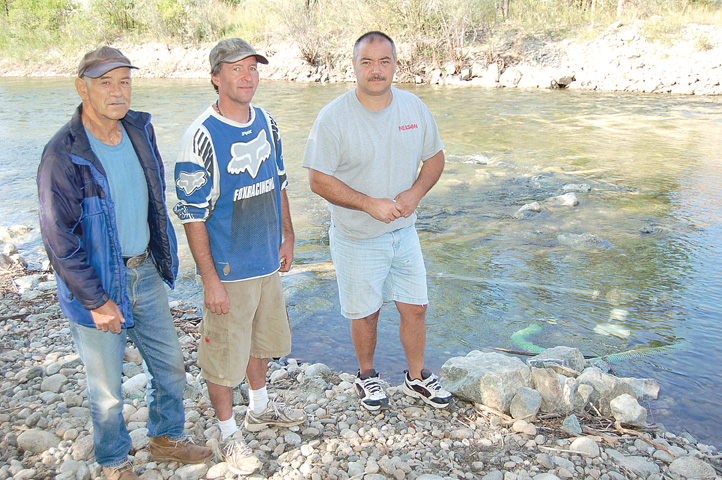

Farmers Dan Pinske (left), Gordon Forbes and Art Dias stand near the water intake in Okanagan River. The ORRI and the Ministry of Forests are trying to work with the farmers to address their concerns about lack of water volume to irrigate crops.
Lyonel Doherty photo
Two farmers are starting to lose faith in the Okanagan River Restoration Initiative after four years of negative impacts on their livelihood.
Gordon Forbes and Art Dias claim that the river restoration project (ORRI) has prevented them from properly irrigating their fruit and vegetable crops because of decreased water volumes.
Forbes and Dias have long-standing rights (via licence) to draw water from the river for irrigation purposes. They obtain the water by using intake pipes in the river.
Prior to the ORRI, their pipes were in the middle of the river, where they had a lot of volume to draw from.
But when Phase I of the initiative began, the pipes were modified and relocated because of work in that section of the river. The initiative’s primary objective is to enhance fish habitat.
The modification of the farmers’ intakes resulted in them being moved to shallow water, which in turn resulted in a lack of water volume for irrigating. In addition, both farmers had problems with a build-up of silt and sand in their intakes and sprinklers, many of which had to be replaced at their cost.
During Phase I, Forbes reported that he lost his ground crop at $40,000 per acre. He subsequently had to tap into the Town’s water system to irrigate his crops.
“It was like seeing your farm dry up and die right in front of you,” Forbes told the Chronicle.
This year, during Phase II, the situation is better because ORRI engineers put Forbes’ intake in a deeper pit in the river, but the river level has dropped considerably and he worries that he won’t be able to draw water. He currently has to buy water from the Town to irrigate his ground crops.
Dias, who grows tree fruit off Meadows Drive, said he had to downsize the farm because of the decrease in water volume. He noted his desire to replant, but that wasn’t possible under the circumstances.
“I have cancelled all my new trees for 2013 due to not knowing where we stand on getting water.”
Dias said he and Forbes were initially promised wells to solve the problem, but that never happened.
“They were all broken promises . . . they said they would not start Phase II until the Phase I problems were dealt with.”
Dias said he and Forbes pay a fee for their water licenses, so in effect, ORRI has been violating their water rights for the last three years.
“It’s just the stress of not knowing whether I’ll have enough water to irrigate.”
Dias estimated that he had to replace 100 sprinkler heads because they were plugged up with sand.
Both Dias and Forbes said installing wells makes sense because it gets their intakes out of the river and away from the fish and their eggs.
They reiterated their support for the river restoration project, but not how it was handled.
Dan Pinske, a neighbouring farmer who grows hay, said he doesn’t have a problem with a lack of water, but rather too much water (flooding). He noted that he can’t grow hay anymore on his family’s property.
Pinske said he feels the people in charge of the ORRI did not properly communicate with those directly impacted by the project.
But Phase II public relations coordinator Lee McFadyen said she visited every property in close proximity to the site before the project began. She noted the Forbes and Dias farms were included in these visits.
“I gave each property owner, or left at the door, a written explanation of the work to be done.”
She noted that fisheries biologist Karilyn Alex from the Okanagan Nation Alliance was working with the farmers to upgrade their irrigation system.
“There is no doubt that the Forbes in particular have had water shortage problems resulting from the work done. There is also no doubt that many steps have been taken and the costs have been covered by ORRI to solve the problem,” McFadyen said.
Brennan Clark, public relations officer for the Ministry of Forests, Lands and Natural Resource Operations, acknowledged that Forbes and Dias have experienced continued difficulty obtaining sufficient water supply since 2009, and repeated efforts by ministry staff to correct the problem have been unsuccessful.
Clarke said the problem appears to be increased siltation at the relocated intake due to changes in river flow.
”After reviewing the available options, ministry staff determined that installing wells to provide the landowners with an alternate source of water on each property would be the most effective long-term solution.”
Clarke said the ministry provided sufficient funding in the 2013 budget to install a well and casings, and work on the wells is slated to begin this fall. Details on funding for the purchase of pumps and electrical hookups have yet to be finalized.
Clarke said ministry staff conducted regular maintenance work to ensure adequate water supplies for the 2013 growing season.
Southern Interior MP Alex Atamanenko got involved in helping Forbes during Phase I by writing to the provincial agriculture ministry.
“It’s frustrating to hear how this has impacted Gord and his ability to farm.”
Oliver Mayor Ron Hovanes said the Town has lobbied for Forbes (via letter) asking the Okanagan Nation Alliance to rectify the situation.
“It seems that this has been going on far too long and I understand that the Forbes want a real solution to this problem.”
But in a letter to Forbes and Dias, ORRI technician Camille Rivard-Sirois outlined what they have been doing to mitigate the problems.
For example, the alliance was to install a silt fence upstream to prevent silt building up near the irrigation intakes. In addition, piles of silt have already been removed from the river where the intakes are located.
Lyonel Doherty
Oliver Chronicle