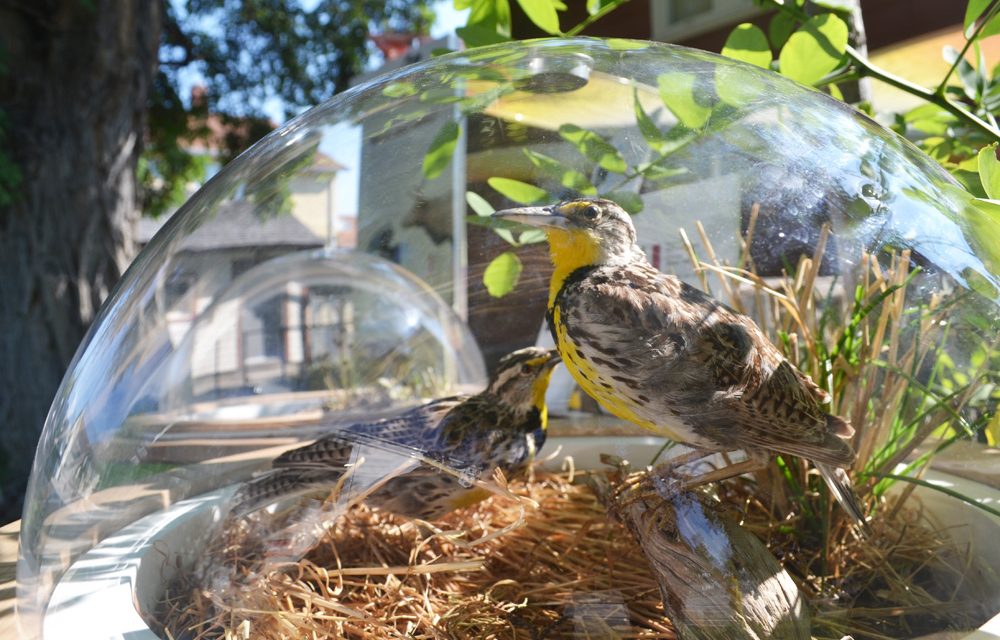

People might be surprised how many endangered species there are in the Okanagan. Here, a Western Meadowlark is on display during the travelling exhibit at the Oliver Museum. Photo by Trevor Nichols
The Dark Saltflat Tiger Beetle is a tiny, bright green insect that runs so fast it can blind itself.
The Pale Jumping Slug convulses violently in order to escape from predators and wears all of its internal organs in a prominent hump on its back.
Big-eared bats drop their heart rates from 100 to about five beats per minute during hibernation, losing more than half of their total body weight over the winter.
These are just a few of the wildly diverse and endlessly fascinating species native to the South Okanagan, and each of them is in danger.
The Royal British Columbia Museum’s mobile endangered species exhibit was in Oliver last week, acting as a centrepiece for a day camp teaching kids about the region’s threatened species.
The British Columbia Ministry of Environment website says that while the Okanagan has a diversity and uniqueness of plant and animal species, it is also the region with the most endangered, threatened and rare species in the province.
Gavin Hanke of the Royal BC Museum has said the province’s endangered species are “one of the most important conversations British Columbians should be having right now,” even though “we don’t hear much” about them.
The museum is trying to combat that.
Rachelle Linde is learning program facilitator with the Royal BC Museum. She’s one of two summer employees touring with the travelling exhibit, and has spent most of her summer studying and teaching kids about the region’s most threatened species.
According to Linde, there is one common thread woven through almost all of the region’s threatened and endangered species: habitat destruction.
“Almost every single one” of BC’s endangered or threatened species are struggling because they don’t have enough places left to live, and the blame for that lies squarely on the shoulders of human beings.
“It’s all our fault. I’m not going to beat around the bush, we are doing a lot of damage,” Linde said. “In the Okanagan it’s a lot to do with putting in wineries, and digging up the ground to put in condos, that sort of thing.”
She points to the Great Basin Spadefoot, a species of toad that survives extreme heat and cold by burrowing about a metre underground, where the temperature is more constant.
“So you don’t know it’s there, and then someone goes in with a tractor and … oops,” Linde said, raising her eyebrows and pushing her hands together.
Then there’s the Burrowing Owl, which lives in abandoned holes dug by badgers. As human activities drive the badger from the Okanagan, fewer burrows are available for avian squatting.
For a time the owls were extricated from the South Okanagan until conservationists started creating man-made burrows for them.
The BC Ministry of Environment estimates that the Burrowing Owl’s grasslands habitat comprises less than one percent of the area of the province, and that this tiny area is being further diminished by “expanding towns, intensive agriculture and urbanization, especially in the Okanagan Valley.”
There is a long list of species that have already disappeared from the South Okanagan, including the Pigmy Short-horned Lizard, the White-tailed Jackrabbit, the Sharp-tailed Grouse and the Sage Grouse.
Linde pointed out that if development continues to destroy animal habitat many more of the South Okanagan’s threatened species could join that list.
“It’s really depressing to think we’re ripping up all this ground, and it is true, but there’s something you can do about it,” she said.
Something as simple as using less water on your lawn and garden can have an impact on habitat protection. Better yet, try planting local flora that support local species instead of exotic plants that look pretty.
When it’s a caterpillar the Monarch butterfly can only survive on milkweed; planting it in your garden means more food and a greater chance of survival for the iconic butterfly.
“There’s lots of stuff you can do and there’s lots of resources out there,” Linde said. “Have hope, and don’t just sit there and talk about it, get out there and do something about it.”
By Trevor Nichols