
No sooner have British Columbians gone to the polls to vote for new municipal governments and school boards than they’re voting again.
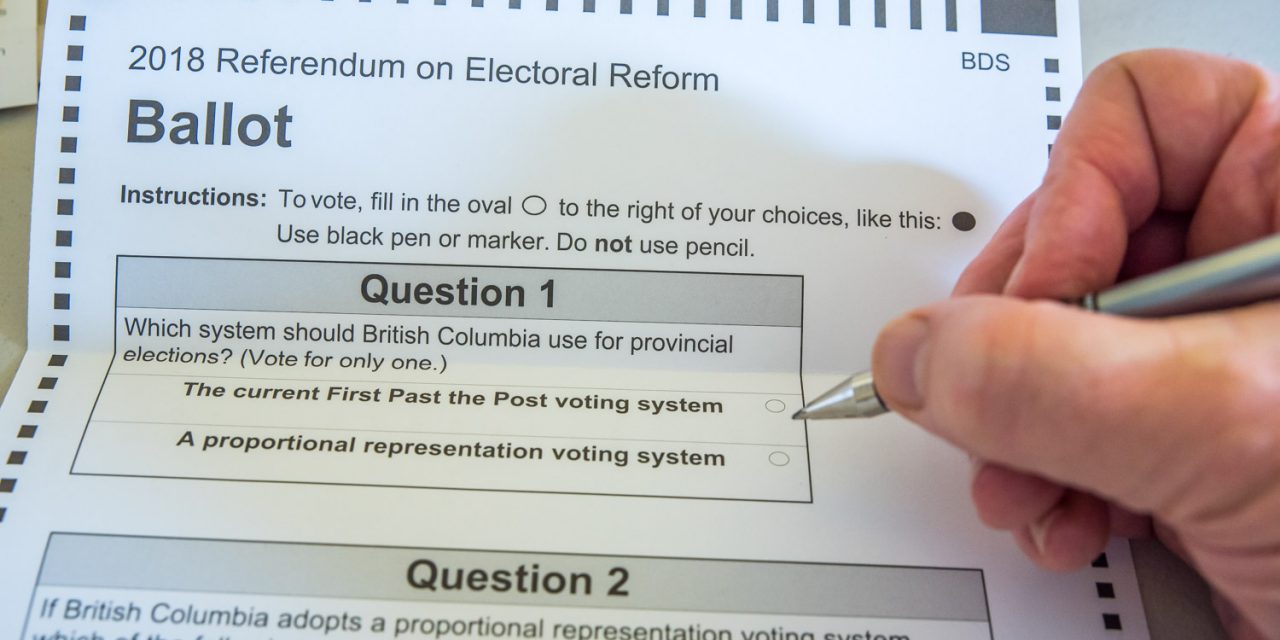
By now you should have received the ballot in the mail to let you vote in the referendum on “Electoral Reform.”
Instead of simply casting your ballot at the same time as you vote for mayor and council, which would have been simpler, you need to take the initiative to mail in your ballot.
Certainly there is room to question the impartiality of the process, which seems designed to elicit votes from devoted partisans while confusing everyone else.
Still, the referendum could bring profound changes to the way we elect our government, even changing our understanding of democracy. This is a very important vote.
Over the past few weeks, we’ve tried to provide a variety of perspectives on the issue – in letters to the editor, opinion columns, analysis and in interviews.
Last week we interviewed federal MP Richard Cannings, who is a strong supporter of proportional representation (PR).
In this week’s paper, we bring you an interview with MLA Linda Larson, who is a strong opponent of PR and supports our current first-past-the-post system.
We often have disagreed with Larson on different issues, but on this one her position makes a lot of sense.
That’s not to suggest we agree with every one of her arguments, but Larson clearly understands the importance of having an electoral district like Boundary-Similkameen represented in the legislature by an MLA chosen by local voters to represent their communities.
Different districts have different interests, and voters want the ability to pick an MLA who will speak for them. And also to vote that person out of office if he or she fails to represent them.
We want to vote for a person based on his or her own merits as a person, and not just vote for a party or a name on a party list.
In fairness, only one of the proposed PR systems appears to be a serious contender – mixed member proportional (MMP).
The other two are not used anywhere else in the world and it’s hard to know if they have any real support, or if they were just put on the ballot to create the illusion of choice. Both are seriously convoluted and dangerously flawed.
MMP does allow about 60 per cent of MLAs to be elected to represent a district – like our present system. So of the three PR systems on the ballot, it might be the lesser of evils.
But the problem is that it would greatly reduce the number of electoral districts and make them much larger.
With the current boundaries, Larson must serve a huge area extending from Manning Park to beyond Christina Lake and from the U.S. border to the Okanagan Connector.
That’s a huge area to get around, and with MMP, it would only be bigger.
The biggest problem, however, is the way the other 40 per cent of seats are allocated.
These are “regional members” who represent political parties. They are put forward on lists by party bosses. Voters aren’t given details on how these lists would work until after the referendum.
“If MMP is adopted, a legislative committee will decide after the referendum whether voters have one vote or two and what type of party list is used,” said the “Voter’s Guide” issued by Elections BC.
You vote blind for MMP, in other words.
While some systems use an open list, allowing voters to support an individual candidate on the party’s list, some systems use closed lists. You vote for a party and you take who they give you.
So our “regional member” could end up being a patronage pick from Kelowna or Castlegar who the party bosses want to reward. Or, there’s nothing to stop a party appointing a “regional member” from the Lower Mainland.
Even those of us who study different systems of government find there are too many unanswered questions about how the PR systems would work and there’s too much potential for unintended consequences.
Unless you’re a Green Party member, where the choice of PR is obvious, staying with the existing system is the only safe choice.
Mark your choice on Question 1, ignore Question 2, and mail in your ballot now before you forget.



“The other two are not used anywhere else in the world…” yes — but that could be because nowhere else has the geography, populations and distances involved. BC is unique, so new ideas may be needed to best meet our needs.
I have voted for PR, with the rural/urban sub-choice.