
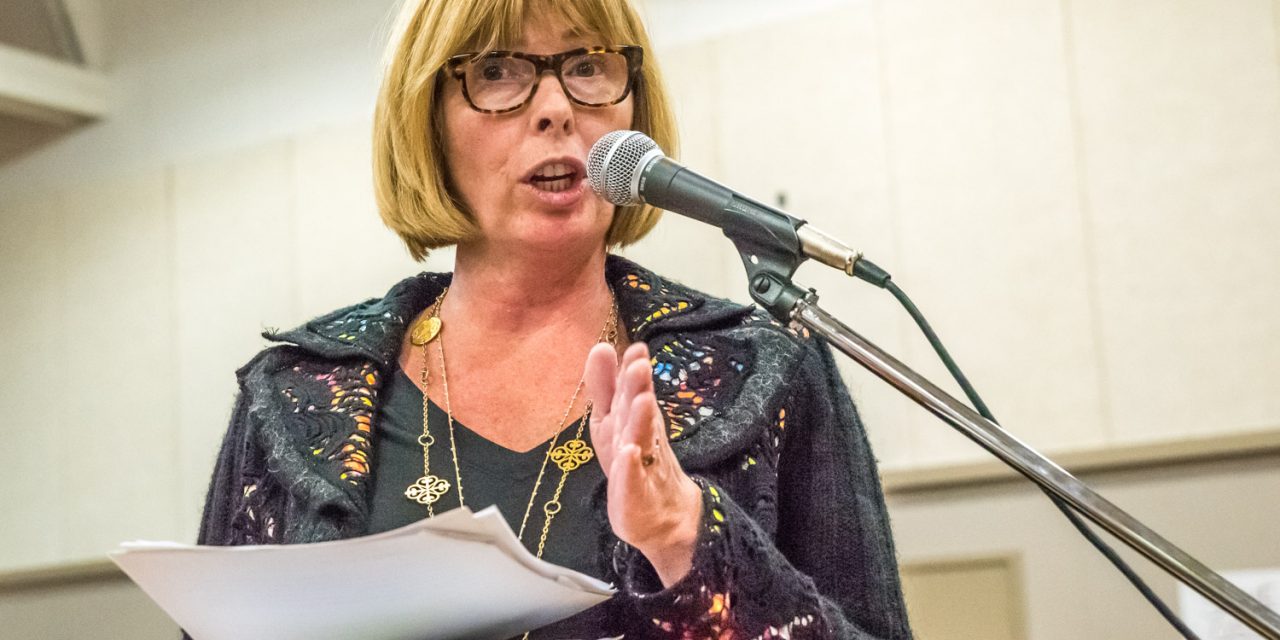
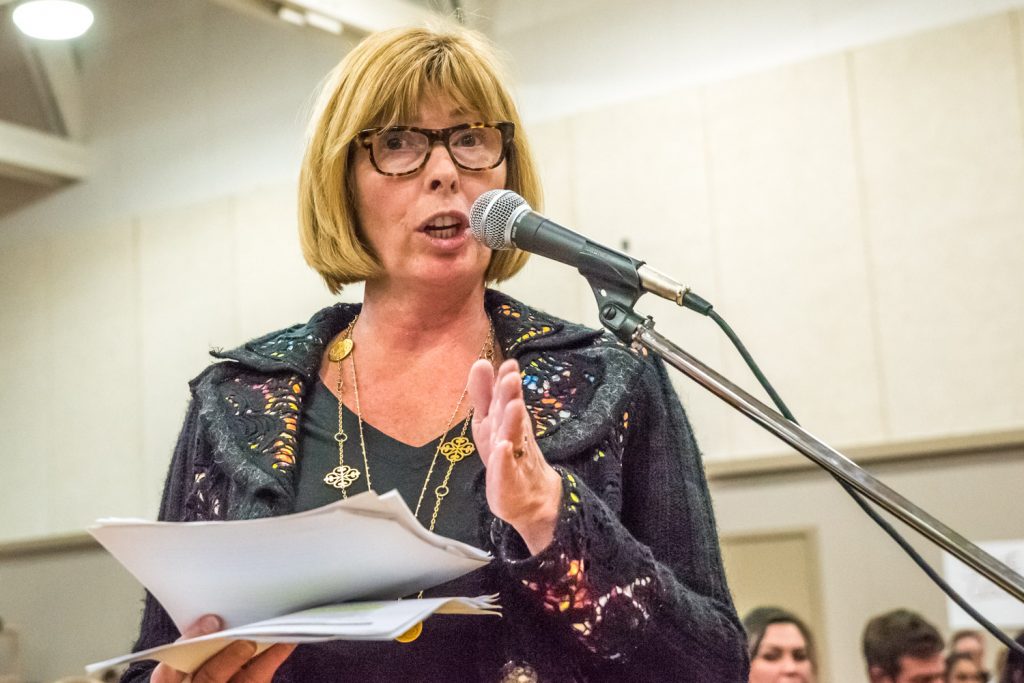
Martha Collins argued that there has recently been a baby boom and this should result in future enrolment increases. She suggested that waiting until the results of the 2016 census would confirm this trend. (Richard McGuire photo)
One of the problems with forecasting school enrolments for coming years is that the forecasts rely on computer models of existing data.
According to School District 53’s projections, overall enrolment will continue to decline across the district, even though enrolment at Osoyoos Secondary School (OSS) would be more or less stable.
Most of the decline is at the overbuilt Southern Okanagan Secondary School (SOSS) in Oliver.
But what if these projections are all wrong? What if we are on the verge of a modest surge in the population of young people?
Perhaps that sounds like wishful thinking, but there’s already evidence this is happening.
Martha Collins, an Osoyoos chiropractor, who just happens to be the wife of former mayor Stu Wells, makes a strong argument that we are entering a baby boom that was first reflected in the 2011 census.
It’s not just Collins making this argument. Demographers in Canada and internationally have been pointing to this trend in the last few years.
As Collins points out, the Canadian population of children aged four and under surged by 11 per cent between 2006 and 2011, according to Statistics Canada.
This is the highest growth rate in that age group since the 1956 to 1961 period at the peak of the post-war “Baby Boom.”
It’s also the first time in 50 years that the number of children aged four and under increased in all Canadian provinces.
Part of what is happening goes back to the baby boom that lasted roughly from 1946 into the early 1960s. With the end of World War II and prosperity of the 1950s and 1960s, there was a surge in children born.
When the “Boomers” grew up, they gave birth to another surge, the so-called “Echo Boomers” born between the 1970s and the turn of the millennium.
This group, often called “Millennials,” is increasingly having children of their own.
As Collins points out, behaviour is shifting. Not only is the recent trend of women having babies in their 30s and into their 40s continuing, but younger women are also giving birth.
This phenomenon is occurring throughout the developed world.
In September 2013, BCA Research issued a study titled: “The Coming Baby Boom in Developed Economies.”
It predicted a new baby boom that will be bigger and longer lasting than the one following World War II. Not only are Millennials entering prime childbearing years, but families that delayed having children after the 2008 recession are making up for lost time.
Medical improvements, it notes, also mean women can have two or three children later in life and many want exactly that.
Other trends are at work.
Immigrants tend to be Millennials these days, and many come from cultures where larger families are the norm.
And, as NDP Education Critic Rob Fleming points out, families experiencing hard times in the Alberta oil patch are returning home to B.C. and some families are escaping Vancouver housing prices to come to the Okanagan.
At the end of World War II, governments and bureaucracies failed to predict the baby boom and were caught flat footed.
If Osoyoos loses OSS, we’re not getting it back. And what a shame if our school trustees make this unnecessary closure, blind to the demographic trends that are occurring.
In less than two months, Canada is conducting the 2016 census and new demographic data will be available in early 2017. The school board owes it to us to wait and see if the new census proves their enrolment forecasts all wrong.

