By Don Urquhart, Times Chronicle
Just how much longer can staff be paid and the lights kept on are the constant fears that stalk Cameron Bissonnette’s thoughts as the American trade war continues to bear down on the Canadian economy.
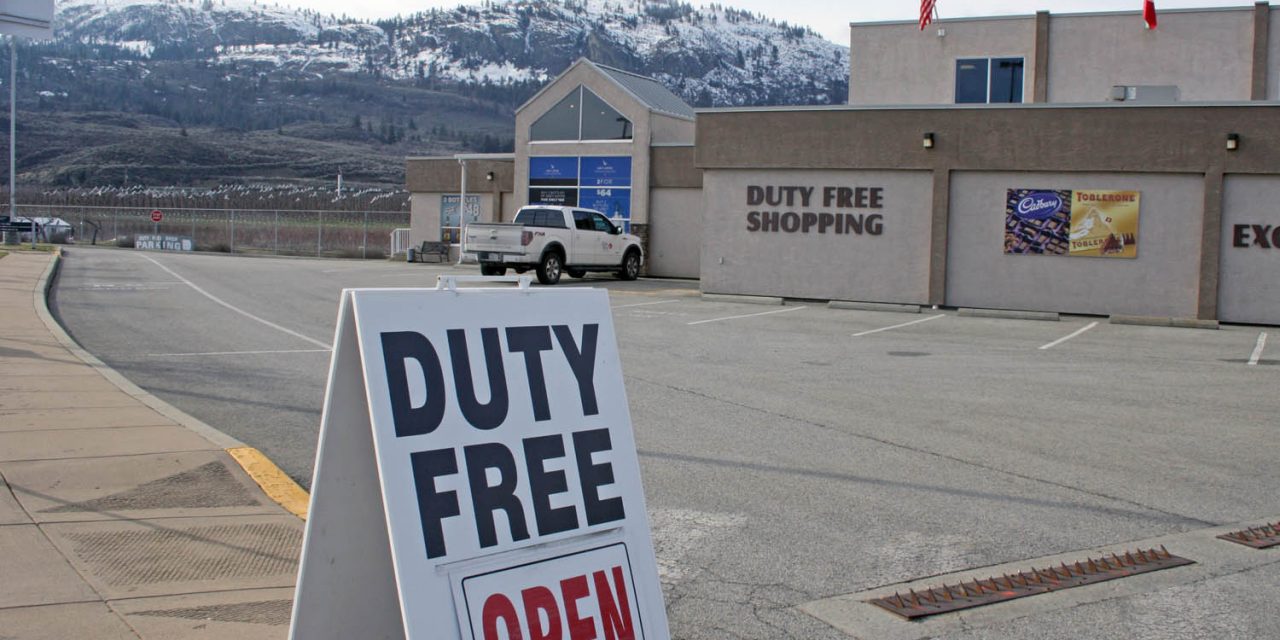
Speaking during a Border Mayors Alliance press conference Friday morning on Zoom, Bissonnette, who owns and operates the Osoyoos Duty Free Shop at the Oroville-Osoyoos Border Crossing (as well as the Kingsgate Duty Free Shop in the Kootenays) spoke of the difficulties Donald Trump’s trade war is causing for his business.
“Every single product that leaves my front door has to go into the United States,” he says and that means Americans get hit with a 25 per cent tariff on their purchases when they reach US Customs. With vehicle traffic down substantially business is just plain bad.
Bissonnette noted one particular day last week when the store made a negative $67, because someone came in to do a refund.
He adds that his business is still recovering from the COVID-19 pandemic which saw sales down 90-95 per cent for two full years. It was thanks to government subsidies that his business even survived, he said, but “It’s pretty tough to run a business that way.” And he’s still paying off his Canada Emergency Business Account (CEBA) Loan.
He became visibly overcome with emotion when he explained, “I’ve had to fund the business myself out of my personal savings to keep the lights on, pay taxes, all the things that come with running a small business.”
The situation, compounded more recently by the tariffs, have forced him to make a career change that includes moving from Osoyoos to Kelowna to start a career in real estate finance. He did this because he could “see the writing on the wall”.
His children have long since given up any thoughts of taking on the second-generation duty free business that was started in 1986, and pursued other careers.
Bissonnette’s thoughts return to his local business and his employees. “There’s really good people that work for me, taking care of it [the duty free business] for me while I do other things,” he says, adding that he hasn’t collected a pay check from his business since June last year.
“Now it’s even at a point where I’m wondering, how much longer can I pay my staff”.
He related a recent membership survey conducted by the Frontier Duty Free Association – a non-profit organization that represents Canada’s land border duty-free shops – in which up to 30 per cent of respondents were unsure if they would still be operating in six months time.
He was asked how long he thought his business could remain solvent. “That was a punch in the gut because I really had to think about it and it was the first time I thought ‘am I going to be here? How long will I be here for?’”
“The duty free association, much like Canada in general, we’re small, we’re scrappy, we are always going to punch above our weight. We’re survivors, so we’re gonna do everything we can, but right now it really feels like we are hostages in economic warfare.”
Bissonnette added that in comparison to the aluminum, lumber, or automotive industries – obviously much larger employing hundreds of thousands of people in this country – which can pivot and sell their products to other markets in the world, the duty free business is tied to one market and one only.
In reference to announcements of government support Bissonnette says the duty free sector is “not looking for a lot of money.”
“We just want to be able to stay solvent. We want to be able to pay our bills. We want to be able to pay our staff and, you know, hopefully be here for the next five or 10 or 20 years, or however long that’s going to be.