Some would probably recognize Don Brogan from his “first cup of coffee in the morning, slightly disheveled, gravelly-voiced early morning Facebook weather update” that he does from lakeside at Nk’Mip Campground & RV Park. It’s oddly compelling – if you’ve seen it, you know.
As far as local personalities go, Brogan surely fits the bill. An Oliver-born son who left the South Okanagan straight after high school upon having his fill of local notoriety. Not because of any ill-behaviour, at least not any he’s admitting to, but because of his parent’s involvement in the community.
His family owned the SuperValu in Oliver for 47 years. And of course, his dad was mayor of Oliver in the ‘80’s.
“I grew up as a kid with everybody knowing who I was and I didn’t quite know who everybody was. I couldn’t drive my car quickly down the road without four phone calls to my dad so it was a place I thought I would never see again when I graduated high school,” Brogan chuckles.
He eventually returned in 1996, and after running a produce store in Penticton ended up in the hotel business. It was a gig managing the Osoyoos Holiday Inn that kicked off a whole career including GM positions at Walnut Beach Resort, the Coast Oliver Hotel, and Fairfield Inn & Suites by Marriott in Penticton.
Returning to the present at a recent Rotary Club of Osoyoos lunch, Brogan presented an update on the return to cannabis retailing by the Osoyoos Indian Band (OIB). It was congruous having Brogan as the lunchtime speaker as he was one of the charter members who helped establish Rotary here in 2003.
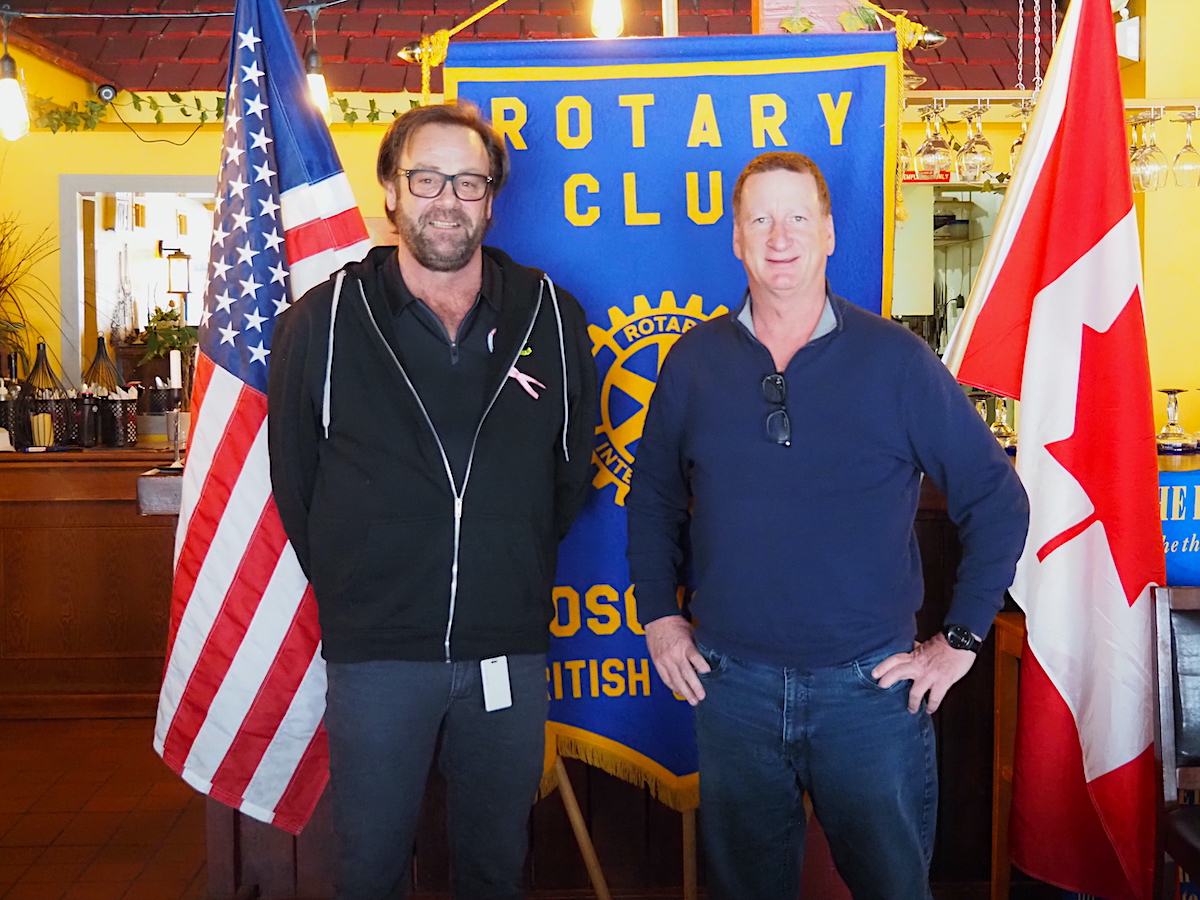
Don Brogan (left) and Rotary Osoyoos Vice President Elliott Friedrich.
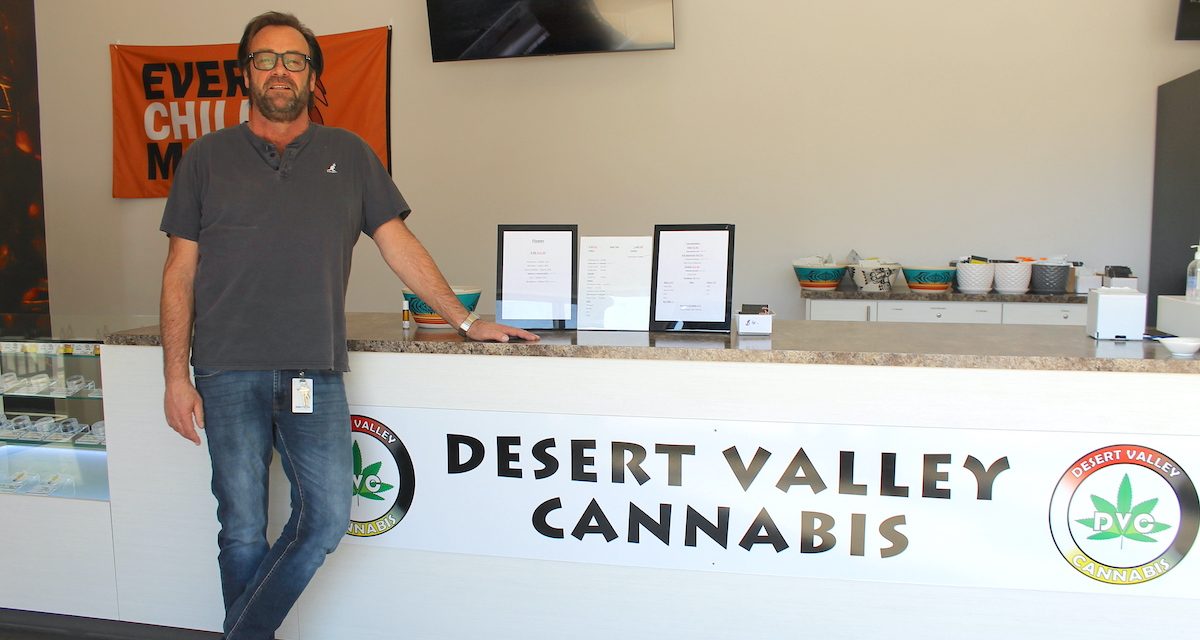
Brogan, who is General Manager of the Nk’Mip Campground & RV Park and has done various consulting jobs with the OIB, has now been tasked with the OIB’s cannabis project.
The OIB had a partnership with a company called Indigenous Bloom for the locations that were on their land which includes a location next to the District Wine Village in Oliver and at Nk’Mip Corner in Osoyoos.
That partnership dissolved and “after the dust settled the Osoyoos Indian Band was able to take over the assets of the two buildings and once we got our ducks in a row, we were able to re-open the building here in Osoyoos as a dispensary,” Brogan says of the renamed Desert Valley Cannabis store.
The one in Oliver is being leased for a year to one of their suppliers and they will give it a shot at retailing. “That neighbourhood is a little tough, a tough market. You’ve got a couple of, for lack of a better term, ‘illegal shops’ that are on the highway there that are undercutting the market price of most of the product.”
“We thought it would be better to let a bigger company that has multiple stores and experience to weather that and see if that might cause one of the other ones to close up. We don’t know, we’ll find out,” he adds.
It is a curious situation because these “illegal shops” he refers to are leasing the land from OIB members, effectively fostering competition with the OIB’s official business from within the band.
Brogan says it’s unlikely any pressure will be put on the band members leasing their land because of their sovereign right to make a living. “If that’s what they choose to do, the band’s not going to stop a band member from earning a living,” he says.
The business in Osoyoos has been up and running since February 1 and Brogan says things are going well. “We’re not breaking even at the moment, but it’s definitely going in that direction.”
He notes the situation is unique because being on OIB land means the legal jurisdiction that they fall under is Indigenous, not federal or provincial.
This means they don’t have to adhere to the same laws and regulations that retailers not located on band land have to, such as not paying tax, which Brogan acknowledges gives them a distinct leg up on non-Indigenous retailers.
He says really the only thing they do that skirts the regulations is that the dosages of their edibles are higher than what the provincially regulated stores sell.
A package of gummy bears for instance cannot contain more than 25 mg of THC (the psychoactive constituent in cannabis) in the whole package. So 10 gummies in a package will each have 2.5 mg of THC.
But at the OIB retail shop a package of three edibles contains up to 1,500 mg of THC or 500 mg in each gummy. Brogan says the provincial limits are set to increase in the near future.
Brogan says it’s been a learning curve. “All this is new to me. I didn’t know a whole lot about cannabis other than that I used to smoke it,” he laughs.
It was a sharp learning curve, he says, with one of the biggest surprises being that the vast majority of the customers are people looking for the medicinal benefits of cannabis such as relief from pain, anxiety, and to help with sleep.
“I would say one or two out of 10 people coming into the store are looking to buy a joint to get high. That’s not the type of people that are coming to the store.”
It surprised him that a large proportion of the customers were senior citizens looking for relief from various ailments. “So that made me feel a lot better about what I was doing in this project,” he adds.
He also says that when he agreed to do the project, he told the OIB: “I agree to do this project, but I don’t wanna be the guy standing behind the counter selling weed, and they said ‘oh no, you’ll have staff and everything’.”
He wryly notes that because they have a policy of always having two staff on duty, the widespread labour shortage means he’s behind the counter two days a week.
He notes it’s very important to be sure of the credibility of the suppliers. “We don’t just buy from anybody.” He’s had people show up claiming to be legitimate suppliers who have a big duffel bag of cannabis and just photocopies of laboratory test results. Brogan says it was a “thanks but no thanks” situation.
Currently, they have only one supplier, the former supplier of the Indigenous Bloom enterprise. “So all of the products currently in the store right now are almost exactly the same as what Indigenous Bloom was selling, it’s just re-packaged and it’s now called Bloom Community Cannabis.”
He notes they will be expanding their suppliers, and in fact, is travelling to Montreal along with the OIB’s Nathan McGinnis to meet an Indigenous company that produces and does both retail and wholesale across the country. “Because they’re an Indigenous company we want to explore doing business with them,” Brogan says.