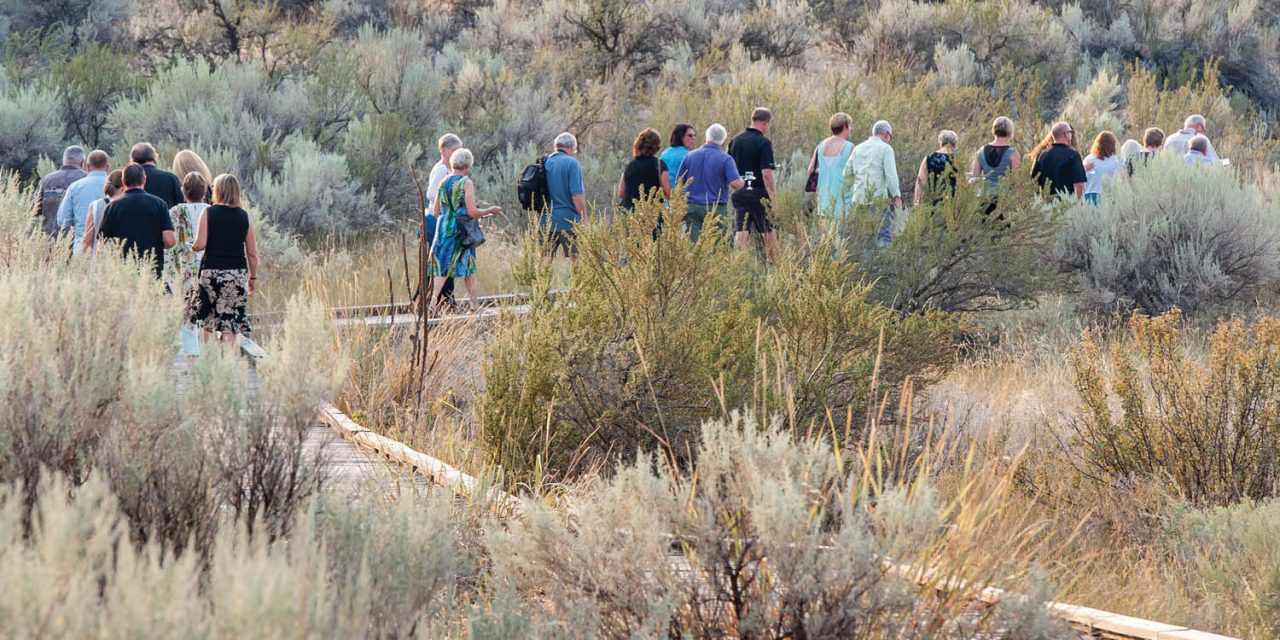
The Osoyoos Desert Society has found itself between a rock and a hard place due to an oversight in planning for the replacement of the tourist attraction’s 1.5 km boardwalk.
The issue is up to 490 tonnes of pressure-treated wood requiring costly disposal to the tune of some $257,000. Unfortunately for the Desert Society, while disposal cost for the lumber was factored into their budgeting for the boardwalk replacement it did not take into account the higher cost of the pressure-treated wood.
“As you can imagine we are devastated by this news and mortified that we overlooked this significant expense in our budget. This oversight puts our boardwalk project in real jeopardy,” said Jayme Friedt, managing director Osoyoos Desert Society.
The iconic tourist attraction that helps educate visitors about the unique desert environment of the Osoyoos area was awarded a Province of BC Community Economic Recovery Infrastructure Program (CERIP) grant earlier this year to replace the 25-year-old wooden boardwalk that as Friedt noted, “was truly at the end of its life.”
She notes that with an average of 10,000 visitors a year, “we were really thrilled to get this grant.”
In a presentation to Osoyoos Town Council, Friedt said that despite an annual maintenance program on the boardwalk since its construction, “it was getting more and more difficult and more and more expensive to simply maintain it.”
“So this grant couldn’t have come at a better time,” she added. The grant is aimed at bolstering the recovery of the tourism industry, as well as stimulating the local economy and creating local jobs specifically targeting underrepresented groups such as new Canadians, Indigenous peoples, women, and youth.
But now the project is in danger of literally going ‘off the boardwalk’ as tenders for the project will fully utilize the $837,000 total grant without taking into account the potential $257,000 disposal cost.
Clearly grasping the unfortunate situation it has now found itself in the Desert Society has come up with a number of ideas to help reduce the volume of wood waste and was before council essentially hat in hand seeking assistance to overcome this substantial hurdle.
Friedt notes that in discussions with its volunteer consultant Larry Stone as well as town staff, it’s been recognized that the estimated weight of the wood may actually be less due to 25 years of drying out and wear and tear.
Further, she notes that as a conservation society, the Osoyoos Desert Society wants to see as little of the waste material as possible go into the landfill. “We intend to upcycle as much of the material as possible to construct some decks and also fences that we require.”
The Society has also sent notices to supporters for them to take materials away for their own personal use. “Anyone taking material away will get a letter noting it is pressure-treated lumber and the precautions they need to take with that material,” Friedt highlighted.
Mayor Sue McKortoff said: “I’m pleased that you are looking at other options such as using lumber in other areas and offering it to people who might need it for their yard. But obviously, you have to be careful about the lumber and how it’s used.”
Councillor Jim King asked what percentage of the wood could be reused through the Society’s proposal, to which Stone replied around 50 per cent.
There is also the added cost of transportation to dump, on top of the dump fees. Stone noted that while a two-by-six-inch pressure-treated board is about several pounds per foot, the waste boardwalk lumber is likely down to about three pounds per foot because it’s dry and “probably many of the boards have worn down and lost thickness.”
But whatever the case, all parties agreed that there will still be a significant volume of waste that needs to be disposed of.
With the smell of desperation heavy in the air, McKortoff suggested the Society relook its plans.
“Maybe you need to look at your plans a little differently. Either not do the entire length if this does not work in your favour and there are definitely concerns about that. Because we cannot say right now, not at all, that we can forgive this or not charge anything.”
“It’s not in the bylaw, it wouldn’t be fair to everything else, there are too many things to consider to even do that, however, I certainly like the idea of looking at all these other options perhaps reducing the length of the walkway and I don’t know if that has been considered.”
Allan Chabot, chief administrative officer for the Town of Osoyoos also highlighted that the waste management bylaw doesn’t provide any mechanism for reducing fees. “The only way is an amendment to the bylaw,” he added saying the appropriate way is to charge based on the different classes of waste as it comes in, which is the current system.
But both Chabot and Stone agreed there is a discrepancy between the landfill facilities website and the applicable bylaw.
Chabot suggested that council could consider a bylaw change providing a rate class for the disposal of waste by not-for-profit societies who have a presence in the local community. “It might make sense to lessen the burden on those groups who are typically dependent on grants and donations that contribute to quality of life and tourism,” he said.
Other options include a diversion of town funds from projects that have been scaled down, delayed or cancelled. An outright grant from the town is a further option.
The provincial grant comes with a requirement that projects must begin before the end of 2021 and be completed in a timely manner. The Desert Society had planned to complete the boardwalk project next year.
There is the possibility of stockpiling the lumber until 2022 and a solution can be found, Friedt said.
The meeting adjourned with both parties agreeing a more definitive estimate on the actual volume of the wood waste needs to be determined. Town staff will also work to come up with possible options. Any change in bylaw would require at least two council sessions, or roughly just over a month to conclude, should that option be pursued.