Image: Government of BC Flickr
Lyonel Doherty
Aberdeen Publishing
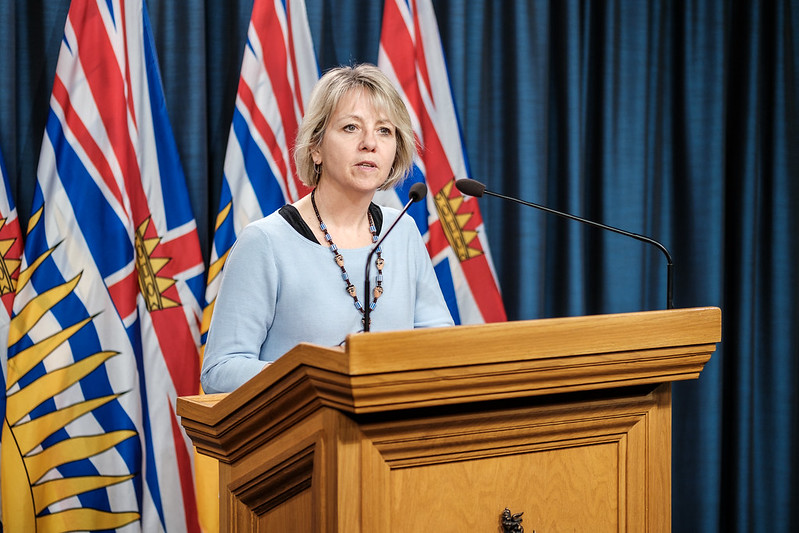
Provincial Health Officer Dr. Bonnie Henry finds it heartwarming to see how people are coping with the COVID-19 pandemic.
“I’m seeing things that make me smile,” she said at a news conference today, citing examples of people staying virtually connected while shut inside their homes.
She referred to the 7 p.m. nightly cheer in neighbourhoods where people are banging pots and pans in support of health care workers and first responders.
She cited incidents where people are leaving flowers and groceries on their neighbours’ doorsteps, and young children having virtual playdates.
Henry is moved by adults having evening electronic gaming marathons with teenagers who, not long ago, were limited to how many hours they could play.
She noted that more people are using social media than ever before, and mentioned that flower mills are working 24/7 to provide fresh loaves of bread for online purchase.
“This is a very challenging time for us and it’s hard to know how things are going to go. But right now we seem to be holding our own, and without a doubt we will get through this no matter what happens.”
Henry reported 53 new cases of COVID-19 in B.C., for a total of 1,066, including 114 in the Interior Health region. Yesterday the region had 107 cases.
She also reported outbreaks in 21 long-term care facilities, up from 19 yesterday.
“This really reflects the challenging situation (we are in) and the importance of catching it (the virus) early.”
Henry said 142 people are hospitalized with COVID-19, including 67 in critical care.
One additional death has been reported in the Fraser Valley, bringing the total virus-related fatalities in B.C. to 25.
But Henry was happy to report that 606 people have fully recovered from the disease.
The health officer said the government has developed an ethics framework to address questions from the public (posted to the B.C. government website). The framework also addresses the allocation of personal protective equipment to ensure that these scarce resources are maximized.
Henry said they have received hundreds of offers of support through community collaboration, adding they have established a supply hub that businesses can contribute to.
“It really does show me that we will get through this together.”
Health Minister Adrian Dix said the province now has 4,192 acute care beds available to address the need.
He also pointed out that people are using the health care system less at the moment, adding there are fewer ambulance calls and fewer emergency visits.
“This is the time we have to be 100 per cent all in,” Dix said, noting that every single person who comes back to Canada on a flight must self-isolate.
He stressed it would be a “betrayal” not to follow these rules, stating there should be “no ambiguity” around self-quarantine these days.
“We can’t stop now, we just cannot stop now . . . our task is simple; we have to dig deeper, work harder and keep our distance (to bend the curve and stop the spread).”
During question period, Henry qualified the use of non-medical masks by some people who have no symptoms. She said these masks may prevent you from touching your face and can keep your droplets in, but they are not proven to protect you from the virus.
Once again, the question of COVID-19 testing was brought up, with Henry saying they have increased their testing capacity and are primarily focusing on people who are at high risk.
Henry said the province is now one of the top jurisdictions in the world when it comes to testing per capita.