By Roy Wood, Special to the Times Chronicle
The projected cost of the new domestic water treatment plant for Osoyoos has jumped to just over $80 million and is expected to be operational in about four years.
Such a facility would replace the aging well and pump system, which has been at the centre of controversies around brown water coming out of taps and dramatic hikes in user costs.
While little has been going on publicly, work has been progressing behind the scenes around what the project will look like and where the money is going to come from to pay for it.
Earlier this year the town hired Colliers Project Leaders, a consulting firm with offices across Canada including in Kelowna, as the project managers.
Two of the firm’s consultants, Angela Alambets and Ben Prashaw, gave town council a project update at Tuesday’s Committee of the Whole meeting.
Among their revelations was an updated project budget totalling $80,419,699. The cost estimate as recently as April of this year was $51 million.
Among the highlights of the budget are:
- $14.7 million for consulting, including $2 million for project management, $8.8 million for engineering work and $1.9 million for design contingency;
- $59.9 million for contractors, including the construction of the water intake, pipeline and treatment plant;
- $3 million for land acquisition; and
- $3.15 million for project contingency.
As for where all that money is going to come from, it will likely be a combination of grants from senior levels of government and water user fees for the system’s customers.
In an interview Tuesday, CAO Rod Risling told the Times Chronicle the town hopes to increase the funding it gets from the province beyond the $9 million announced early this year for a water treatment facility.
“We’ve been working on it already,” said Risling. “We met with elected officials at UBCM. There’s lots of work going on behind the scenes, but you never get guarantees. We’re doing what we can.”
He said some funding may come from the federal government, but usually, such grants go to the province for administration and distribution.
Any costs beyond those covered by grants will be covered by users, he said, “Unless people say they don’t want potable water.”
Following Tuesday’s presentation, Councillor Myers Bennett asked the consultants about the potential for cost overruns.
Prashaw told him that Colliers takes many steps, including working with potential suppliers, to try to make sure there are no overruns. “Although we can’t say for sure there won’t be.”
The potential site for the treatment plant remains shrouded in secrecy.
Alambets told council that the original list of seven or eight potential sites has been reduced to a shortlist.
Asked if he would share what locations are on the shortlist, Risling said, simply, “No.”
In its 75-page “Source Water and Treatment Feasibility Study” presented to council in April of 2024, Carollo Engineers had identified two options for siting a surface water treatment plant.
First, a location south of the Crowsnest Highway 3, between parts of the golf course which has the advantage of being easy to access and mostly flat. However, this option was not identified as a preferred location because it would require additional pumping to supply Reservoir 340.
The second and preferred option identified at the time was further west next to Hwy. 3. This site is further from the North Basin intake but is larger and much closer to Reservoir 340.
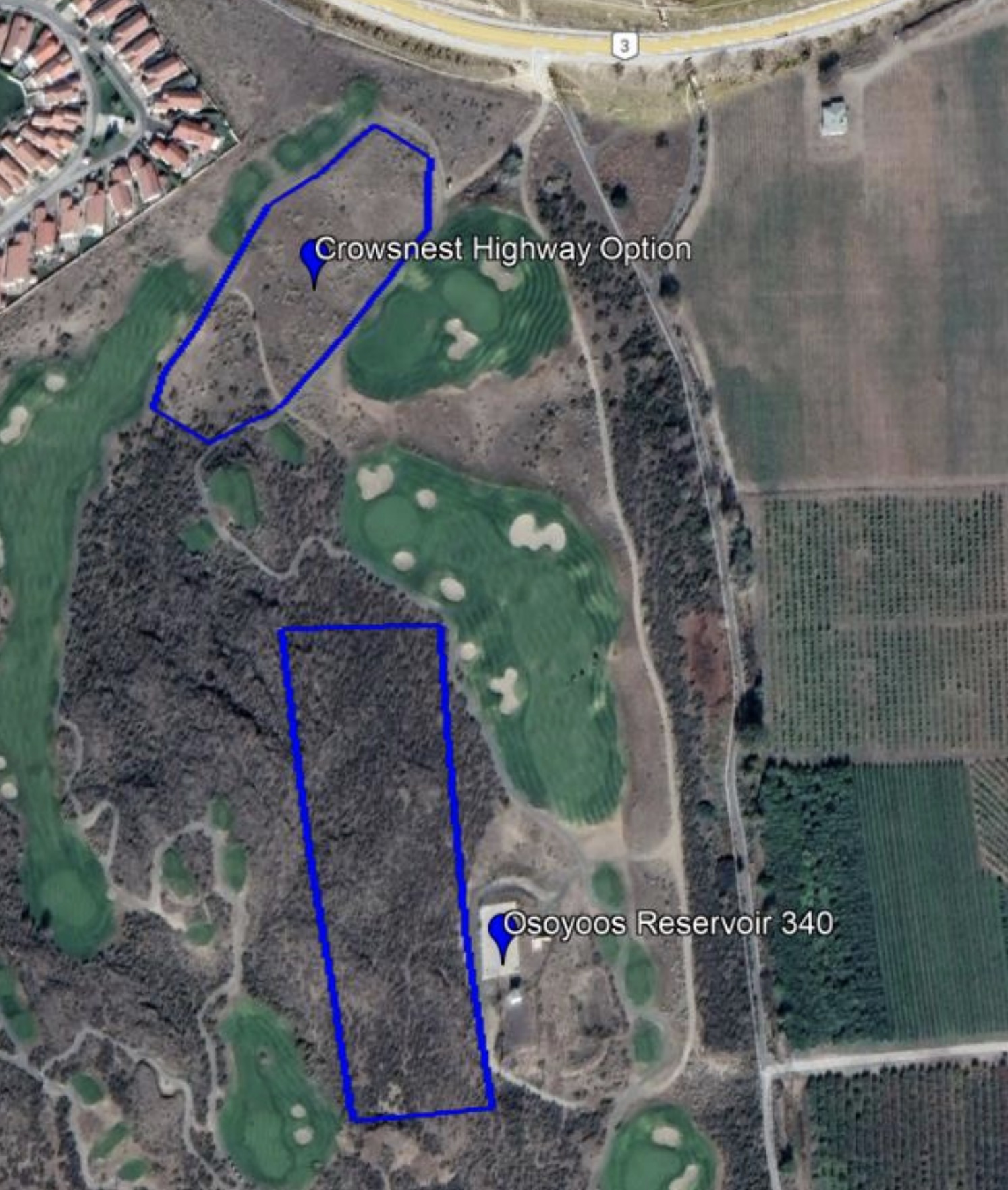
Potential Locations for a Surface Water Treatment Plant Along the Crowsnest Highway 3 or the
Reservoir 340 Site first proposed in the Carollo report presented to council in April 2024.
At this point, the plan calls for using water from Lake Osoyoos to feed the treatment facility with the intake, which according to the Carollo report, would be best sited (based on a study by Self and Larratt in 2020) adjacent to the existing Station No. 8 Intake (agricultural water) at nearly 30 metres in depth.
The other choice would be to use water from wells, including those currently in use. For a variety of reasons, including a considerably higher cost of using such groundwater, the option was rejected at least for the time being.
At the time the Carollo report was released the surface water treatment facility was estimated to have a capital cost of approximately $51.74 million compared to $61.5 million for groundwater treatment. It’s not clear what the updated cost of groundwater treatment would be.
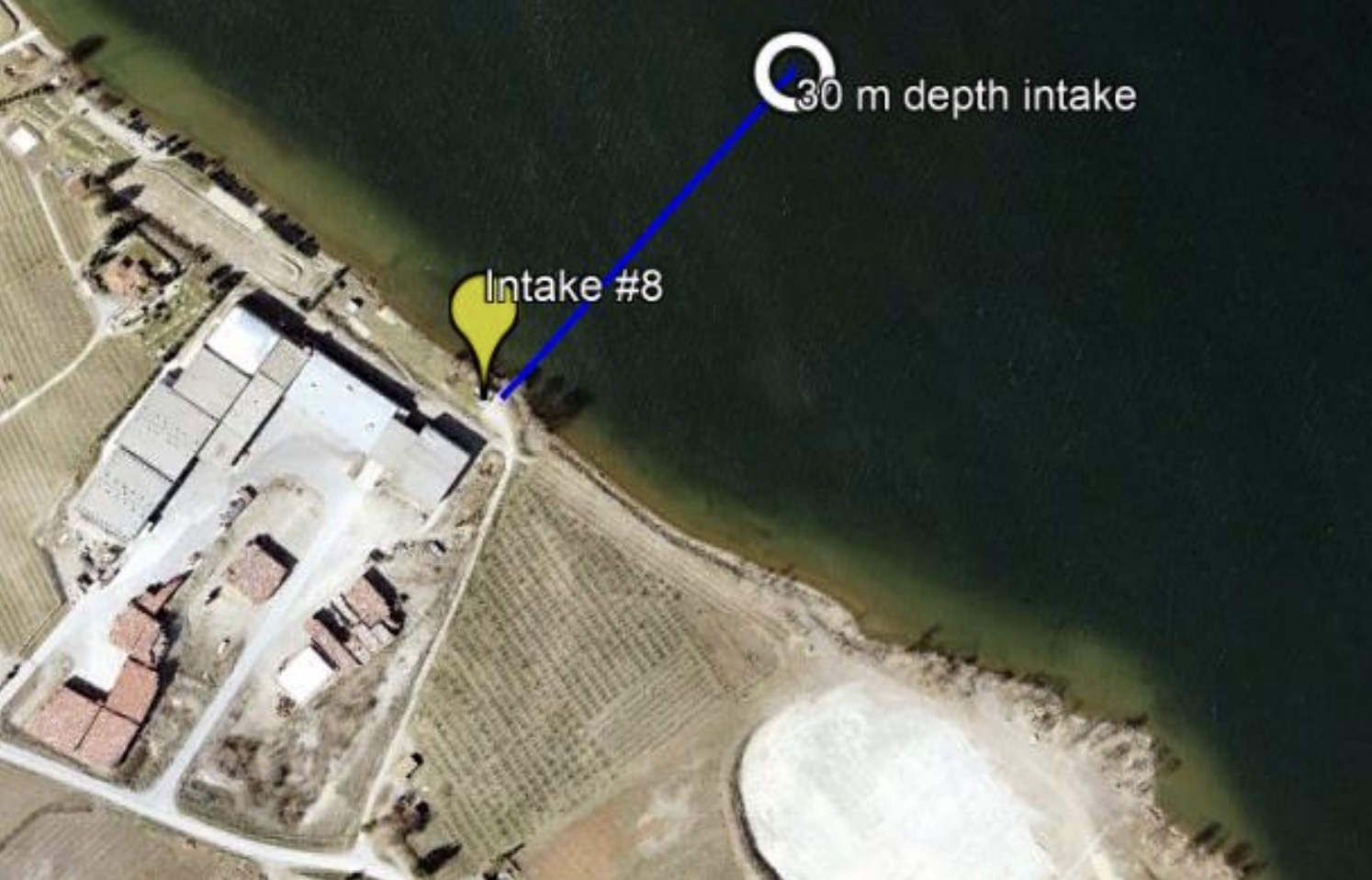
Osoyoos Lake Proposed Intake Location adjacent to the existing Station No. 8 Intake off of 87th St. north of 122 Ave. first proposed in the Carollo report presented to council in April 2024.
At the insistence of Interior Health, testing to make sure the lake water is safe began in August and will continue for about a year.
The Colliers presentation includes a rough timeline for the project:
- Analysis of procurement options to be completed November 2024;
- Awarding of the design and build contract – April 2025;
- Completion of lake water sampling – October 2025;
- Completion of preliminary design – fourth quarter 2025;
- Detailed design contract and confirmation of maximum price – first quarter 2026;
- Substantial completion of construction – first quarter 2028; and
- Completion – third quarter 2028.
Beginning shortly, Colliers will complete a “market sounding to obtain local market input into the project delivery, methodology, and project risk management.”
In November a contract will be awarded to design and supply a water treatment piloting facility.