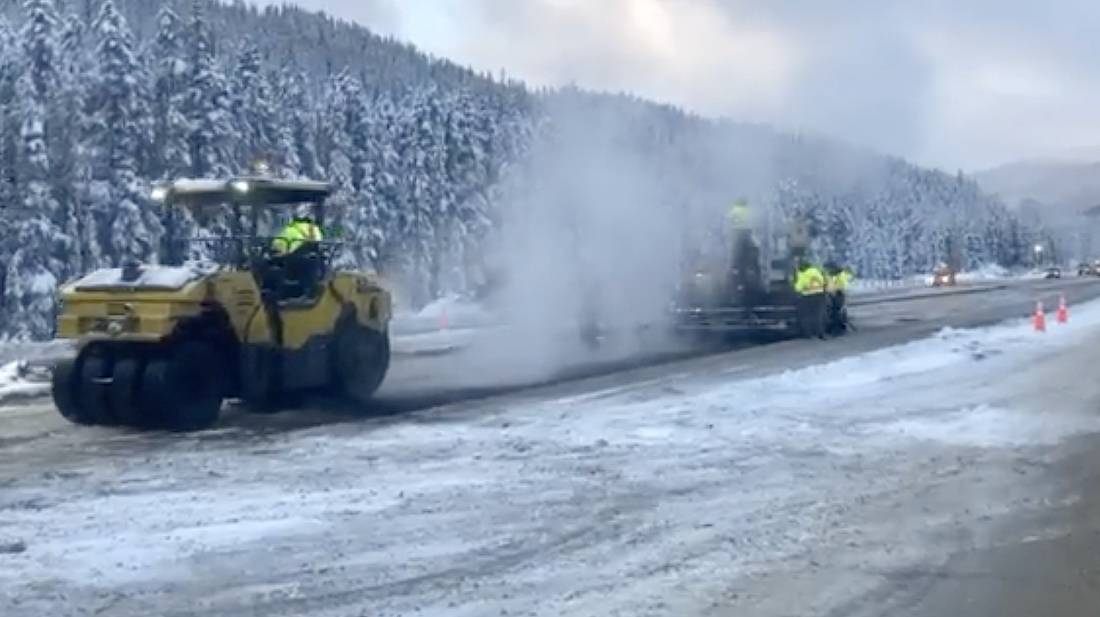
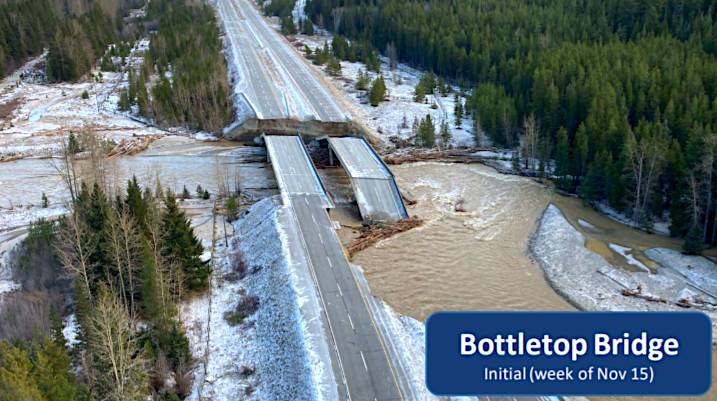
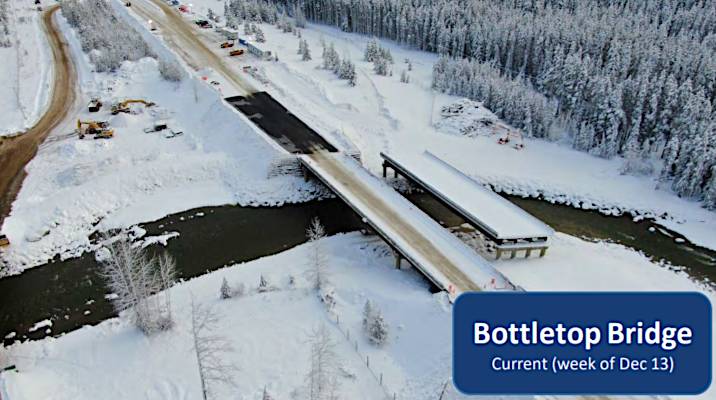
Described as one of the most remarkable engineering feats in B.C.’s recent memory, repairs to the Coquihalla Hwy 5 will enable it to reopen on Monday, Dec. 20, paving the way for non-essential traffic to begin using the Crowsnest Hwy 3 one day later.
Following the historic atmospheric river storm one month ago, work on 20 separate sections of the Coquihalla and seven collapsed bridges has been intense, with round-the-clock work by some 300 workers and 200 pieces of heavy equipment.
“The Coquihalla will reopen to essential traffic no later than end-of-day on Monday, Dec. 20. The exact time will be determined over the next few days as we complete some final pieces of work that are needed for that reopening to get completed including some paving,” said Rob Fleming, Minister of Transportation and Infrastructure.
“We will remove the essential travel restrictions from Hwy 3 about 24 hours later,” he added.
The 24-hour delay to opening Hwy 3 is to give the trucking sector the ability to adapt schedules and migrate back to Hwy 5. “We want Hwy 5 to be the overwhelming truck route,” connecting the lower mainland to the interior with what is a faster, more direct route, Fleming said.
“We don’t want immediate mixing of cars and trucks on the first day,” in the interest of safety he added.
Commercial vehicles will have a choice of using either Hwy 5 or 3, but typically Hwy 3 has vastly less commercial truck traffic than Hwy 5. Hwy 3 is averaging around 3,000 commercial trucks a week, of which Fleming says 85-90 per cent would normally be on Hwy 5.
The highway ministry is advising drivers to use “extreme caution” on Hwy 3. “It is a safe route, as long as people are prepared, responsible and drive to conditions but it’s a mountainous route, it has steep grades, winding curves and the weather and road conditions can change quite quickly,” Fleming said.
“People who are not experienced with winter driving in the mountains are encouraged to use alternatives,” he added pointing to extra flights mounted by airlines, capped prices as well as inter-city bus services.
Ongoing maintenance, improved signage, enhanced checkpoints, additional police and Commercial Vehicle Safety and Enforcement (CVSE) will all be features of the reopening to regular traffic.
“We hope the volumes are not excessive,” he added, reminding drivers to follow health orders.
The reopening of the Coquihalla will also enable the reopening of Hwy 99 for general travel that is currently restricted between Pemberton and Lillooet. This will also occur on Monday, Dec. 20. The prohibition on any vehicle larger than a cube truck remains in place.
The timeline for the reopening of Hwy 1 remains the same. A total of 12 sites have been remediated but the continuous route from one end to the other will not be ready until mid-Jan. Five active sites still need work over the coming weeks to meet the deadline.
Fleming also cautioned that “while we are thrilled to reopen the Coquihalla highway it is not the Coquihalla as we know it.”
Some sections will be open to two-lane traffic only, with one lane in each direction. There will be several speed reductions and crossovers along the route with an estimated additional 45 minutes added to the travel time – in optimal weather conditions – as a result of these segments.
Fleming also thanked all those who got the highways to this point – the companies, the trade unions, engineers, suppliers, and workers “who have been on the ground day and night literally around the clock.
“The work you have done has been inspiring and very selfless and dedicated on behalf of all British Columbians you are serving.”
He added that in the global industry B.C. road builders are “held in extremely high regard and they are second to none that you will find anywhere in the world.” But with the work undertaken to get the Coquihalla useable again, Fleming said this industry took it to a “whole new level and literally defied the odds.”