(The following is an analysis.)
By now, you’ve probably received the voting package for the referendum on electoral reform in the mail.
If you’re an active partisan for a political party, you’ve probably already figured out which of four electoral systems will give the most advantage to your party.
But if you’re like most British Columbians, you’re probably scratching your head and trying to figure out what the different options mean.
First some background. The referendum comes about because of a Confidence and Supply Agreement (CASA) reached in May 2017 between the BC NDP and BC Greens that allows the NDP to govern with the support of the Greens.
The Green Party has long been frustrated that under the current electoral system, known as “first-past-the-post,” they’ve been unable to elect MLAs in most electoral districts. In most districts, the Greens get between 10 and 25 per cent of the vote, which is not enough to win a district.
In Boundary-Similkameen in 2017, for example, Green candidate Vonnie Lavers took just 10.23 per cent of the vote, compared to winner Linda Larson of the B.C. Liberals, who won 42.8 per cent.
Greens therefore prefer a system where the number of seats each party gets is proportional to their popular vote across the province, rather than being determined by the outcome in each electoral district.
In 2017, the Greens took 16.84 per cent of the popular vote province wide, but they only took three seats, all on Vancouver Island. Under a proportional system, with 87 seats in the legislature, the Greens might be expected to gain about 15 seats in the legislature.
It’s less obvious how proportional representation would benefit the NDP. In 2017, they took 40.28 per cent of the vote, which would give them roughly 35 seats if these were allocated by percentage of the popular vote. This is actually less than the 41 seats the NDP won in 2018 under the current first-past-the-post system.
But without the support of the Green Party, the NDP would no longer have enough seats to command control of the legislature. Without the CASA signed between the two parties, the B.C. Liberals, who won two more seats than the NDP, would likely have remained the government.
And CASA is clear in one of its conditions that a referendum on proportional representation must take place in the fall of 2018.
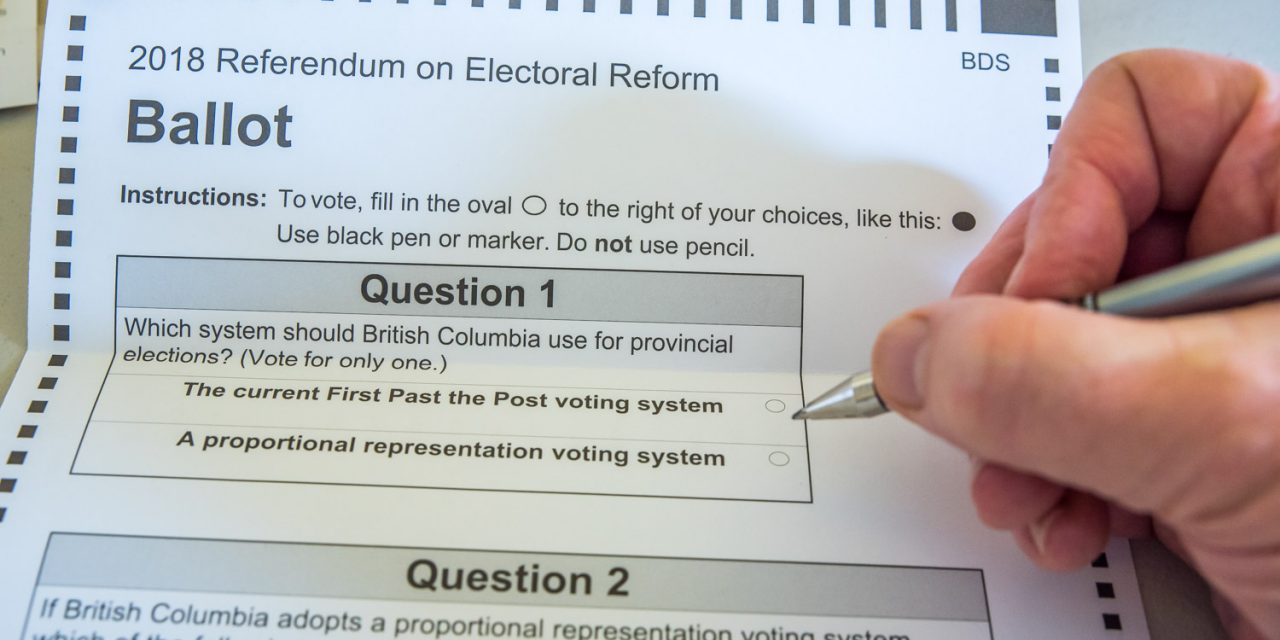
If you’ve looked at the ballot, you’ve seen that it asks two questions. The first asks people whether they prefer the current first-past-the-post system or a proportional voting system. The second question asks voters to rank three proposed proportional systems in order of preference.
If you prefer the status quo, all you need to do is mark Question 1 to say you want the current first-past-the-post system. You don’t need to answer the second question, although you can.
As most people know, under the current system, the province is divided into 87 electoral districts. Each district is represented by a single MLA who is picked by name by the voters. The candidate with the most votes in each district becomes the MLA, regardless of whether they win a majority of votes in that district, or just a plurality (more votes than any other candidate).
In Boundary-Similkameen in 2017, Larson, with 42.8 per cent, won with a plurality, but not a majority. With 87 seats across the province, any party with 44 or more MLAs elected is able to form a government. Usually, under first-past-the-post, one party achieves that threshold and receives a mandate to govern for four years.
The 2017 election, in which neither the B.C. Liberals with 43 seats nor the NDP with 41 reached the 44-seat threshold, was an exception. And that meant the Green Party with its three seats had the ultimate power to choose which of the two leading parties would govern. It could tip the balance of power.
Proponents of first-past-the-post argue that the system is stable, easy to understand, and it allows voters in each district to choose the individual who will represent them in Victoria. It also encourages the formation of “big tent” parties in which people with a range of views work together for the broader good of their party and the people they are elected to serve.
The three proposed proportional representation systems all work a little differently from each other, but they all share the goal of making the number of MLAs from each party more or less reflect the percentage of the popular vote that each party receives across the province.
While to some extent they still allow voters in each district to be represented by their own MLA, many of the MLAs are appointed from lists by party bosses instead of directly by voters. This varies somewhat between the three proposed PR systems.
Many of the details on how these systems will work won’t be known before the referendum but will only be decided afterwards by a legislative committee. Voters must have blind faith in that committee, which hasn’t yet been chosen.
For example, it hasn’t yet been decided if voters under the mixed-member proportional system would vote for a closed list determined entirely by the party, or from an open list, in which voters could choose individual candidates from the party list.
Supporters of proportional representation operate under the assumption that a party’s power in the legislature is proportional to the number of seats a party holds. They describe a system with proportionality as “fair.”
PR advocates often ask the question of the present system: “Why should a party with 40 per cent of the vote have 100 per cent of the power?”
PR puts greater emphasis on the role of political parties than on the interests of particular electoral districts or the personalities of individual candidates.
Because PR increases the representation of smaller and single-issue parties, it reduces the tendency towards “big-tent” parties, which are favoured under first-past-the-post.
In addition to the Greens, other more narrowly focused parties are likely to win seats in the legislature. And the two big-tent parties could fragment into smaller factions, resulting in a multitude of small parties.
In Brazil recently, for example, 35 parties competed for seats in the chamber of deputies, which is elected by proportional representation.
Whether or not PR in B.C. results in that many parties competing, minority governments would become the norm, with smaller parties able to choose the terms under which they would allow larger parties to govern. And smaller parties would be able to withdraw support and topple governments that don’t adhere to their demands.
The three options for proportional representation systems on the B.C. referendum ballot are too complex to fully detail here, but voters can find explanations in the Voter’s Guide that was mailed out by Elections BC before the ballot was mailed.
It can also be found online at: elections.bc.ca/referendum/.
The three systems are: Dual Member Proportional (DMP), Mixed Member Proportional (MMP) and Rural-Urban Proportional (RUP).
Of these, MMP is used in some countries around the world, but the other two systems have never been tried before.
Under DMP, most, but not all electoral districts will be combined with a neighbouring district and these will be represented by two MLAs. Some of the larger rural ridings will continue to elect one MLA.
Parties put one or two candidates on the ballot and choose which is listed first and which is listed second. The first MLA elected is the candidate listed first by the party with the most votes. The second MLA is chosen according to province-wide share of the popular vote.
Under MMP, there are two types of MLA – one is chosen to represent a district through the present first-past-the-post system. The other, representing a wider region, is picked from party lists to ensure that the number of total MLAs in the legislature reflects the province-wide popular vote.
It won’t be decided until after the referendum whether voters will have one vote or two under this system.
Under RUP, voters in urban and semi-urban districts would use the single transferable vote (STV) system that was rejected by B.C. voters in 2009. Parties can list multiple candidates and voters can rank them in order. The districts would be much larger with multiple MLAs.
In rural districts under RUP, voters would use MMP to pick district and regional MLAs. Again, MLAs would be chosen so that their party affiliations roughly reflect provincial share of the popular vote.
The referendum does not have a minimum voter turnout requirement and for either first-past-the-post or proportional representation to win, support only needs to exceed 50 per cent.
This means a profound change to our voting system could be made by only a small percentage of the population. Then again, giving power to the minority may be what this referendum is all about.
Richard McGuire is the editor of the Osoyoos Times. He is a political science graduate. Before coming to Osoyoos, he worked 14 years at the federal House of Commons and briefly at the Alberta Legislature.