By Lyonel Doherty
As the Community Active Support Table (CAST) prepares to roll into the South Okanagan, Oliver’s new safety committee hopes the program will solve some challenging problems here.
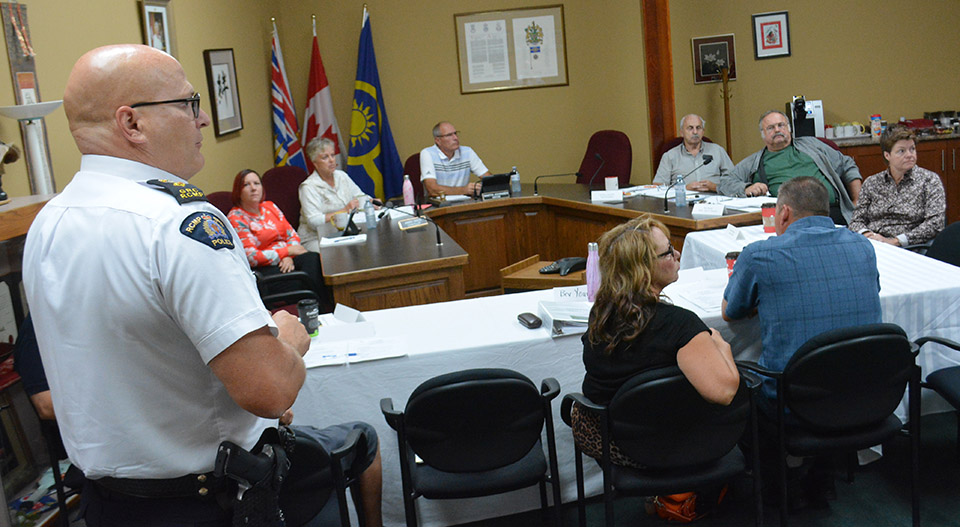
On Wednesday RCMP Superintendent Ted De Jager presented a report on the Penticton model of CAST and its successes.
CAST is a multi-agency approach designed to provide quick support for people suffering from mental health issues, poverty, addiction and homelessness.
De Jager said a federal bill (C-75) will amend the Criminal Code by impacting this new approach, acknowledging the over-representation of certain segments of the population being incarcerated.
The officer said police won’t be putting these people in jail anymore because their issues are social in nature, not criminal.
He noted that society expects police to deal with mental health problems and homelessness, but they are not equipped to do that.
“People may not agree with that, but what’s the alternative?” he asked.
De Jager said more than 60 per cent of police calls for service in the South Okanagan is non-criminal, leading him to add that communities don’t have a policing problem but a “marginalized people” problem.
He explained that on his way to the meeting in Oliver, he observed a woman wearing a pink shirt and dancing in the middle of the street.
This is one of the pressures that police are faced with, he pointed out.
“Some ask why aren’t police getting this sketchy looking person out of my neighbourhood?”
De Jager noted that at any one time at night in the South Okanagan, there is “maybe” eight police cars on the road.
“So the expectation that we’re going to be where the crime is happening at that particular time is completely false. It’s not achievable unless we have 30, 40, 50 cars on the road, which is not attainable.”
The officer said another pressure is a vocal, anti-vulnerable sentiment and intolerance; a mindset that must change.
“I don’t know what the solution is with somebody who has a brain injury standing in the middle of the street and yelling.”
Police will bring them to the hospital, but they will be released and end up back on the street, he pointed out.
Privacy is another big hurdle, he added. De Jager said If you want to see the ultimate in government bureaucracy, you’ll see people trying to help each other but don’t want to talk to each other because it’s confidential.
“That is absolute nonsense.”
But now there is legislation in place that allows the sharing of this information, he stated.
While it can take the police months to get a charge, and months for the case to reach trial, CAST can provide intervention within 24 to 48 hours, De Jager said.
“The whole principle is dealing with acutely-elevated risk. These people are going down the tubes quickly and we need to deal with it right now.”
It’s not about arresting people but making lives better, he stressed.
For example, a single mom with two young kids who can’t afford to feed them is caught shoplifting. Despite the crime that was committed, it is not a policing issue but a poverty issue, the officer said.
“We shouldn’t be putting her into the criminal system, we should be putting her into a support system.”
De Jager said it is expected that CAST will roll out to other communities by September of 2019.
He believes that many interventions will come down to housing. For example, the lady dancing in the street in Oliver would likely be served by supportive housing.
De Jager said one thing police struggle with in Penticton is a very strong and vocal group of incredibly intolerant people.
“I don’t like addictions. I don’t like people on the street doing drugs. I get it. I don’t think anyone does, including the person that’s sticking the needle in their arm, who would want nothing better than to get off it but simply can’t because fentanyl is such a monster.”
De Jager said these people have the exact same rights as everyone else. “We’re not loading them on the bus. We’re not sending them to Kelowna, we’re not sending them to Vancouver, we’re not sending them to Ontario. Canadian citizens have the right to live anywhere they want.”
The superintendent said CAST has dealt with 60 situations (people and families).
He noted that one case brought to the table by School District 67 literally changed the lives of three young girls, who were provided help through Social Services.
In another case, a homeless war veteran was walking around with no shoes on his feet, getting into drugs and being treated for post-traumatic stress disorder.
“It’s incredible the things that he experienced over there (in Afghanistan). And really, there’s that thread of society that considers him garbage. Look at him, he’s a drug user, he’s injecting himself on the street. He’s a hero is what he is.” Safety committee member Michael Guthrie agreed there is a time and place for CAST but wanted to know what is being done about the career criminals who continue to manipulate the court system to their advantage.
“How do we break them out of this and get them into something like a jail cell?”
He cited the case of one prolific offender in Penticton.
“This guy’s got a hundred convictions and you guys in Penticton let him out and two hours later you’re arresting him again (for stealing a car). What is he doing on the street?”
De Jager said CAST doesn’t deal with prolific offenders, only people at elevated risk.
He noted that police would agree with putting a person with 100 convictions in jail, but there should be supports in place to address whatever is causing this person to be a criminal.