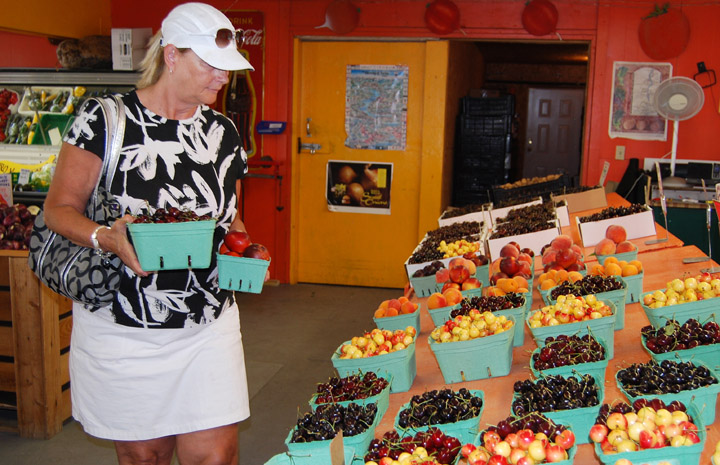
Edmonton’s Marilyn Sebzda checks out the cherries for sale at Osoyoos’s Fernandes Fruit Market. The price of cherries varies significantly from fruit stands to local grocery stores. Photo by Laurena Weninger - Click on picture for larger image
OSOYOOS TIMES-July 21, 2010
By Laurena Weninger – Osoyoos Times
“I think generally speaking, when they cheapen the product the overall feeling among some consumers is cherries are cheap,” said Greg Norton, chair of the Okanagan Kootenay Cherry Growers Association. “I really am uncomfortable when these supermarkets do that. It sets a tone that production is cheap.”
Norton is talking about the price of cherries at some of the local grocery stores and how those prices compare to local farm-gate cherry sales.
A tour of cherry outlets around the Osoyoos area shows a discrepancy in prices.
The best of the shiny, red, plump cherries at two local fruit stands – Fernandes Fruit Market and the Golden Mile Fruit Market – were going for $3 per pound on July 16.
Osoyoos’s Family Foods was selling local vans for $2.49 per pound – but they had just recently been on sale for $2.29.
On July 17, Buy Low Foods had bags of local cherries for only $1.48 per pound.
Norton said he can’t imagine how the stores have managed to set prices so low and still pay the farmer for the product.
“I really have to assume that is a loss leader,” he said.
A loss leader is a sales technique in which a store will sell something at a loss in order to get more people to shop at the location.
“That’s a ridiculously low price,” Norton said. “I can’t imagine them getting cherries so cheap they could make money at $1.48.”
But Trudy Harrison, a produce clerk at Osoyoos’s Family Foods, said they aren’t selling the cherries they have to offer at a loss.
“We still mark them up,” she said, pointing out the store’s cost for the fruit this year has been anywhere from $1.50 to $2 per pound.
This year, the supplier for the store’s cherries is a family related to one of the store’s employees – but Harrison doesn’t think that is a big factor in the pricing.
Last year, the store also paid anywhere from $1.50 to $2 per pound.
The store then marks up the fruit, anywhere from 25 to 35 per cent.
Daniel Bregg, president of Buy Low Foods, would not discuss the company’s pricing policies.
He said they try to be competitive in the marketplace and the price they set on the cherries would be based on the price they paid for those cherries – but he would not comment on how much they paid or whether the fruit is being sold at a loss.
Norton said the fruit stands’ prices are more in line.
“The $3 at the fruit stands reflects the cost of production and allows the producer to make a living.”
Plus, cherry prices are strong this year due to lower production, both in the Okanagan Valley and the U.S.
“Washington is less than half,” he said, pointing at last year when Washington state cherries flooded the market, making Okanagan cherries harder to sell.
But even though prices are good, it’s still a tough year for local growers.
“When you get less than half a crop, the prices never make up for it,” he said.
The biggest challenges this year are mostly weather-related.
A cold snap last October started off a season of weird weather.
A mild winter, spring frost – and not much heat yet this summer.
“We’ve still only had six or seven days of real heat. That’s incredibly unusual,” Norton said.
He said these conditions have added up to cause the most challenging year he has ever had as a grower.