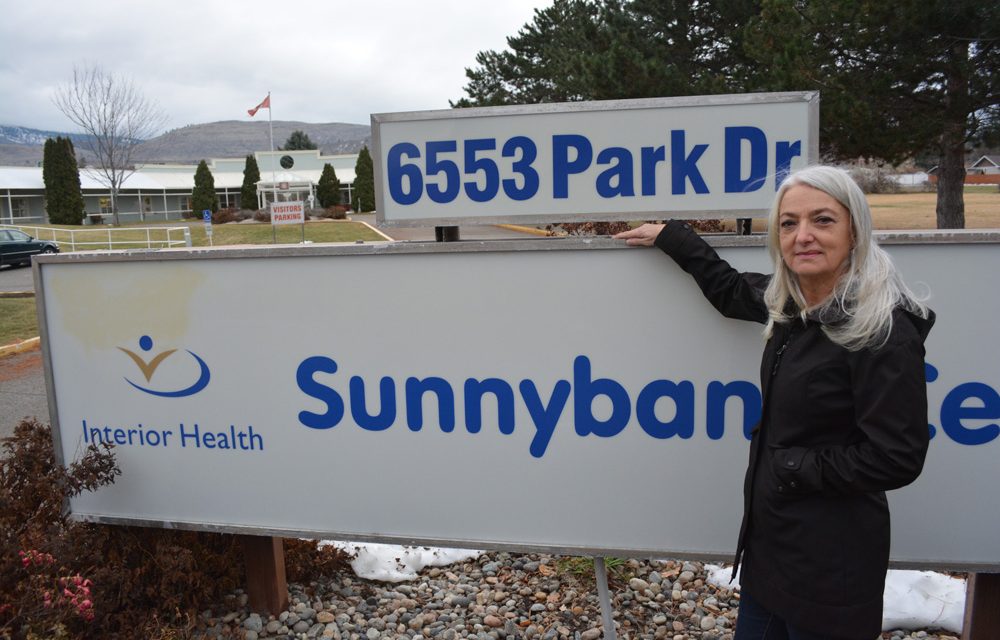
 Operational changes at Sunnybank Centre in Oliver are causing concern among some volunteers and a family member of a former resident.
The perception is there is not enough staff to adequately care for the residents, changes are made without consultation, dementia patients are wandering around “lost,” and the front (coded) gate has been left open several times.
But Interior Health maintains it is meeting best practice standards at Sunnybank and is planning to increase nursing hours and add a new care coordinator position.
Sunnybank volunteer Nan Hendrie would welcome all of this, but is not convinced that the facility is changing for the better.
“There’s not enough staff . . . there’s no tender loving care anymore,” she said, noting there are only two licenced practical nurses (LPNs) at night looking after 51 beds.
Hendrie said if a problem occurs in one of the wings and the two LPNs are dealing with it, that leaves the other residents with no care.
Another volunteer, who did not want to be identified, said Sunnybank used to be a “home” where the residents were treated like individuals, not clients or numbers.
But since Interior Health took over, Sunnybank has turned into an institution with the proverbial staff cutbacks, the volunteer stated.
She noted the following other concerns:
Wing 4 (formerly the “Poppy Wing”) is no longer a secure wing, with patients wandering around and getting lost in the facility. This creates liability if residents manage to follow someone outside through the front gates.
The volunteer said she observed the front gates left wide open on two occasions recently.
“Staff can’t watch it. If visitors leave it open, residents who shouldn’t leave will leave, even in the cold.”
Cindy Reiger, Interior Health services administrator for the South Okanagan, said sometimes the gate is inadvertently left open by visitors.
“Every attempt is made to ensure that the gate is kept closed, including signage reminding visitors not to leave it open for the safety of residents.”
Reiger noted that staff take the safety and well-being of clients seriously and have strategies in place to monitor residents, respond to their individual care needs, and minimize the risk to their personal safety.
Reiger pointed out that Sunnybank is not intended to keep residents confined.
She explained that many in the Poppy Wing are living with varying stages of dementia.
“Best practice standards for those with dementia include an environment where they can move around freely. These residents respond well to an environment where they explore other areas of their home and participate in activities going on throughout Sunnybank Care Centre.”
Reiger said skilled staff are available to respond to the care needs of all residents and are able to assist when someone needs help finding their way back to their rooms. She added that other residents may request staff assistance if they feel a resident is lost or needs assistance.
Regarding the perceived lack of staffing, Reiger said Sunnybank has not had any reductions in staff over the past year.
“In fact, we are planning to increase our nursing complement as well as add a new care coordinator position.”
Reiger noted that LPN hours will be increased and they will adjust RN (registered nurse) support to allow more flexibility in responding to resident needs. This will improve staff-to-resident ratios, according to Reiger.
In addition to staffing changes, Interior Health is planning on some adjustments to how the beds are used at Sunnybank, she pointed out.
Reiger said they plan on transitioning 13 beds in the Poppy Wing to “short stay” care (convalescent, respite and end-of-life care).
The remaining 38 permanent beds at Sunnybank are designated for a mix of complex care clients, Reiger said.
The health services administrator said consultation with staff and volunteers has been ongoing, noting that Sunnybank leadership meet with staff on a regular basis to engage them in client care planning.
“The families of residents in the Poppy Wing have been provided with written information about planned changes, and the manager has met with families in person to respond to any questions.”
Reiger said each staff member is providing the best possible care to the residents, and there are processes in place to ensure this is happening.
But Beverley Nichols from Surrey isn’t so sure after what happened to her aunt recently.
Eileen Walt, age 90, was diagnosed as terminal with two brain tumors and lung, liver and bone cancer.
She spent the first month in South Okanagan General Hospital in a room with four beds.
“This very quickly became a nightmare for a dying woman who should have been in palliative care. However, there were no beds available.”
Nichols said the staff were amazing even though their working conditions were far from ideal.
On November 26 Walt was moved to Sunnybank because they were able to turn respite room into a palliative care room. After two days her condition deteriorated, and she requested morphine to ease her pain, which was becoming unbearable.
Nichols said the doctor ordered that the morphine be administered every one to two hours. This was initially followed by the nurses, but after a while, the frequency of the morphine was cut back to every three to five hours, according to Nichols. This caused extreme fluctuations in Walt’s comfort level.
Nichols asked the staff what was going on.
“I was told that the administrator had told the staff that it was a ‘moral’ issue and they can lose their licence to practice.”
Nichols said she was told that if her aunt started grimacing in pain or shouted out, that she just had to ring the bell and staff would give her morphine.
“Are you kidding me?! said Nichols, who informed the staff that they were obligated to follow the doctor’s orders, not the administrator’s.
Walt had a legal document that stated she wanted medication mercifully administered to her to alleviate suffering even though it may hasten her death.
Nichols said staff began administering the proper dosage and things immediately changed; her aunt started to feel more comfortable.
“I wonder what would have happened to my aunt if I had not been there 24/7 to advocate for her . . . I shudder to think.”
Reiger said she couldn’t comment on Walt’s care due to provincial privacy laws. But she noted if anyone has concerns about the care of a loved one at Sunnybank, he or she can file an official complaint, or talk directly to the centre’s manager.
Complaints can be directed to 1-877-442-2001 or by email to [email protected]
Nichols said she spent a lot of time at Sunnybank and noticed the low staff-to-patient ratio. She said only one RN was on duty from 7 am to 7 pm. She also saw five care aides and one LPN on shift from 7 pm to 7 am.
Nichols said she was informed that Interior Health is cutting more staff in January; eliminating the RN position, leaving only one LPN to look after 51 beds.
“I am appalled and saddened by not just what is happening at Sunnybank but what is taking place at care facilities all over BC.”
Nichols said people have to start saying no to these drastic measures that the government and Interior Health is trying to implement.
“They don’t tell us what they are planning until after it’s too late. The baby boomers and older are in serious trouble if something isn’t done.”
Mary Unger, a former administrator at Sunnybank, acknowledged there has been a lot of discontent at the facility. But she said everyone must keep in mind that the sole reason for being there is to meet the needs of residents.