By Don Urquhart, Times Chronicle
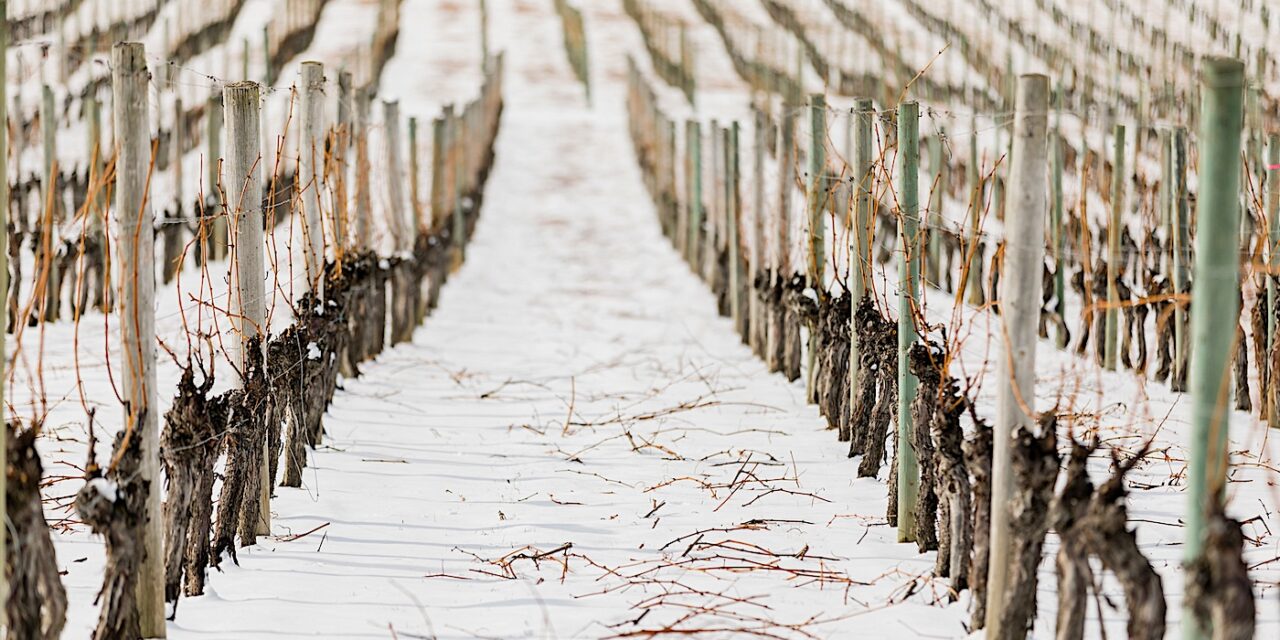
January’s polar vortex which sent temperatures plunging well below -20°C throughout the Okanagan Valley has devastated grapevines with estimates of 97-99 per cent crop loss across BC’s wine industry.
Facing an “almost complete write-off” of the 2024 vintage the BC industry – vineyards, wineries and suppliers – are facing revenue losses of $440-445 million, according to a new report by Cascadia Partners for Wines of British Columbia.
The devastating extreme cold event occurred between January 11-15, 2024 and eclipses the BC-wide drop in grape and wine production of up to 58 per cent last year as a result of the December 2022 cold event.
That particular event was not as cold nor anywhere as long as the extended cold snap last month. In the North Okanagan the more than -20°C temperatures lasted overt 50 cumulative hours.
This temperature is a key risk factor for grapevines, a situation exacerbated by the relatively mild winter temperatures in December and early January that directly preceded the cold snap.
Immediately following the cold snap, industry experts collected and tested thousands of bud dissection samples from across the industry.
These samples provide a snapshot of the health of grapevines across the province including 32 grape varieties from nine provincial wine regions.
“Unfortunately, the results confirmed the industry’s worst fears, with the vast majority of samples showing no signs of life in their primary or secondary buds.” It added that due to the extent of damage, typical pruning practices would be ineffective.
“Due to the extent of damage to primary and secondary buds observed across a wide range of regions and grape varieties, the January 2024 cold event is anticipated to result in catastrophic crop losses within the BC wine industry,” the report’s authors state.
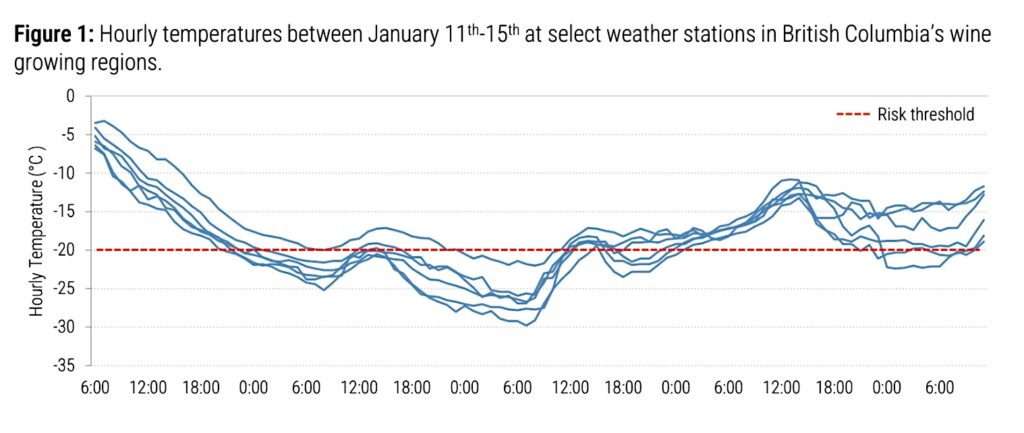
Hourly temperatures between Jan. 11-15 at select weather stations. Cascadia Partners graphic
Describing it as an “enormous challenge” for the BC wine industry “in 2024 and beyond,” the preliminary industry-wide estimates cited in the report indicate the crop will produce just 1-3 per cent of typical yields.
The majority of this will come from unaffected regions such as the Fraser Valley and Vancouver Island, it noted.
The report also warns that BC wineries will struggle to keep 100 per cent BC wine stocked on retail shelves, to supply hospitality channels, and to fulfil wine club subscriptions.
Of the economic impact vineyards and wineries face revenue losses of $340-346 million and this decrease in production will have knock-on effects elsewhere in the supply chain, with a further $97-99 million in anticipated revenue losses for industry suppliers, logistics providers, and distributors, according to Cascadia Partners.
“Longer term impacts on grapevine health – including the need to replant – are also anticipated but cannot be precisely estimated until later in the year,” the report says.
These impacts will amplify the revenue losses as well as require significant capital outlay from vineyards and wineries to replant vines.
Representatives from Wine Growers BC, BC Wine Grape Council and the BC Grapegrowers’ Association met with Minister Pam Alexis, Ministry of Agriculture and Food, Minister Lana Popham Minister of Tourism, Arts, Culture and Sport and senior staff and were briefed on the report according to Wines of British Columbia.
There was also an opportunity to briefly update Premier David Eby on the status of the industry, the industry association added.