By Dan Walton
Many teenagers rely on a strong performance in high school to embark upon the first step in their careers, but 17-year-old Ryan Encina from Oliver is pursuing his greatest ambitions through the 232 Bighorn Squadron Air Cadets program.
Encina will be graduating from Southern Okanagan Secondary School at the end of the month. But instead of applying to a typical college or university, he’ll be spending the next year-and-a-half leading his squadron as Warrant Officer 1st Class (W01) – the highest rank achievable through the cadet program. An extremely small number of cadets ever reach W01, and oftentimes, the rank is only awarded symbolically in the final days of a cadet’s tenure.
“As a younger cadet, I was never expecting to get this high or far in the program,” he said.
When he first began cadets at the age of 12, Encina followed procedures and kept out of trouble, but he didn’t fully understand the importance behind every routine. Then as he became more familiar, “I started to appreciate smaller meanings behind everything.”
For example, keeping a pair of boots well polished at all times can seem trivial, but “If you’re incapable of keeping your boots shiny, then how can you be trusted to run a squadron properly?”
Polishing a pair of boots properly, he said, is a tedious task.
“To be completely honest I haven’t even completely mastered polishing myself,” he said. “You put on a base coat, then slowly as it gets gritty, you add more water and polish and it makes it smoother and smoother until it reflects right back at you. It’s actually not the polish that shines, it’s the water sealed in the boots that shines.”
There are a few shortcuts to shining those boots, but a good W01 lets the younger cadets figure that out on their own. And while cadets can get tips and feedback from their superiors, they’re expected to put their full uniform on without help from anybody else.
And now Encina is a senior cadet, he finds himself enforcing the dress code, helping the juniors look their sharpest when they suit up.
Encina ensures the local squadron is disciplined and punctual, and he’s effective without being overzealous. When he was a junior, he remembers finding greater appreciation in cadets thanks to the warrant officer of the day.
“I loved him. He was better than me,” he said. “I looked up at him, and in becoming a W01, I picked out the qualities of him that I really liked.”
He admires the sense of professionalism, and how the program advances cadets to greater ranks when the time is right. As he continues to progress through the program, the adult officers still follow procedures he has to learn more about, but when he looks down the ranks at the junior cadets, he completely understands the procedures, even though he was a little confused about them when he was younger.
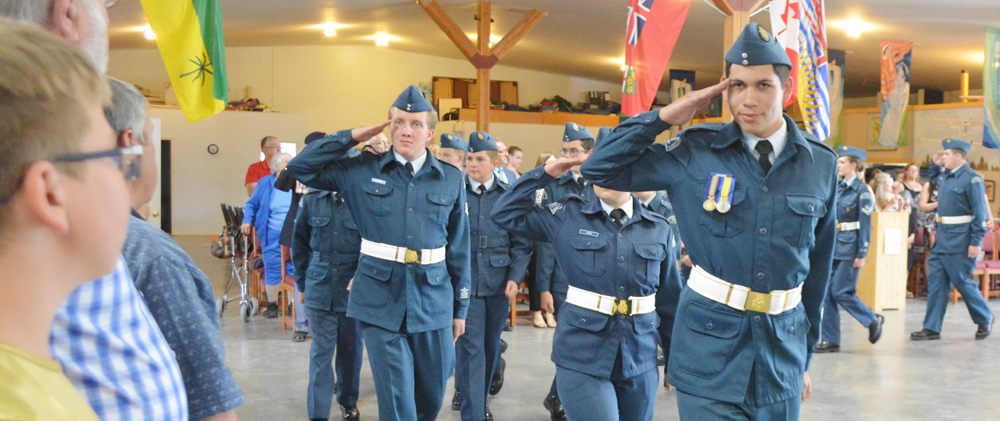
Encina was promoted to W01 on May 28 at the annual cadet review, and he plans to hold onto that position as long as he can, which is when he turns 19 near the end of 2018. Until then, he’ll rule the roost among his peers.
“There’s such a vast amount of opportunities within the program,” he said, having embarked upon a path in aerospace and flight. “There are so many different things you can take out of it that it’s kind of like choose-your-own-adventure.”
One of the endeavours undertaken by Encina was a space cadet camp in Ontario, where he spent six weeks training like an astronaut.
“It covers everything that has to do with aerospace, from ground control to a space walk simulation and repair something on the space station – I even got to control a simulated Canadarm.”
Some of the training exercises were done underwater in scuba gear to mimic the effects of low gravity. “They had us build computers and solve puzzles underwater – it was one of the strongest leadership training things I’ve ever done.”
While Encina was learning the ins and outs of rocket science, his cadet counterparts were becoming pros in different fields. Each member of the squadron chooses the cadet camps that appeal most to them, and after gaining a comfortable understanding on the subject, they return to Oliver and share their new knowledge with their peers.
“Then you’re qualified to teach that program to your squadron,” he said. “There’s something there for everyone, no one’s left out.”
Four years ago, Encina took a course in basic aviation and aerospace. Recently, he returned to that same facility to be the instructor of that course. “It gave me a whole new perspective.”
The programs branch out into vastly different directions, such as health fitness and first aid. But whatever each cadet is specializing in, everything in the program is tied together through leadership.
Encina’s experience with cadets is very likely to come in handy once he enrols at the Royal Military College of Canada.
He had considered applying there this year, but he wants to see a smooth transition of power after he leaves the local cadets, and he also wants to spend more time with his family, so decided instead to wait until 2018.
The Royal Military College is located in Kingston, Ontario. He hopes to study as either a pilot or aerospace engineer, “Wherever they need me from there – that’s the expectation I’ve set for myself.”
In some respects, Encina hopes to jump right in to the military, earn a five-year degree and then pay for it through military service.
“Then after that I want to continue working for the army until I get a full pension so I can step back and retire from the military at a really young age.”
But while that path would ensure a promising career, he is a little apprehensive about spending his entire youth under the confines of strict army environments.
Encina’s experience through the cadets technically doesn’t give him any special treatment as an applicant of the Royal Military College, but the training is quite similar, so he isn’t worried about any unexpected challenges or rapid changes that the next level of military service may pose.
“I just want to have that exhilarating feeling of just flying.”