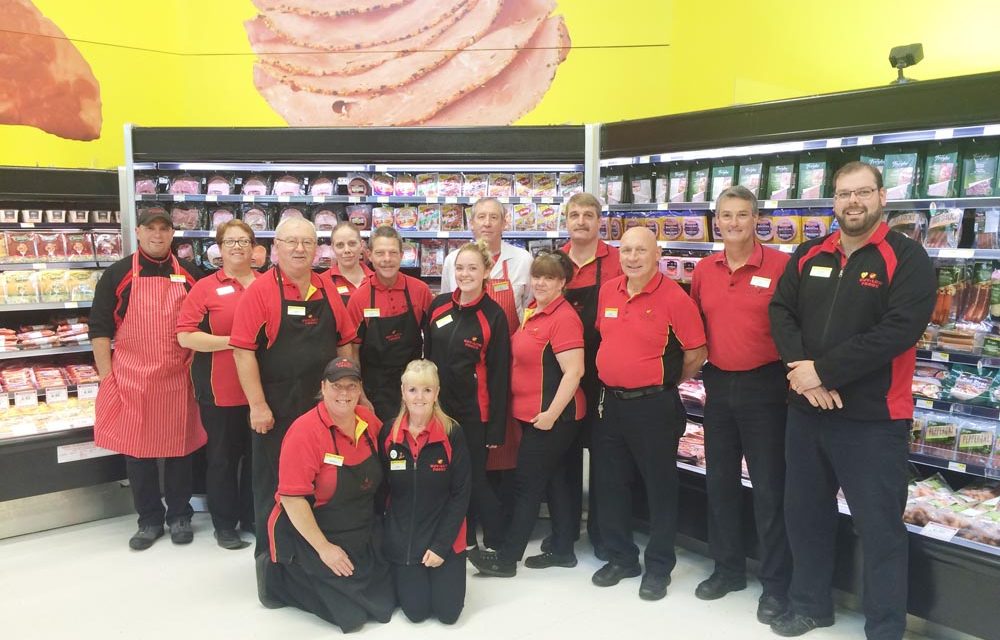

Buy-Low Foods’ staff is the strongest asset in the store. And because the company is smaller with more control, it has the autonomy to support many local organizations and causes in each community.
Photo contributed
Sometimes being a smaller company in a sea of big ones gives you the autonomy to provide more support in the community.
“We try not to say no to anyone,” said Tyler Gludovatz, manager of Buy-Low Foods in Oliver.
Although trying to make everyone happy is a tall order (some say it can’t be done), Gludovatz appears to be scoring high in this endeavour.
While he’s busy catering to customers’ wants, he has to keep his people happy and juggle the needs and requests of the community. And that’s only the start of his responsibilities of running the store in Southwinds Crossing Shopping Centre.
Gludovatz concedes that the most challenging but rewarding part of his job is the interaction with customers and his most valuable asset – his staff.
“I need to keep them happy and engaged . . . I try to keep everyone happy.”
Gludovatz, who graduated from Oliver’s high school, makes it a point to hire many students, up to 60 per cent of the employment pool.
“We try to mold these kids. This (for many) is their first experience, so we want to make it positive.”
Another philosophy that Buy-Low adheres to is supporting the community as much as possible by way of donations and fundraising. The list of causes it supports is a long one and includes Multiple Sclerosis and Variety, the children’s charity, which Buy-Low supports through the annual Show of Hearts Telethon, and other events and programs.
Locally, Buy-Low sponsors the Oliver Sunshine Festival, Festival of the Grape, and the Osoyoos Coyotes hockey team.
But it doesn’t stop there.
Last summer the company donated more than two skids of water to local firefighters during the wildfires in Oliver. And $1,000 worth of beef jerky, Gludovatz said.
“That’s our way of giving back,” he stated.
“That’s our philosophy. We’re not the biggest corporation, but we live in the community and support the little guy. They (the company) let us have that autonomy.”
Gludovatz said one of the things he values is the store’s ability to buy fruits and vegetables from local farmers, which saves customers money. Buy-Low has about a dozen farmers it does business with in the purchase of cucumbers, tomatoes and apples, for example.
It also works with the local food bank in donating various items that may be damaged or past expiry. For example, a lot of day-old bread goes to the food bank, Gludovatz said.
A bit of trivia: What’s the number one produce item at Buy-Low? People might think bananas, but it’s avocado, Gludovatz pointed out.
The manager noted that buying habits have changed significantly over the past 10 years. Case in point: gluten-free and natural products are the trend now.
“Ten years ago the selection was minimal. But now it’s a huge trend in North America,” Gludovatz said. “Buy-Low is trying to cater to this. It’s trying to give more healthy options and less of the pre-packaged, high sodium products (that are not selling like they used to).”
Ten years ago it was common to bring in a pallet of Chef Boyardee, but not anymore, Gludovatz said.
The manager also said he has noticed more customers reading product labels to determine what ingredients they are buying.
As a point of interest, Buy-Low Foods no longer sells seafood classified as “red-listed” or unsustainable. In fact, it is the first major grocer in North America to achieve its commitment to SeaChoice by selling “sustainable and eco-friendly” fish products.
We would talk more about Buy-Low’s in-house sausage works and marinated ribs and chicken breast, but that would make us too hungry.