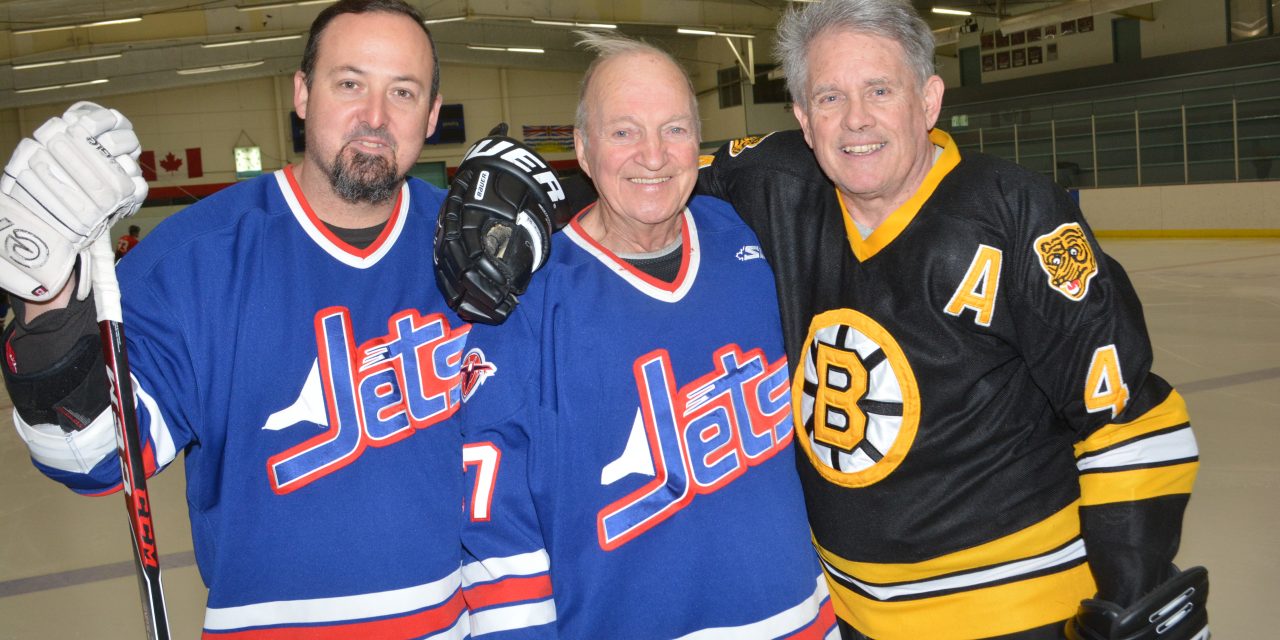
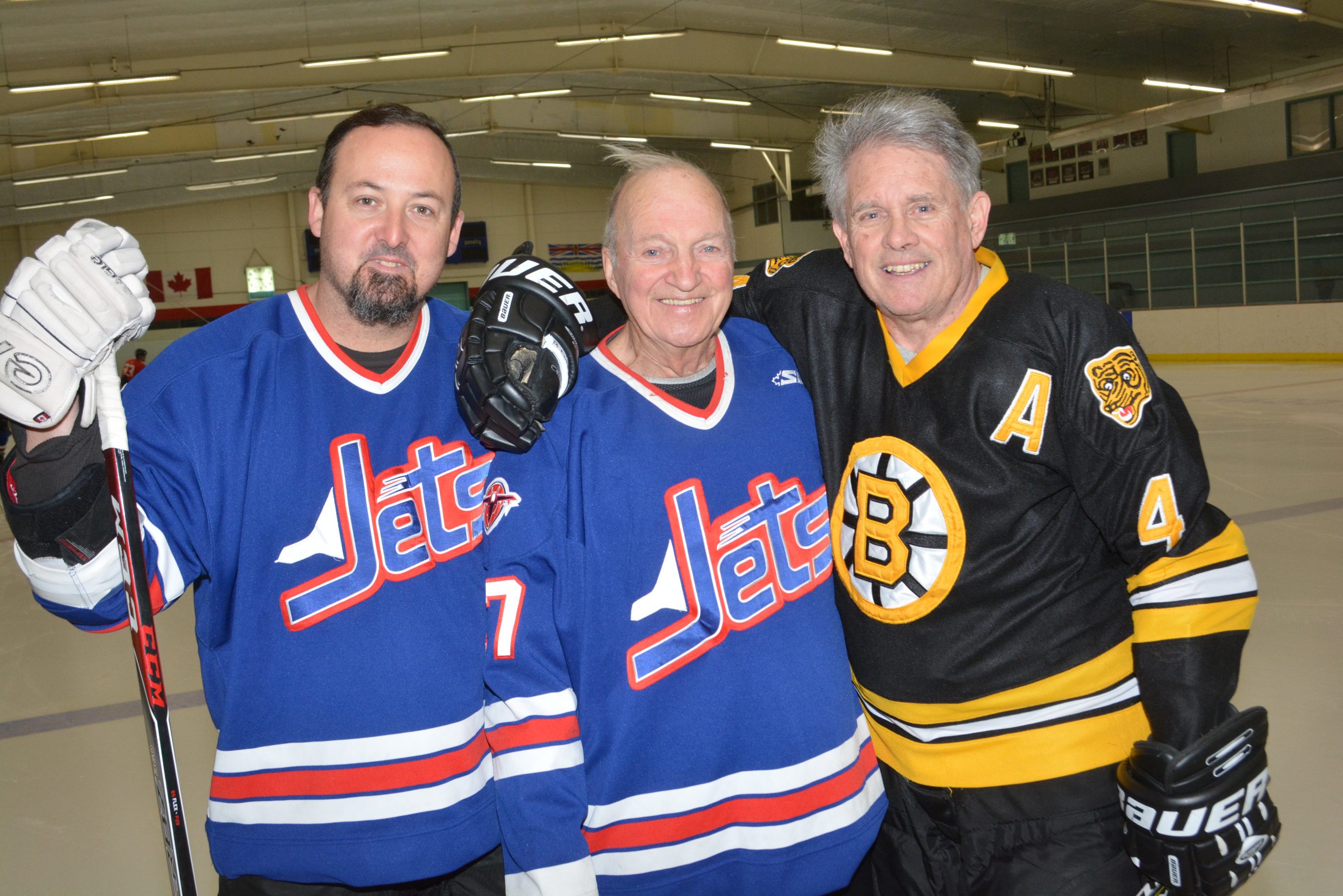
Harold Cox is flanked by Jeff Crowley (left) and Bryan Coles who saved Cox’s life five years ago when his heart stopped during a recreational hockey game in Oliver. At 79, Cox is still playing hockey and enjoying life. (Lyonel Doherty photo)
By Lyonel Doherty
Aberdeen Publishing
What does it feel like to die and come back to life?
Harold Cox from Osoyoos would love to tell you, but he can only count his blessings five years after his heart stopped beating while playing hockey in the Oliver arena.
“The way I look at it is . . . I’ve got extra days, 1,825 days (to be exact),” he said while suiting up for yet another game with the boys.
“I would have missed a whole pile of things. I would have missed 62 extra hockey games. I would have missed my grandkids growing up. I would have missed visiting another seven countries.”
The 79-year-old has five men to thank for allowing him to see many extra sunrises. Those men are Jeff Crowley, Bryan Coles, Marty Whiteman, Doug Hume and Steve Arstad. They were the ones who brought Cox back to life with CPR and an automated external defibrillator (AED).
In talking to fellow player Al Brandt, Coles will never forget the moment that Cox hit the ice.
“Do you know what happened first, Al? He was skating towards the bench to replace you when his eyes went first. Harold’s eyes . . . his eyes went blank.”
Brandt, from Osoyoos, recalled that Cox had just put his stick up to indicate he was coming off the ice when he suddenly went down.
“He went flat down on his face, so I went down and got on my knees. He was already grey. One guy, Doug Hume, started pumping on his chest, and another guy started giving him mouth-to-mouth.”
The arena had recently purchased an AED, which Crowley quickly hunted down because time was of the essence.
“I play hockey down in Osoyoos, and we had a little bit of training on that thing about a week before,” Crowley said.
He recalled the AED was initially locked in an office, but now it’s out in the foyer for easy access and staff are all versed on how to use it. (In fact, anyone can use an AED successfully without training because the machine talks you through the steps.)
Crowley admitted there was stress and panic during the moment, but everyone rallied together and did their part to make it work.
“I mean, I don’t take credit for it. I don’t think any of us do. If I was by myself or Bryan was by himself, or somebody else, maybe I wouldn’t be drinking his (Cox’s) beer today.”
• Read more: Coyotes’ Bryson Rody recovering from ‘predatory hit’
In any event, the incident prompted a lot of change in the community by bringing awareness to the AED, Crowley said. Now, more facilities have this tool, and more people are trained on how to use it. The machine is operated by attaching two electrodes to the patient’s chest and shocking the heart back into a rhythm.
Reflecting on Cox’s ordeal and the fifth anniversary of his near death, Crowley couldn’t help but offer this: “Well, I just think he hasn’t changed his attitude; it’s still bad,” he laughed.
“No, he’s just a good guy, a good community member, good father and good husband . . . just an all around super good guy and I was happy to be part of that day.”
Crowley said he isn’t surprised at the least that Cox is still around.
“No, no, no. Harold is one of those guys that I think will be here until he can’t.”
Coles said he wasn’t aware of how well known Cox was in Oliver.
“What we found out,” Crowley interjected, “was that Harold used to be an old Chippendales dancer.”
“He is so well respected in Oliver,” Coles continued.” It was like, holy mackerel . . . the connections!”
In retrospect, Coles said something “phenomenal” occurred that day after Cox went down.
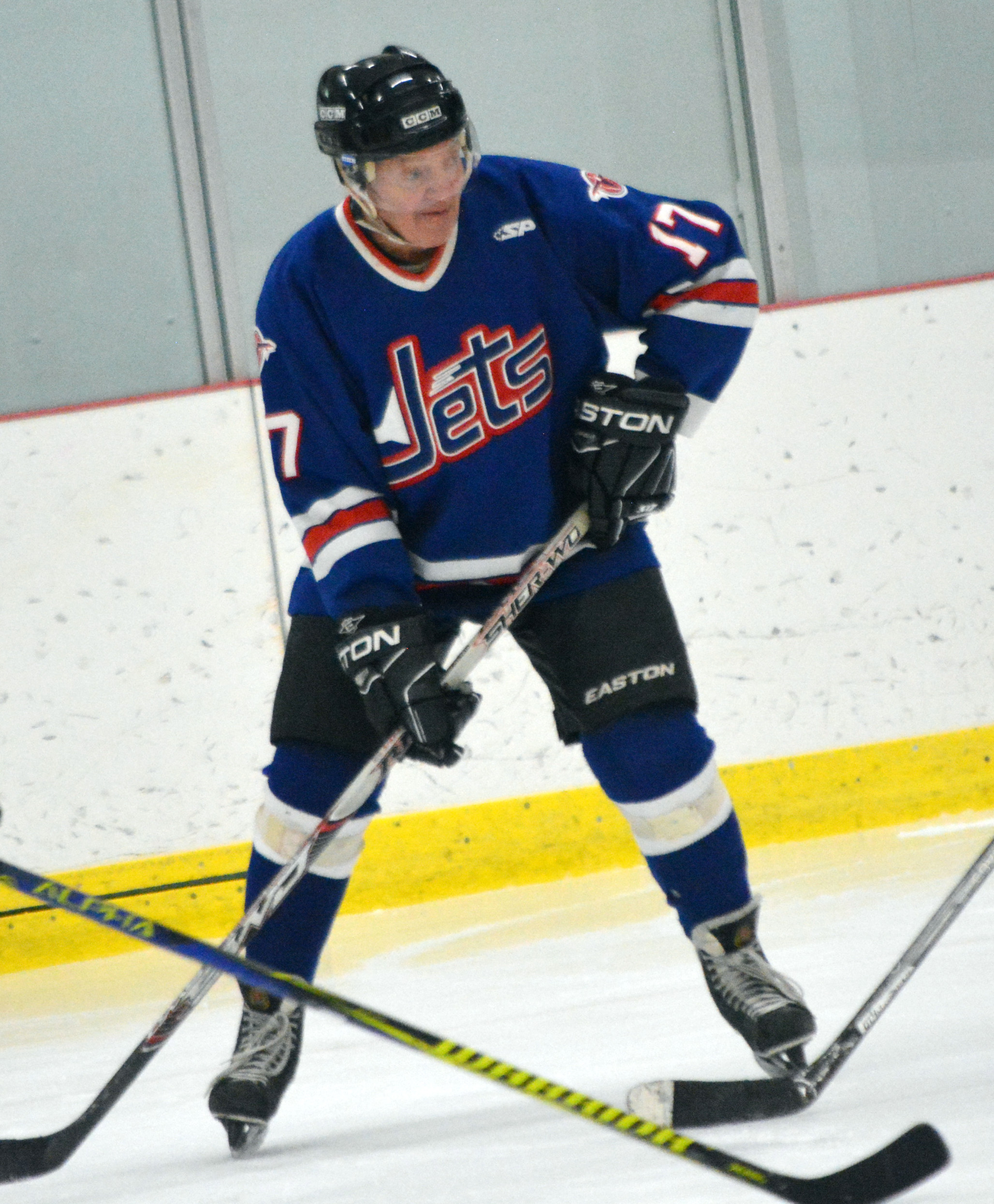
Five years ago, Harold Cox’s heart stopped during a recreational hockey game in Oliver. Today, he still loves playing the sport. (Lyonel Doherty photo)
“How did this all happen? Apparently the odds of recovery are not real high. How did we luck out?”
Crowley likened it to winning the lottery.
He recalled the sheer emotion of it all, admitting that he sobbed about it in the dressing room afterwards.
Cox is still fearful for his health whenever he steps onto the ice.
“Yes, I worry about it every time I go out . . . but it’s not going to stop me in life and enjoying things.”
Cox said there were a lot of miracles that day, referring to the arena having a new AED and the ice attendant being present, along with Hume who knew CPR.
“In total, as far as I can gather, I was gone (dead) for eight minutes.”
Cox said his doctor told him the chances of resuscitation via a defibrillator outside of hospital are very slim.
“Luckily these guys (my buddies) looked after me.”
Today, Cox tries to remain as active as possible and enjoys every day a little more.
“I appreciate things a lot more than I ever did before, and I’ve got a reason to.”