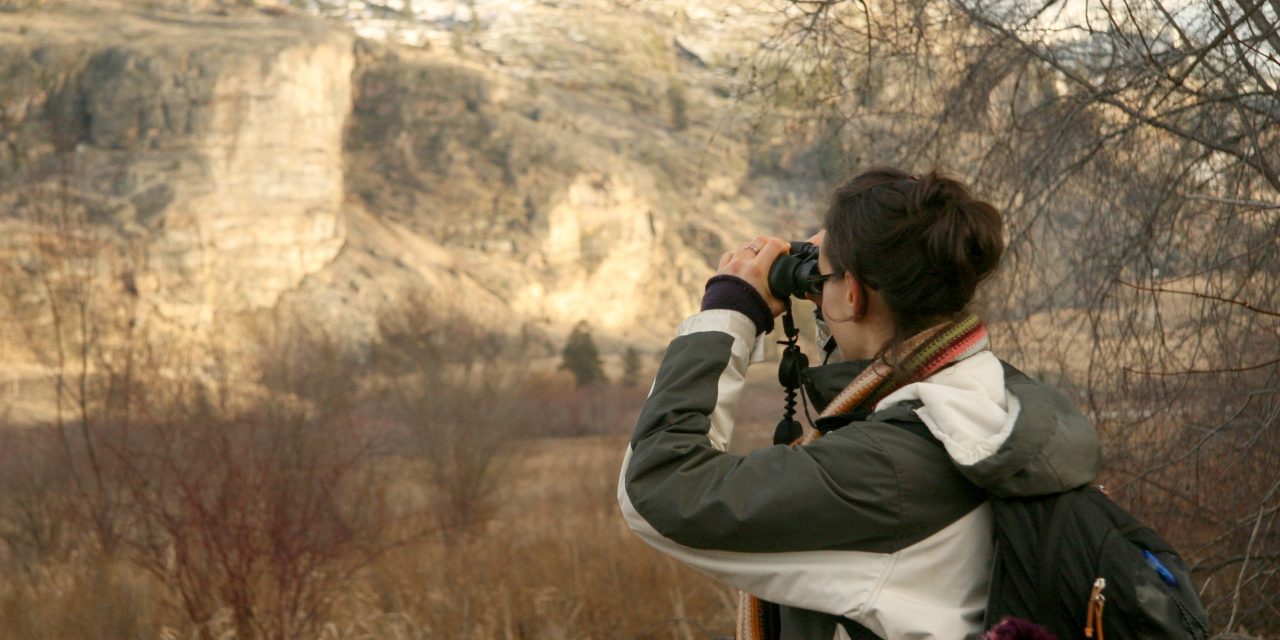
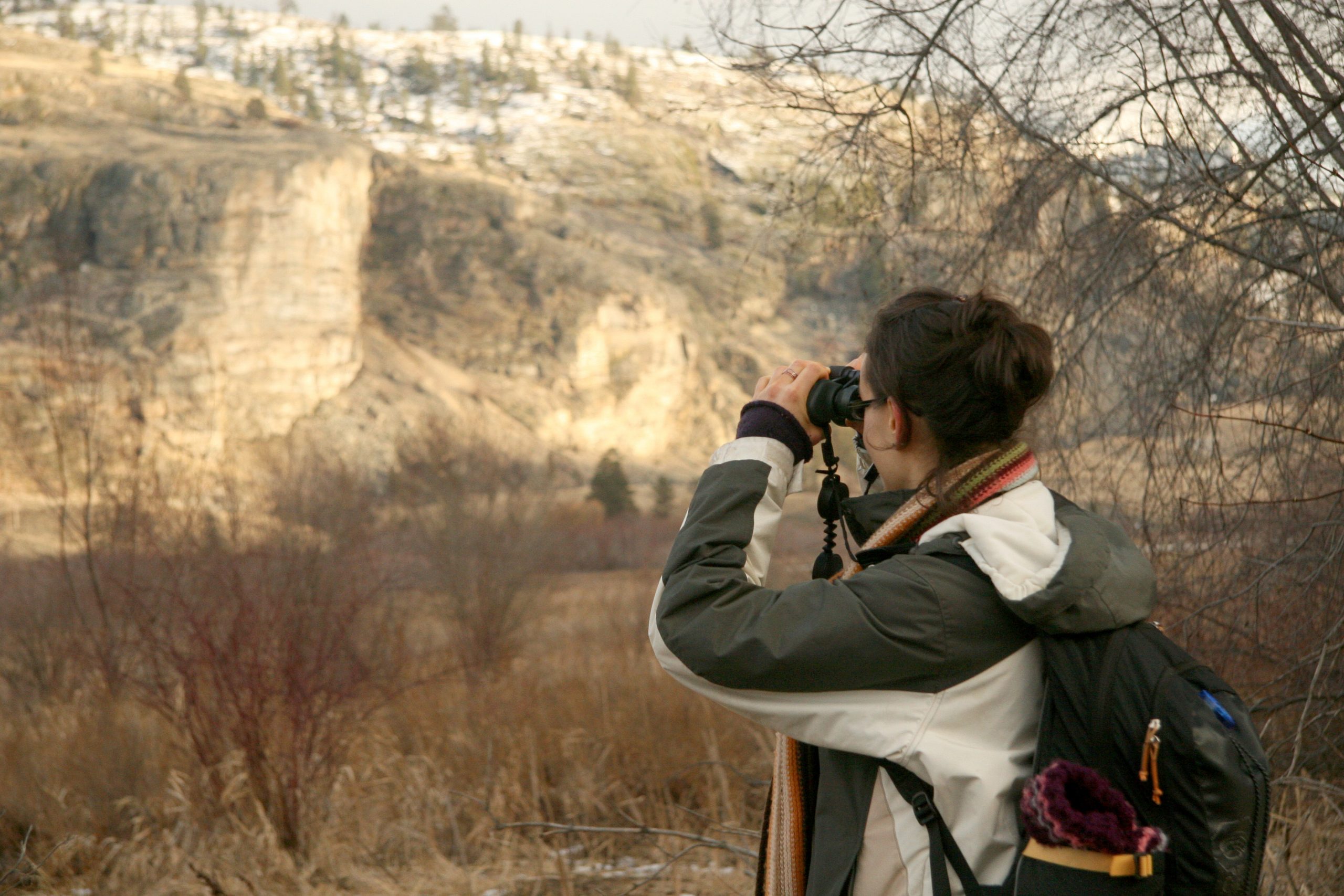
Jennifer Smith looks through binoculars for birds near Vaseux Lake during a previous Christmas Bird Count. The count is done by volunteer bird enthusiasts. (Dick Cannings file photo)
More bird species and total birds were recorded in this year’s Oliver-Osoyoos Christmas Bird Count than last year’s, but numbers are still low compared to the past decade.
Roughly 21,200 individual birds from 110 species were counted by 39 volunteers on Dec. 27, said count organizer Doug Brown.
The number of volunteers – 36 in the field and three watching their feeders – was the same as last year, though some of the people changed, said Brown.
This was the 36th year for the annual bird census in the Oliver-Osoyoos area.
While this year’s count was higher than the 36-year average, Brown said the average is skewed by low counts in early years when there were few volunteers.
Last year, only 18,970 total birds were counted from 102 species and last year was the lowest count since 2002.
Brown attributes the low count this year to low numbers of local breeding birds such as house finches, house sparrows and chickadees of all kinds.
The mild fall meant there were larger numbers of some other species such as ruby-crowned kinglets and yellow-rumped warblers, Brown said.
“Those we get very few of normally and not every year,” said Brown. “We had seven ruby-crowned kinglets this year, which was near the record, and we had 13 yellow-rumped warblers, which was a record. Actually, a couple days before the count I had a flock of 22, which is just unheard of in winter.”
Besides being a poor breeding season for some birds, weather also was a factor, both in increasing and decreasing numbers for different species.
Dabbling ducks like mallards were down because some of the sloughs aren’t frozen. Diving ducks though were up considerably because Osoyoos Lake is totally open, Brown said.
As usual, Oliver-Osoyoos had a higher count of species than other parts of the B.C. Interior.
“We were hoping to beat the Kelowna and Penticton counts,” said Brown. “They got 98 species, so we slaughtered them. It’s funny, some of the birds that we had lower numbers of, Penticton got big numbers of.”
Though not a highly regarded bird, the starlings chose to spend Christmas in Penticton instead of Osoyoos.
“They had thousands and thousands of them,” said Brown. “We had lower numbers of flickers and apparently Penticton just missed their all-time record. So some of it was just a local distribution thing, probably again because of weather factors.”
There were also some unusual birds spotted.
A snow goose was seen for only the fifth time in the 36 years of the local count. A long-tailed duck was seen for only the second time, which is very rare for the interior, Brown said.
“We had peregrine falcons, which was the first ever for the counts,” said Brown. “They have increased in recent years as a breed in the Okanagan and they’ve gradually started staying the winter. At first they were only here in the summer and now they’re staying in the winter.”
In addition to the Dec. 27 date for the local count, volunteers monitor the three days before and after for any additional species that aren’t recorded on that date. This year a cinnamon teal and a ruddy duck were spotted – both unusual for winter, Brown said.
Locally the Oliver-Osoyoos Naturalist Club sponsors the count and organized a post-count gathering.
Counts are held across North America and elsewhere on different dates between Dec. 14 and Jan. 5.
This was the 115th year of the count in North America. The annual Christmas tradition of counting birds was established as an attempt to replace the earlier tradition of the “side hunt” in which teams competed to kill the most birds and small animals.
Today the count helps to monitor environmental threats to habitat including the impact of climate change.
RICHARD McGUIRE
Osoyoos Times