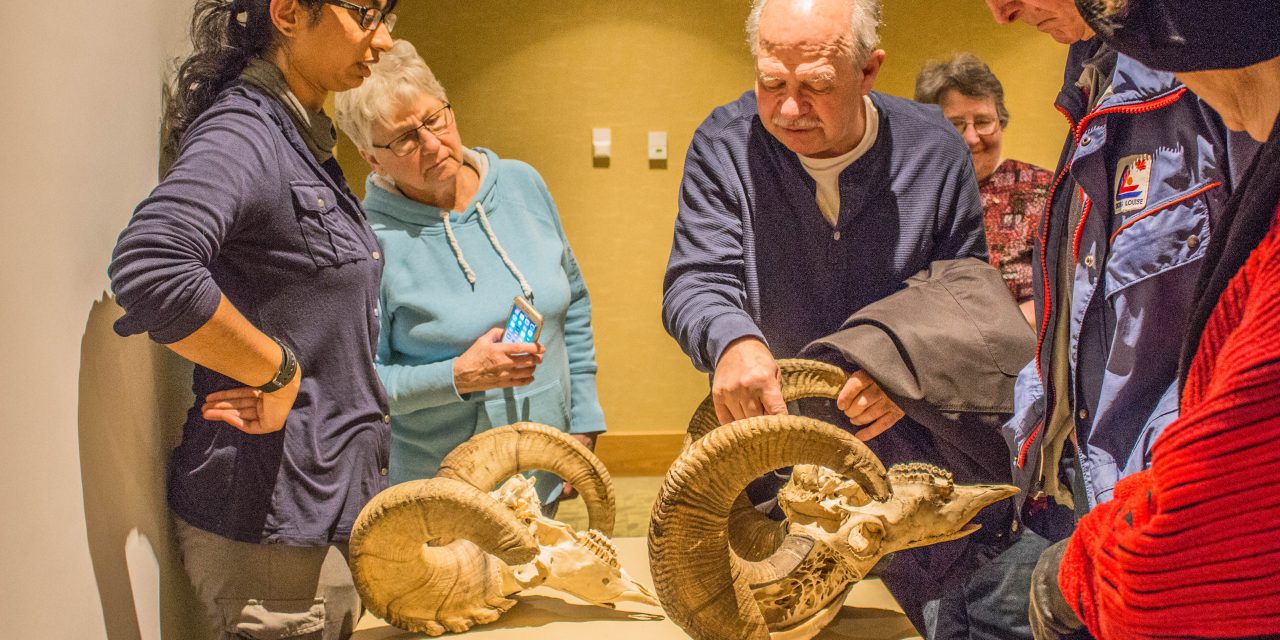
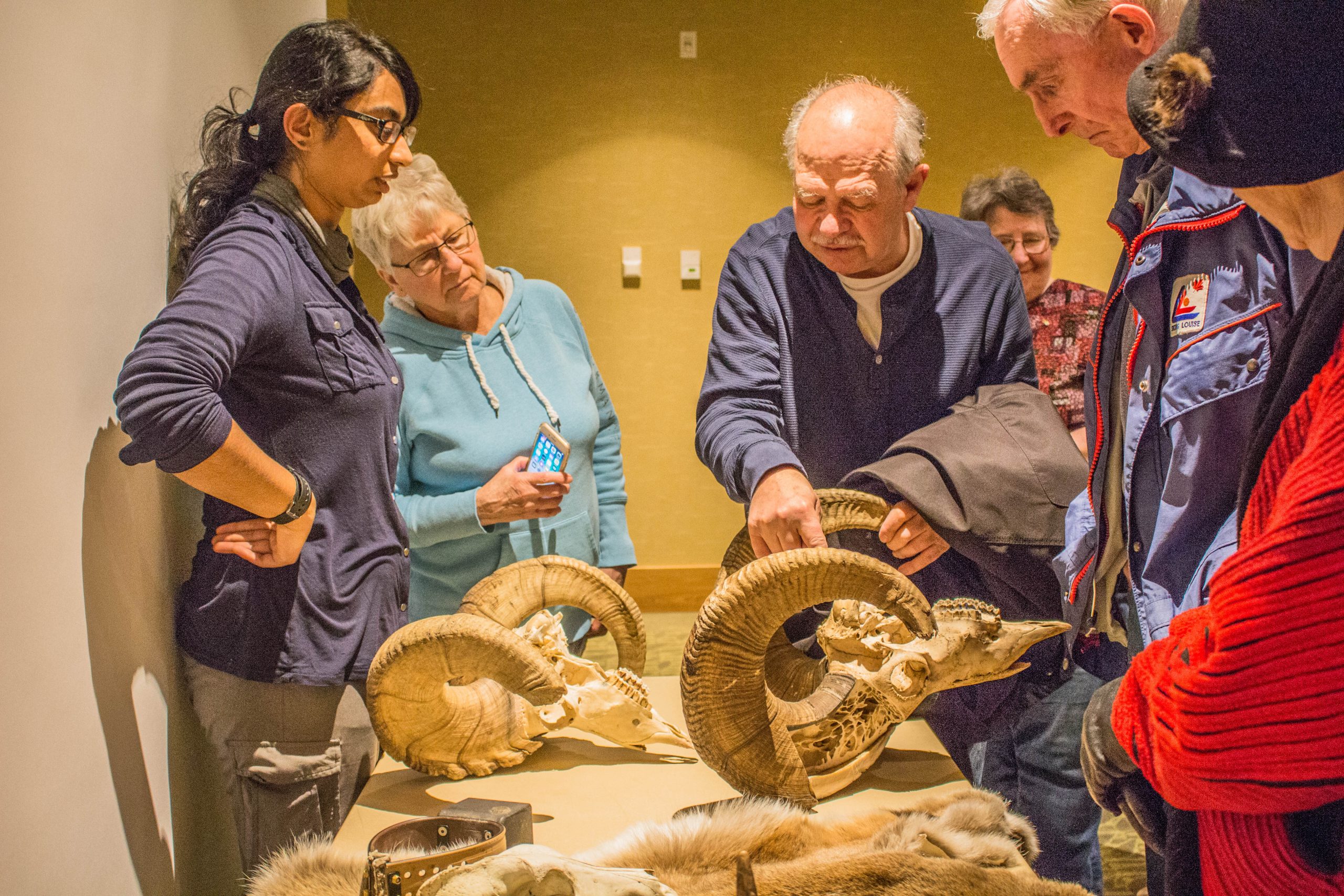
Attendees of the Osoyoos Desert Society’s “Movie and an Expert” event last Saturday afternoon had the chance to get up close with bighorn sheep skulls and a variety of animal furs. Sultana Majid (left), a masters student at the University of British Columbia Okanagan spoke about her research on bighorn sheep populations infected with a parasitic mite. (Vanessa Broadbent photo)
By Vanessa Broadbent
Osoyoos Times
If you spot a herd of bighorn sheep west of Highway 97, there’s a chance that they’re covered with parasitic mites.
The non-burrowing ectoparasites, called Psoroptes ovis, lead to a disease called psoroptic mange and University of British Columbia Okanagan masters student Sultana Majid told attendees of the Desert Society’s Movie and an Expert event on Saturday afternoon about her research on infected bighorn populations in the South Okanagan.
Majid is currently one year into a two-year collaboration with the B.C. Government’s California Bighorn Sheep Psoroptes project, started in 2015. Psoroptic mange was first discovered in B.C. in Olalla in 2011.
The objective of her thesis is to determine if psoroptes infection reduces survival and recruitment (the number of new lambs that enter the population in a year) of local infected bighorn sheep, compared to uninfected populations.
Infected populations, currently only located on the west side of the Okanagan Valley, have significantly declined, Majid said.
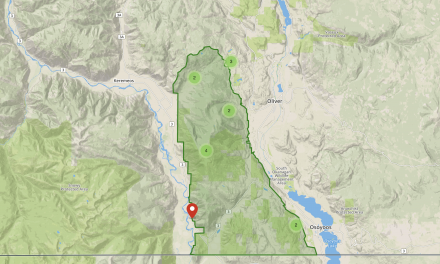
In the late 1980s and ‘90s, there were around 600 bighorn sheep in the Similkameen – Ashnola region. In 2018, there were 200.
• Read more: Desert Society’s Winter Program Series lineup announced
Currently, Highway 97, along with the lakes, towns and high fencing of orchards along the valley, keep the infected sheep in the west but researchers are worried the mites might cross.
“There are still high concerns of it transmitting from the west to the east,” Majid said. “We’re monitoring movement to see if there’s any areas of interconnectivity where they can mix between east and west and isolate those areas at risk.”
One of the ways regional biologists track the sheep is with GPS collars, placed on both infected and uninfected sheep.
The collars give researchers a GPS point every 13 hours, and if no movement has occurred in six hours they get a notification, indicating a possible mortality.
Within 48 hours, biologists check on the sheep and do an on-site investigation to determine the cause of death.
“We look at what the cause of mortality was and we collect any soft body tissue samples we can and we collect the collars back and redeploy them,” Majid said.
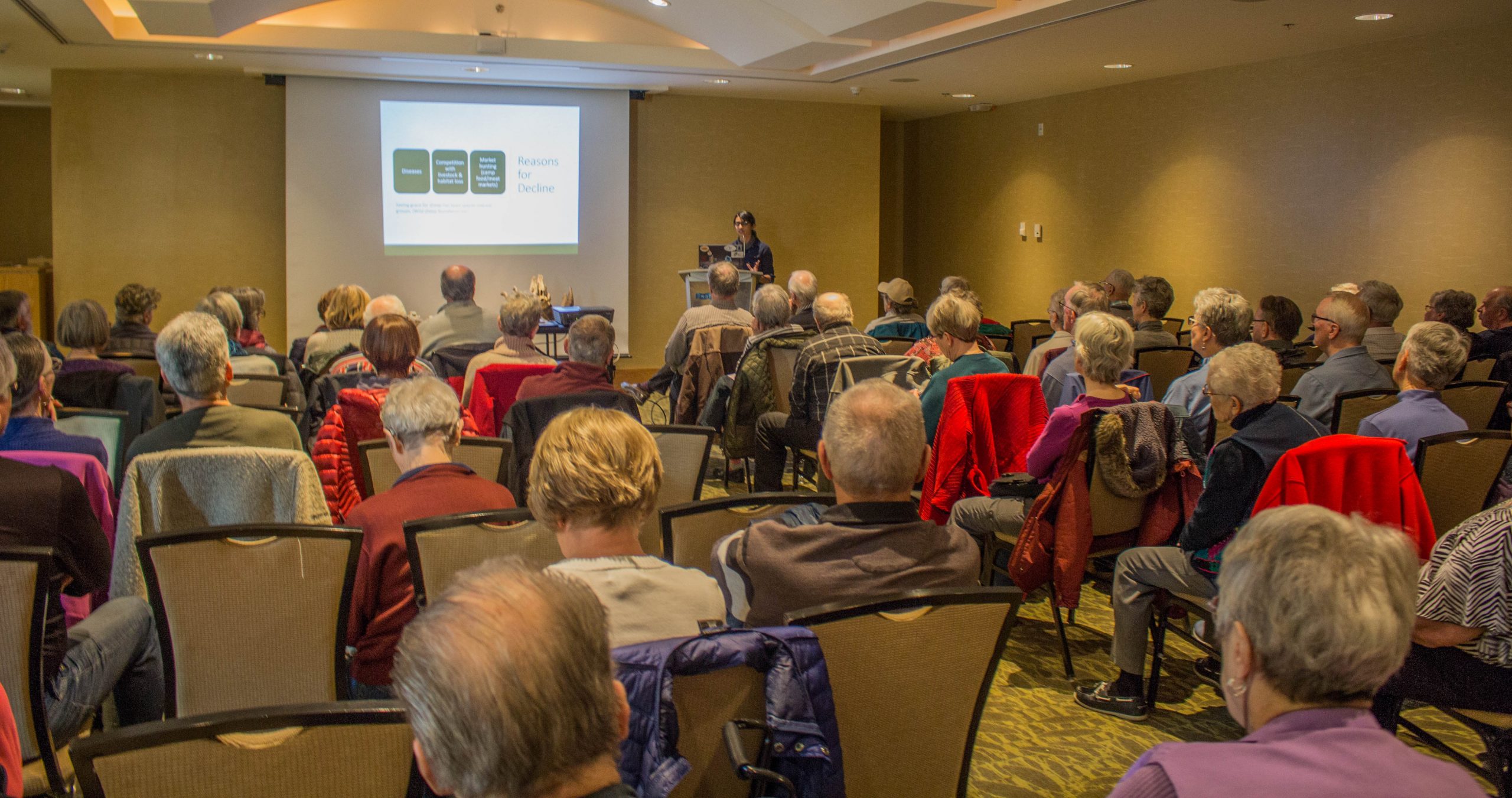
Sultana Majid, a masters students at the University of British Columbia Okanagan, told attendees of the Desert Society’s Movie and an Expert event last Saturday about her studies on the effects that psoroptic mange, a disease caused by a parasitic mite, has on local bighorn sheep. (Vanessa Broadbent photo)
As of 2018, 75 sheep are collared: 45 infected in the west valley and 30 uninfected in the east valley.
From data collected in 2018, 29 mortalities were reported – 20 among infected sheep and nine uninfected.
Of the infected deaths, 13 were caused by cougar predation, three were health related, two were from vehicles and two were hunter harvests.
While psoroptic mange is not in itself fatal to the sheep, Majid explained that it makes them more susceptible to other causes of death.
“These conditions of psoroptic mange and scabies create a huge energetic load on the animal,” she said.
“Either the animal is spending a lot more time trying to relieve themselves of the itchiness and less time foraging, or even that huge parasite load is moving resources to the parasite instead of to the animal and can lead to a decreased body condition and starvation.”
The disease also causes flaking and buildup in the sheep’s ears, which blocks the ear canals, weighing down the ears and impeding hearing, and in serious cases makes them more likely to contract infections.
• Read more: 100 caring men fund Osoyoos Desert Society
Researchers are exploring ways to treat and mitigate the populations infected with the mites.
A project spearheaded by veterinarian and University of Saskatchewan PhD candidate Dr. Adam Hering saw sheep given an injection normally used to treat cows. The sheep were housed in pens on the Penticton Indian Band.
While the injections didn’t work, an oral treatment of Bravecto, a flea and tick treatment for dogs, showed positive results.
“It greatly decreased or eliminated mites within a month of treatment,” Majid said.
When the study period ended in early 2018, the treated animals were released.
“We do need further studies before this treatment can be implemented,” Majid said. “Bravecto treats all the mites within a month but we don’t know after that month. We don’t know if the mites can come back, if they can reestablish on that same animal.”
Habitat restoration can mitigate the disease by increasing habitat quality and forage quality, Majid said. To mitigate disease transfer, biologists have also relocated a herd in the McIntyre area that was 200 metres away from an uninfected population in the east.
“If we just let it go, there’s the potential of it decimating our east population and that’s a huge loss,” Majid said.
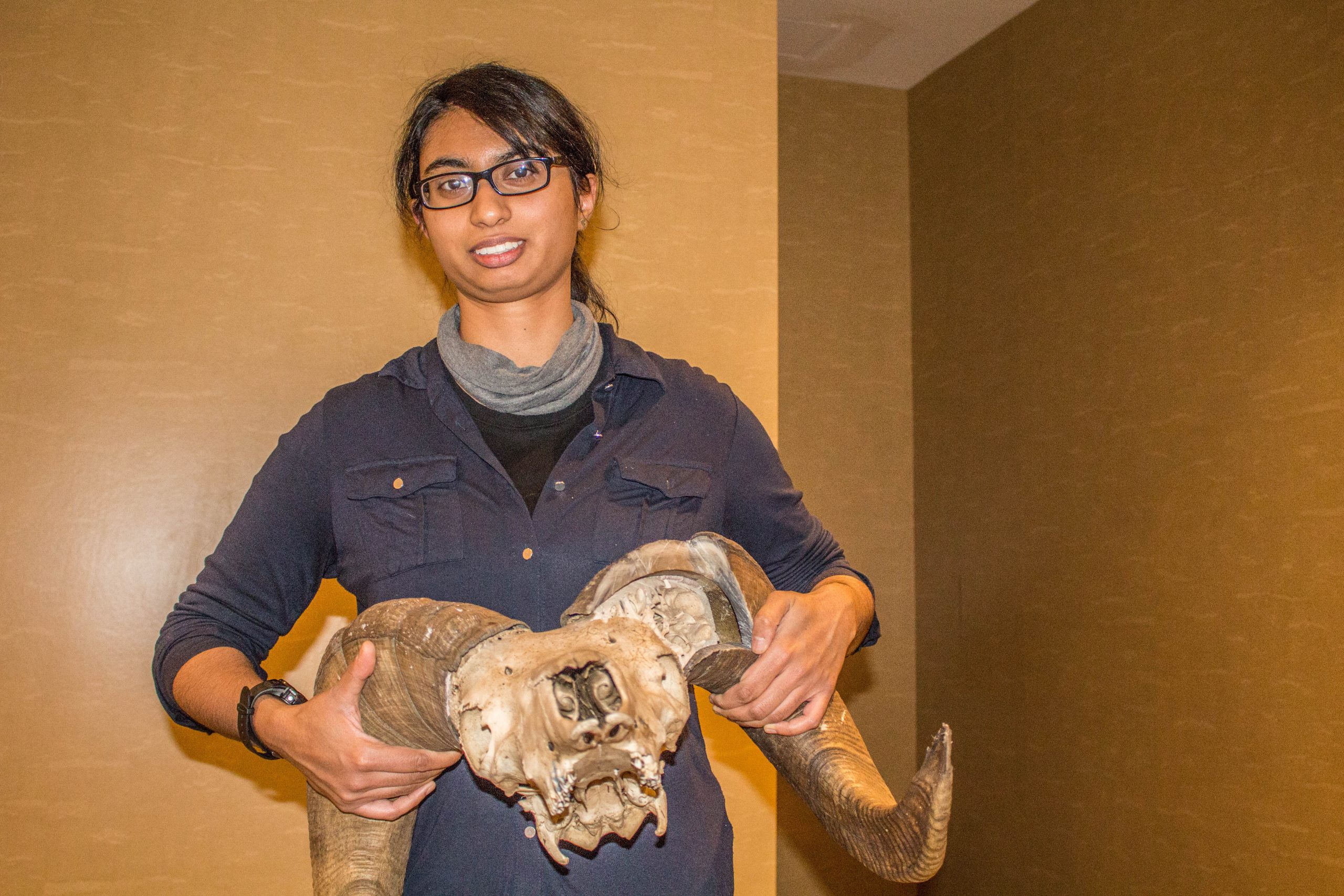
Sultana Majid, a masters students at the University of British Columbia Okanagan, is studying the effects that psoroptic mange, a disease caused by a parasitic mite, has on local bighorn sheep. (Vanessa Broadbent photo)