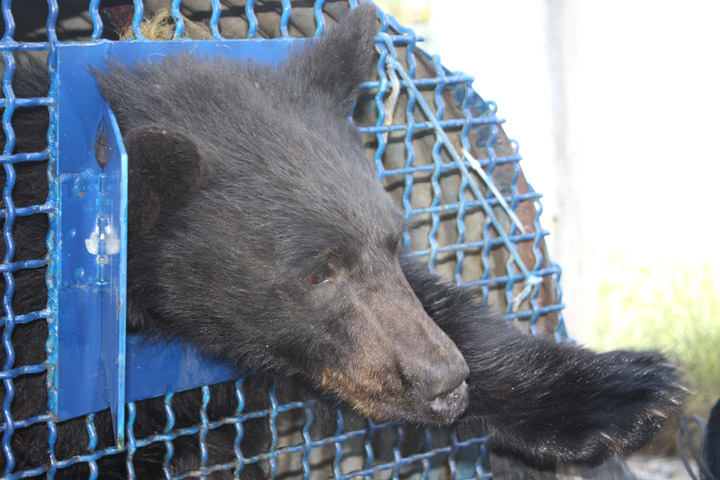
This black bear was trapped on an 89th Street property on June 3. The property owner said the animal had been hanging around his home for at least three days. Photo by Paul Everest - Click on picture for larger image
OSOYOOS TIMES-June 9, 2010
By Laurena Weninger and Paul Everest – Osoyoos Times
“We’re going to have bears as long as we have fruit in the valley and garbage in our garbage cans,” said Bob Hamilton, conservation officer for the South Okanagan.
It’s quite normal this time of year for bears to come into residential areas after coming out of hibernation, said Hamilton, and that means the recent bear sightings are par for the course.
Hamilton was in the Osoyoos area on June 3, picking up a black bear that had been caught in a trap set out by the conservation service.
When bears come out of hibernation, they start out by eating the grasses up in the hills.
But they soon tire of that diet and the animals’ preferred diet of berries isn’t yet ripe, Hamilton said.
That means the bears hit the road looking for some other food to eat.
It’s common for the bears to come into the Osoyoos area at the end of May and into early June, but the heat will soon drive them back into the hills for the summer, said Hamilton.
At least until the fall, when ripe fruit brings the animals back to the area.
Hamilton is receiving up to 15 calls a day about bears in residential areas from Osoyoos to Peachland.
Other reports to the Osoyoos Times indicate a bear sighting in a neighbourhood in the 26th Avenue area and also up Anarchist Mountain.
The bear Hamilton came to pick up on June 3 was on the lakeshore north of town, on a property on 89th Street.
Hamilton said the bear was between three and four years old, and a “problem bear” – at least in part because it is aggressive.
That means it would be euthanized.
The property owner, who asked not to be named, reported that the bear started showing up on June 1 and was seen under a deck and in garbage cans.
Apples from a nearby orchard were seen in the bear’s scat, the owner said, and the bear ate four of five bluebird babies in a birdhouse on the property.
The trap was set up on June 1, with sardines inside, and while the bear ate the bait, it didn’t spring the trap.
But more sardines did the trick and on June 3 at about 1:30 p.m., the property owner heard the spring-loaded door on the trap slam shut.
Sometimes the conservation service relocates bears, Hamilton said, but only those that are new to the Okanagan Valley and are still shy of humans.
The bear population in the valley has been rising, Hamilton said, adding that euthanizing those bears that come into residential areas actually helps cull the population.
According to the B.C. Environment Ministry, the provincial population of black bears currently ranges from 120,000 to 160,000 and the species is not currently classified as rare, threatened, or endangered in British Columbia.
The Regional District Okanagan-Similkameen (RDOS) has a Bear Aware program, and according to the program’s website, there are approximately 1,000 bears destroyed in B.C. each year due to conflict with humans.
Bears are naturally afraid of humans, but garbage, bird feeders and tree fruits can bring bears near homes.
Once a bear becomes used to human food sources, it is more likely the bear will need to be destroyed.
The biggest attractant for bears in rural areas is garbage and the site offers several tips on how to keep bears at bay.
Residents should properly secure garbage and keep it indoors until pickup days.
Finished compost, leaves, grass or wood chips can be used to cover fruit or other food waste in a compost pile, reducing odours.
Make sure to harvest fruit and remove windfall on properties immediately.
Electric fences can help.
Pet food, birdfeeders, gardens and even dirty barbecues are all attractants.
[email protected]
[email protected]