By Richard McGuire
The B.C. government is resuming talks with the federal government on a possible national park reserve in the South Okanagan six years after the B.C. cabinet killed the idea.
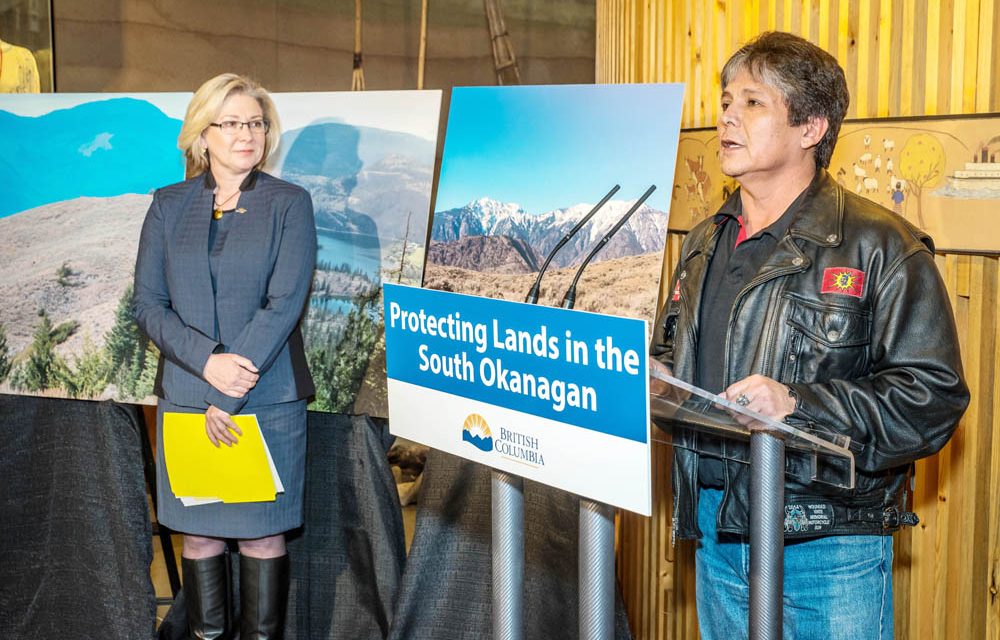
B.C. Environment Minister Mary Polak made the announcement at a news conference Friday at the Nk’Mip Desert Cultural Centre in Osoyoos.
Several supporters of a park who watched the announcement expressed cautious optimism.
“No champagne yet,” said Doreen Olson, coordinator of the South Okanagan-Similkameen National Park Network.
“I’m hoping that it’s not just a promise and that there will be something solid,” said Olson. “Promises can be kept or broken.”
Polak told the Osoyoos Times that her staff has already had preliminary talks with Parks Canada officials and she met with a senior official herself in Ottawa several months ago.
“My staff will begin to talk with them right away, of course,” said Polak. “We’re going into an interregnum with the election, so there won’t be any policy-level decisions made until after the election.”
Participating in the announcement were MLA Linda Larson, who introduced the speakers, and Osoyoos Indian Band Chief Clarence Louie, who also expressed cautious optimism.
The proposal was unchanged from one released by the B.C. government in August 2015 as an Intentions Paper. That proposal received more than 3,400 submissions from the public and stakeholder groups.
It calls for two areas in the north and south to be considered for a national park reserve while a central area, called Area 2, would become a provincial conservancy.
Many of the public submissions called for national park status for Mount Kobau, which is in Area 2, but Polak did not announce any changes for this area.
Nonetheless, she did say that the boundaries of the three areas are not carved in stone.
“It depends on the conversations that we have,” Polak said when asked if the government was prepared to look at protection for Mount Kobau beyond conservancy status.
“We know that it’s very, very important to people,” she said. “So, the important thing here I believe is first the commitment now to re-engage with the federal government and secondly to be able to move ahead with the [First] Nations in collaboration with us on Area 2 and on some of the discussions in [areas] 1 and 3 as well.”
Area 1 is located between Highway 3 and the U.S. border to the west of Osoyoos and Area 3 is located between White Lake and Vaseux Lake near Okanagan Falls.
“Area 1 and Area 3 will be the subject of discussion among the province, the three Okanagan Nation communities and Parks Canada for possible inclusion in a South Okanagan National Park Reserve (NPR),” the province said in a news release. “If these areas do not prove feasible as a NPR, then the province is prepared to open discussions with the three Okanagan Nation communities to protect these areas using the tools under the (B.C.) Park Act.”
The province will continue to work closely with the three Okanagan Nation communities in a government-to-government process to further develop details of the plan, the news release said.
And it will seek to engage with the federal government and the three Okanagan Nation communities around the potential for NPR designation in Areas 1 and 2, the release continued.
Chief Louie, who was speaking on behalf of the Osoyoos Indian Band, as well as the neighbouring Lower Similkameen and Penticton Indian bands, welcomed the return to the negotiation table.
He expressed hope that agreement can be reached on a solution to protect the land from encroachments and to protect its species at risk, many of which are only found in this region.
In an interview after the announcement, Louie said the key concerns of First Nations are protecting aboriginal title rights as well as hunting and fishing.
He noted that local First Nations looked at other models for national park reserves during their research for the feasibility study released in 2013 as Building a Syilx Vision for Protection, Assessing Feasibility of a Syilx/Parks Canada Protected Area: Findings and Guiding Concepts.
One model that interested them was the Gwaii Hanas National Park Reserve in Haida Gwaii, which is jointly administered by Parks Canada and the Haida Nation.
Louie said his personal preference is that the land become a national park reserve rather than remaining under provincial control.
“I have a personal preference because I used to work in a national park as a youth,” said Louie. “That was my best summer job ever. It was in Kootenay National Park when I was 16 years old.”
Officially though, he said he wants more details.
“I don’t think there are as many job opportunities if it’s a provincial status, whereas in a national park there’s a lot more job opportunities,” said Louie. “And a lot more protection. But those details have to be worked out.”
Polak said her government is negotiating from the starting point that existing uses of the land should continue.
“In my initial conversation, my impression was that they (Parks Canada) are far more open to that now than they may have been in the past,” the minister said. “We’ve seen them do urban national park reserves, for example, things they weren’t interested in doing in the past, so that’s a good thing.”
Catherine McKenna, the federal minister of Environment and Climate Change, who is responsible for Parks Canada, issued a statement welcoming the return to discussions with the province and Okanagan Nation communities.
“A new national park reserve would provide an opportunity to protect one of Canada’s iconic natural and cultural landscapes and share this unique and inspiring landscape with Canadians and visitors from around the world,” McKenna’s statement said.