
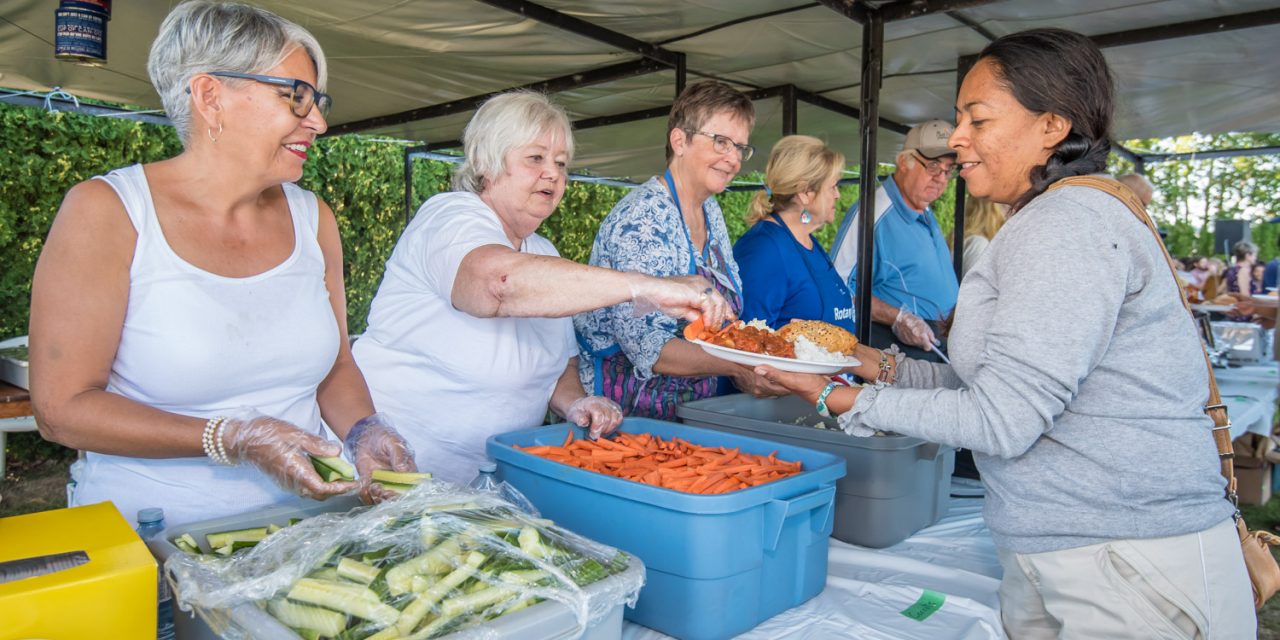

Volunteers from the Osoyoos Baptist Church and the Rotary Club of Osoyoos served dinner to about hundreds of people on Saturday at the church. Most of the guests are young fruit pickers from all over the world. Pictured here, Sophia Olivares, of Oaxaca, Mexico, gets her plate filled by (from left) Teresa Linklater, Sue Martindale and Brenda Saul. (Richard McGuire photo)
The cherry-picking season in Osoyoos may be winding down, but at Osoyoos Baptist Church on Saturday hundreds of young travellers, mostly pickers, showed up for dinner.
This was the last of six Saturday dinners hosted by the church and members of the Rotary Club of Osoyoos were also there to help serve. A few weeks ago, members of town council pitched in.
It’s been common this summer for up to 850 people to show up for Saturday dinner.
As the young people made their way down the long tables under a canopy, it’s immediately clear there’s been a huge demographic change from previous years.
Most are speaking Spanish, unlike in previous years when many dreadlocked Québécois showed up at the church.
“Three years ago we had 10 Mexicans and last year we had 150 Mexicans,” says Pastor Phil Johnson, using approximate numbers. “This year we figure we’re running about 400 Mexicans.”
Last year, said Johnson, about half the visitors were Québécois and about 30 per cent were Mexicans. This year, he said, those numbers are reversed.
As always, the remaining 20 per cent come from all over the world. But even here, these world travellers this year largely come from Spanish-speaking countries – Chile, Argentina, Spain, Central America and elsewhere.
The difference, of course, is that the Québécois can legally work here as Canadian citizens.
Unlike the Mexicans, who have been coming here for years under the temporary foreign worker program, many of the travelling youths come here on tourist visas and make a bit of money picking cherries to help pay the cost of their travel.
The workers are needed and not many locals are lining up for picking jobs, so eyes are looking the other way.
Mostly, Johnson says, the pickers who come to the church are polite and appreciative.
To help meet the need for accommodation, this year the church has established a tent camp on a portion of the church property that is agricultural, allowing farm workers to camp on it.
The church provides showers, a safe place to stay and a welcoming environment.
In some cases the workers prefer the amenities and safety of the Baptist Church. Johnson says some farms don’t provide adequate accommodation and there have been a few cases of farmers sexually harassing the young women, so the church camp is a welcome alternative.
Johnson believes it doesn’t make sense to provide permanent facilities when the main picking season is only six weeks.
There have been very few problems with the campers, he said, adding that the church tries to enforce a policy of no alcohol, drugs or weapons.
“We know that people are drinking every night,” he says. “But we also know that having that rule puts it into the tent.”
People are less likely to sit around drinking openly all night.
“Alcohol makes people do stupid things, so when we see alcohol, we store it for them until they leave,” he said. “We don’t dump it out. We don’t confiscate it. We say we’ll hang onto it and when you go, come and see me and we’ll give it back to you.”
But he emphasizes that those causing problems are a very small minority.
With so many young Mexicans picking cherries in Osoyoos, concern for their wellbeing has been on the radar of the Mexican Consulate in Vancouver.
Last Thursday, Hugo Velásques Vázquez of the consulate came to Osoyoos to speak informally with Mexican pickers at the Baptist Church.
In his talk, he discussed the issue of those working on tourist visas, those with medical problems and the difficulties repatriating them, and he noted that they have rights as workers, even if they don’t have papers to work legally. And he gave each of the young Mexicans his card in the event that they need assistance.
Among those at his talk was Valeria Sanchez from Mexico City. Her English is very good because she had a bilingual education.
She’s completed an undergraduate degree in visual arts at Universidad Nacional Autónoma de México, better known as UNAM.
She’s already travelled in Europe, where she stayed in Italy, and speaks some Italian, and she even learned a bit of Russian while staying in St. Petersburg.
Her plan was to save some money picking cherries in B.C. and then to do some studies in Finland, “because they have the best education in the world.”
Now she’s having second thoughts and she thinks she’ll save money and return to Mexico to pursue a Masters degree.
This trip she went straight to Vancouver and after three days came directly to Osoyoos. It’s her first time in Canada and her first time picking cherries.
She learned about Osoyoos and cherry picking on a Facebook group for backpackers.
“They explained to me that there is a route that goes from Osoyoos to the north, to Kelowna, and you have to follow the season,” she said.
Why did she want to pick cherries?
“In all honesty to make money,” she answers. “Because in Mexico our minimum wage is really low. It’s less than $10 for eight hours of work. Here in an hour you can make $15, so that is a lot more than Mexico.”
She was surprised to learn that the increase in young Mexican pickers is quite recent.
“I guess it’s because of Donald Trump’s policies,” she said referring to the U.S. president’s tough stand against Latin American migrants. “Immigration to United States has always been tough, but now it’s harder. So I think it’s easier for us to come to Canada, make money here and go back home, because we don’t want to stay here forever. We need money.”
She shudders at the thought of spending winter here.
But for many of the visitors, cherry picking is just a way to finance their adventure and travel is their main objective.
Francisc Cadena, 27, and his girlfriend Lili Santos, 22, are both from Andorra, a tiny principality hidden in the Pyrenees Mountains between France and Spain. The people they meet in Canada haven’t heard of the tiny country known for its skiing and duty-free shopping.
The official language is Catalan, but they’re also adept at Spanish and French.
Neither has picked cherries before, though Cadena picked grapes in the champagne region of France.
“We love picking cherries when the cherries are big and the trees are not so tall,” said Cadena, noting that buckets fill faster.
Lili says it’s difficult in the hot sun, but she likes that the pickers can nibble on cherries as they work.
Cadena said they’ve learned to be fast, but gentle – you can damage the tree if you work too quickly.
They’re amazed that Canada, the second-largest country in the world, has just 36 million people – less than the population of California.
“It’s my first time in Canada and I’m enjoying a lot the country,” said Cadena. “Because it’s really wild and the people are really kind. I love Canadian people.”
In Europe the image of Canada is that it’s a cold country, said Cadena, adding that Osoyoos is “f—ing hot.” They are surprised to see the desert environment and a lake with beaches.
And they’re grateful to Osoyoos Baptist Church and Pastor Phil for their kindness.
They want to hitchhike across Canada, but how long they’ll be able to travel depends on money.
“We would love to feel like a leaf moving by the wind,” said Cadena. “If the wind goes to the right, we go to the right.”
RICHARD McGUIRE
Osoyoos Times

We chatted with this young Andorran couple, Francesc Cadena and Lili Santos, who are picking cherries to help fund their travel through Canada. The two enjoyed a meal and a chance to socialize with new friends from all over the world on Saturday at the Osoyoos Baptist Church. (Richard McGuire photo)

Valeria Sanchez, from Mexico City, (right) is picking cherries to help pay for her schooling. She plans to seek a Master’s degree in visual arts. Pictured with her is her new friend, Lili Santos from Andorra. (Richard McGuire photo)

Rotarian Cheryle King serves potato salad to Beatriz Olb, of Mexico City, at the Osoyoos Baptist Church. King asked many of the young guests where they came from and convinced them to take carrots for better eyesight. (Richard McGuire photo)

These young travellers at Osoyoos Baptist Church are from various parts of Chile. From left are Elly Vonschwedler, Lucho Pai, Guillermo Vera and Valeska Marin. (Richard McGuire photo)

The grass next to Osoyoos Baptist Chuch was covered with young travellers as some lined up for food and others ate meals. For the past six weeks, the church has been serving about 850 people every Saturday, most of them here to pick cherries. (Richard McGuire photo)

They share the Spanish language, but Nicol Farias (left) is from Chile and her friends Nina Lopez, Karen Cristal and Aiza Valenzuela are from Mexico. They were enjoying dinner and socializing on Saturday at the Osoyoos Baptist Church. (Richard McGuire photo)

Among those enjoying dinner on the lawn at the Osoyoos Baptist Church was this group from Argentina and Spain. From left are Ignacio Moltelhi, Ricardo Diaz, Paco Ruiz and Vicky Belloza. Moltelhi and Belloza are from Argentina and Diaz and Ruiz are from Spain. (Richard McGuire photo)

Daniel González, from Cuernavaca, Mexico, juggles balls at the Osoyoos Baptist Church. He says it helps his concentration. (Richard McGuire photo)



I live two doors down from the Baptist church. There was no consultation with the neighbors before they moved 200 hundred people next door. I had to go before city council post a sign for 10 days and letters were sent to all my immediate neighbors before I could get permission from the city to build a deck. Yet this happened with zero consultation or input. Shame on them for being proud of bringing another 650 strangers and having a mass BBQ every Saturday for the past 5 weeks. I have not been able to enjoy my property and have a BBQ all summer long because of the noise. The random people walking through my property. The smell due to the garbage. I thought Osoyoos had a good neighbor bylaw. The congregation of the Baptist church should look at what they have done and wonder am I being a good neighbor?
As a fairly new resident, it has been hard to adapt to the inconsistencies and confusion over bylaw enforcement here and what is allowed and what isn’t; who is responsible for enforcing what. Another example of the situation you have had to endure in your own home is what happened on Lakeshore with the drug rehab house. They just opened up without the proper permits and approvals. People want to be treated fairly and consistently especially in the privacy of their own homes. I hope your unfortunate situation can be resolved using and being enforced by bylaws and common courtesy for one’s neighbour, community and neighbourhood. I wish you all the best.