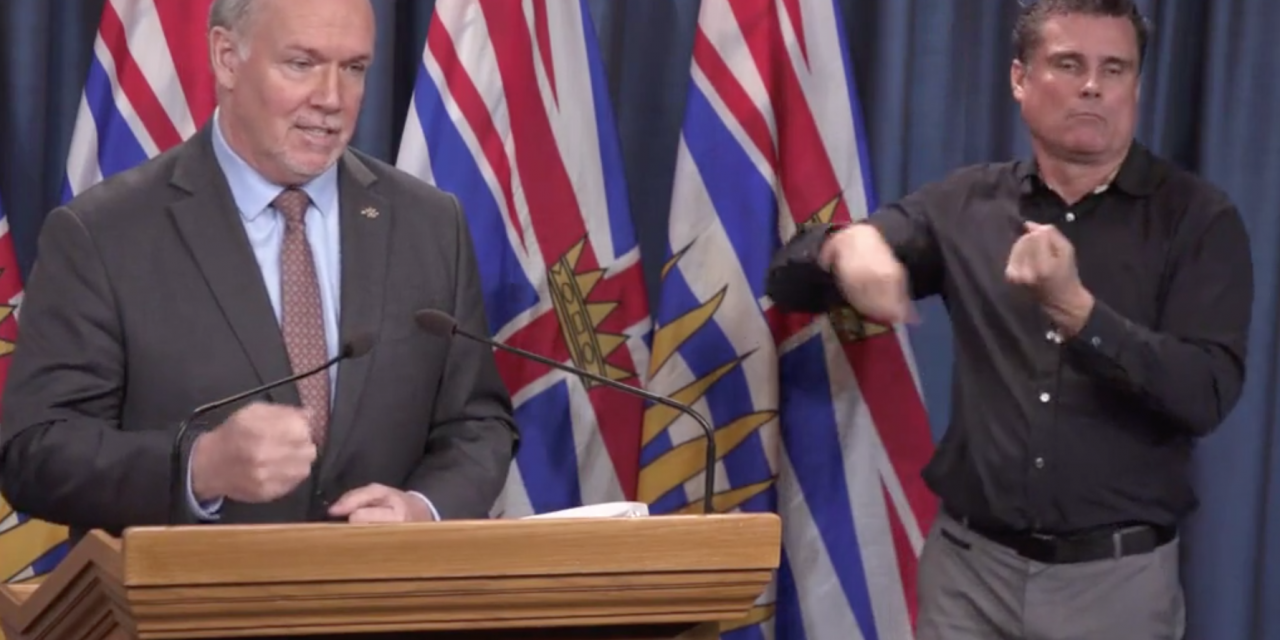
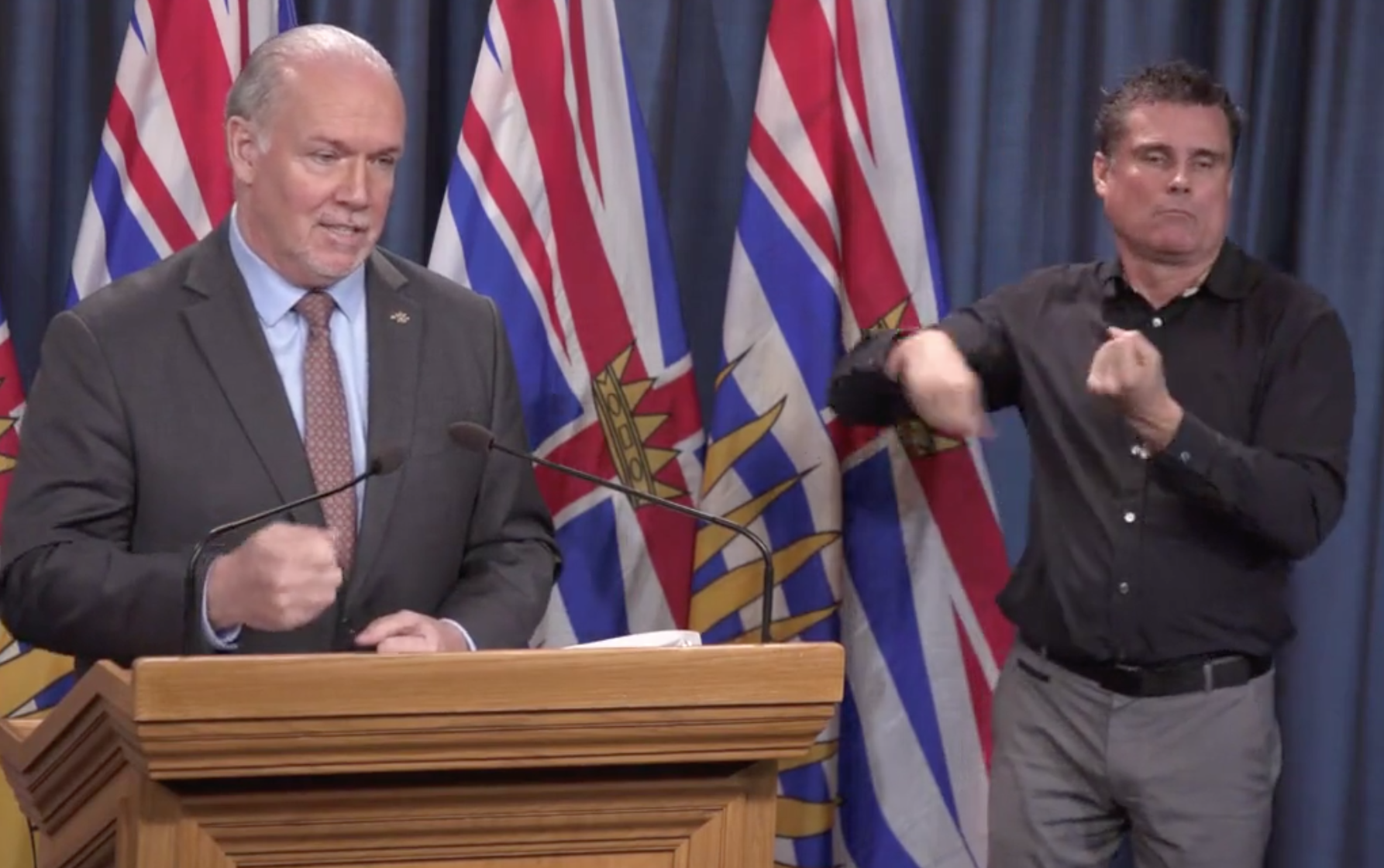
Premier John Horgan addresses media on March 23.
Osoyoos Times Staff
The Province of B.C. announced $5 billion in income supports, tax relief and direct funding for people, businesses and services Monday.
“The COVID-19 pandemic challenges our health, our economy and our way of life. People and businesses urgently need support,” said Premier John Horgan at a Victoria press conference Monday. “Our action plan focuses on services to protect people’s health and safety, gives immediate relief to people and businesses, and plans for B.C.’s economic recovery over the long term.”
The COVID-19 Action Plan announced Monday is aiming to provide relief to people and businesses in the province. The plan dedicates $2.8 billion to help people and fund needed services and $2.2 billion will provide relief to businesses and business recovery efforts.
Of the $2.8 billion dedicated to necessary services, the B.C. government is dedicating $1.1 billion to boost the income of people affected by COVID-19.
A new B.C. Emergency Benefit for Workers will provide a tax-free $1,000 payment to British Columbians whose ability to work has been affected by the outbreak. The benefit will be a one-time payment for British Columbians who receive federal Employment Insurance (EI), or the new federal Emergency Care Benefit or Emergency Support Benefit as a result of COVID-19 impacts.
This includes workers who have been laid-off, who are sick or quarantined, parents with sick children, parents who stay at home from work while child care centres and schools are closed, and those caring for sick family members, such as an elderly parent. The workers can be EI-eligible and non-EI eligible, such as the self-employed. The benefit will be paid to B.C. residents, in addition to their federal income supports.
The economic plan also adds funding to key services like health care, housing and social services.
“While this crisis continues, we need to make sure that people are kept safe and that vital services are available to British Columbians,” said Carole James, Minister of Finance. “That means making sure people can pay their bills, stay safe in their homes and provide for their families during this extraordinary time.”
The COVID-19 Action Plan takes further steps to boost income supports by increasing and expanding the B.C. Climate Action Tax Credit in July 2020. James said as many as 86 per cent of British Columbians will see some extra money from this enhancement.
Eligible families of four will receive up to $564 and eligible individuals will receive up to $218 in an enhanced payment. This boosts the regular climate action tax credit payment of up to $112.50 per family of four and up to $43.50 per adult.
The action plan provides $1.7 billion for the critical services British Columbians need.
The $1.7 billion helps fund investments in housing and shelter supports, income and disability assistance programs and crucial health services, such as funding for the BC Centre for Disease Control hotline, quarantine costs, lab tests and work underway at the First Nations Health Authority and the United Way’s Better at Home program for seniors.
To support non-profits, service delivery agencies and child care providers, the province will continue to provide funding even if these agencies are closed or their regular operations have been disrupted. Licensed child care providers staying open will receive enhanced funding to keep operations going. These centres are eligible to receive seven times their average monthly operating funding from government, which is expected to cover approximately 75 per cent of a group facility’s average monthly operating expenses.
To help people with B.C. student loans, the province is freezing B.C. student loan payments for six months, starting March 30, 2020. Federal student loan payments are being frozen as well.
British Columbians needing more time to pay their bills can also apply to existing payment deferral programs at ICBC and BC Hydro. ICBC is extending deferrals to up to 90 days. People dealing with job loss, illness or loss of wages due to COVID-19 may also qualify for BC Hydro’s Customer Crisis Fund grant program for up to $600.
Business relief
Effective immediately, businesses with a payroll over $500,000 can defer their employer health tax payments until Sept. 30, 2020. Businesses with a payroll under this threshold are already exempt from the tax.
In addition to the employer health tax, the province is extending tax filing and payment deadlines for the provincial sales tax (PST), municipal and regional district tax, tobacco tax, motor fuel tax and carbon tax until Sept. 30, 2020.
The scheduled April 1 increase to the provincial carbon tax, as well as the new PST registration requirements on e-commerce and the implementation of PST on sweetened carbonated drinks, will be delayed and their timing will be reviewed by Sept. 30, 2020.
Business and light- and major-industry property classes will see their school tax cut in half. This will provide $500 million in immediate relief for business that own their property and allow commercial landlords to immediately pass savings on to their tenants in triple-net leases.
In the longer-term, the recovery plan will dedicate funding to particularly hard-hit parts of the economy, such as the tourism, hospitality and culture sectors. The B.C. government is partnering with business and labour leaders to build an economic stimulus plan. The Province has allocated $1.5 billion for economic recovery.
For information on B.C.’s COVID Action Plan and other government resources and updates, visit: www.gov.bc.ca/covid19
To learn more about Canada’s COVID-19 Economic Response Plan, visit: https://www.canada.ca/en/department-finance/economic-response-plan.html
For non-medical information relating to COVID-19, call: 1 888 COVID-19
For more information on how B.C.’s COVID-19 Action Plan helps people and businesses, visit: http://news.gov.bc.ca/factsheets/bc-takes-steps-to-support-people-businesses-during-covid-19-pandemic