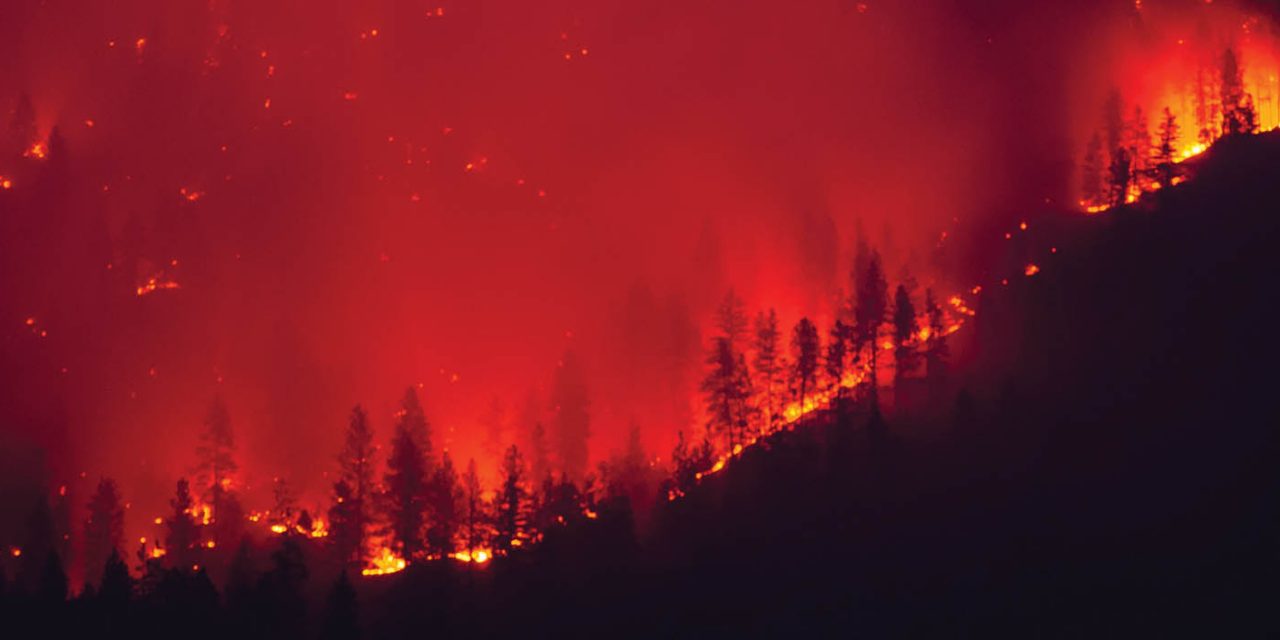
As wildfires continue burning throughout the province, including some in the Osoyoos area, a ban on campfires and other open fires came into effect last Friday.
While the number of fires in the Osoyoos area has diminished since lightning set off nearly a dozen small fires on June 27-28, the seriousness of some fires has increased.
Fire danger ratings in the South Okanagan were considered “high” as of noon Monday, with some areas classed as “extreme.”
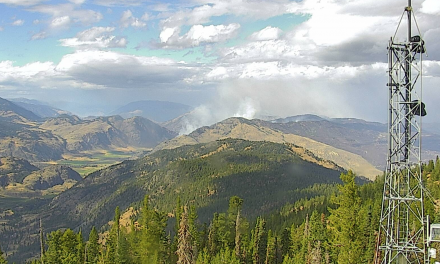
Fires at Newby Lake and Ashnola Road, both to the west of Osoyoos, are now classed as “wildfires of note,” in addition to the Huckleberry fire between Joe Rich and Kelowna by Highway 33.
The Newby Lake fire in Snowy Protected Area south of Keremeos was estimated at 588 hectares as of Sunday night and had jumped the border into Washington State.
This fire is believed to be caused by lightning and was discovered on Thursday, July 2, the B.C. Wildfire Management Branch said.
As of late Sunday, it was completely uncontained, though no buildings were involved. Smoke from this fire is visible in the South Okanagan.
“The majority of resources for this fire have been reallocated to other high-priority fires in the Okanagan,” the Wildfire Management Branch said in a bulletin. “This fire will continue to be monitored and resources assigned as they become available.”
The Ashnola Road fire is north of the Ashnola River to the west of Keremeos. It is believed to be human caused and as of Monday morning it covered about 100 hectares.
The B.C. Wildfire Service was using helicopters and firefighters to slow the fire’s advance to the north. This fire, discovered on Saturday, also was completely uncontained. No buildings were involved.
As of Monday, there were 41 people on the site working to control it.
The Huckleberry fire east of Kelowna, which was discovered last Friday, is now considered completely contained. There were homes located nearby and at one time there was an evacuation order, but that has now been rescinded. Size of the fire as of Monday morning was estimated at 55 hectares.
In addition, a 70-hectare fire at Hunter Creek west of Osoyoos is still active, though it is not classed as a fire of note. That fire was caused by lightning and was discovered on June 27.
Last week a crew with a helicopter bucketing water was working at the site, said Melissa Klassen, fire information officer with the Kamloops Fire Centre of B.C. Wildfire Service.
Other fires to the east of Osoyoos Lake have now been extinguished.
Similarly, a cluster of fires near Spotted Lake, Kruger Mountain and Blue Lake were responded to by air tankers on June 28 and are no longer a threat.
Klassen said the fire ban is being driven largely by the dry conditions and the number of lightning-caused fires.
When fire crews have to respond to human-caused fires, it diverts valuable resources and people from the work on naturally occurring fires, she said.
With warmer, dryer conditions, the fire danger rating can rise very quickly, she said.
As of Monday, there were 184 active wildfires throughout the province, with nine evacuations alerts affecting more than 800 homes, the B.C. Wildfire Service said in a news release.
Campfire bans are now in place throughout the province. Failure to abide by the Wildfire Act, including open burning restrictions, can result in a $345 fine. If damage is caused to Crown land or grassland through arson or recklessness, fines are up to $1 million or three years in prison.
In addition to campfires, the ban that came into effect Friday applies to open fires of any size including industrial burning, fireworks, tiki torches, sky lanterns and burning barrels.
It does not apply to cooking stoves that use gas, propane or briquettes or to a portable campfire apparatus with a CSA or ULC rating that uses briquettes, liquid fuel or gaseous fuel as long as the height of the flame is less than 15 cm (six inches).
To report a wildfire or open burning violation, call 1-800-663-5555 or *5555 on a cellphone.
RICHARD McGUIRE
Osoyoos Times