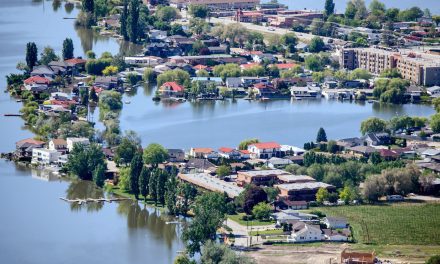
Lakeshore Drive resident Jamie Graham was busy filling sandbags in late May last year as the level of Osoyoos Lake threatened his home. Sand and sandbags are now available across Highway 3 from Dairy Queen, but officials are hoping that flooding can be avoided if the snow melts gradually and there is no excessive rainfall. (Richard McGuire file photo)
As temperatures warm this week, the spring freshet season is underway and officials are assessing the risk of possible floods on the Okanagan River system.
Environment Canada is forecasting temperatures in the low to mid 20s with sunshine for the rest of this week.
David Campbell, section head with the B.C. River Forecast Centre, said in a media conference call on Monday that temperatures will increase this week as a high-pressure ridge takes shape, possibly turning to rainfall when this ridge passes.
Snowmelt will likely occur at middle elevations, he said, but with temperatures in the low to mid 20s, the upper elevations won’t see much effect.
In the River Forecast Centre’s report of April 1 data, snowpacks in the Okanagan and Similkameen were both at 152 per cent of normal. But Campbell said snow has continued accumulating and snowpacks have increased by another five to 15 per cent since the start of April.
Normally mid April is when more snow starts to melt than accumulate, but cooler temperatures this year have delayed that melt by more than a week.
Ideally, snow at upper and middle elevations won’t melt at the same time.
Shaun Reimer, section head with the Ministry of Forests, Lands and Natural Resource Operations, who oversees the dam in Penticton, said lake levels in the upper Okanagan are lower than they were at this time last year, but they will be starting to rise.
Okanagan Lake is currently discharging 1.5 centimetres a day, he said, which should be manageable, but doesn’t take into account wet weather. The lake is currently 61 centimetres below its level at this date in 2017, Reimer said.
For now it’s a case of watch and wait to see how Osoyoos Lake levels will be affected by this spring’s freshet.
Janette Van Vianen, Town of Osoyoos director of corporate services gave council an update last week.
The town, she said, has provided sandbags and sand across Highway 3 from the Dairy Queen, but it’s premature to gather volunteers to fill sandbags.
As of Monday, the level of Osoyoos Lake was 911.89 feet above sea level, only up slightly from the 911.84 a week earlier when Van Vianen gave her update.
The lake level is largely determined by the volume of water coming out of Okanagan Lake at the dam in Penticton, which is controlled by the province, and by the Zosel Dam in Oroville, which is controlled by Washington State under rules established by the International Joint Commission.
The Zosel Dam has been wide open recently, meaning that Washington authorities can’t control the level of Osoyoos Lake.
“It’s all dependent on the weather,” said Van Vianen. “Hopefully if it remains cool enough and we have a slow warming trend, we should be OK, but if it gets warm in the next week or two… we could be experiencing some flooding.”
Last year, when rapid warming caused flooding, snowpacks were only 105 per cent of normal in the Okanagan and 95 per cent of normal in the Similkameen as of April 1, 2017 – substantially below the 152 per cent of normal recorded on April 1 this year.
Van Vianen said she’s also keeping an eye on volumes of water in the Similkameen River, because if the Similkameen at Oroville rises above the level of the Zosel Dam, water backs up into Osoyoos Lake.
As of Monday, the Similkameen River’s discharge rate at Nighthawk, Washington was 3,660 cubic feet per second (cfs), which is still very low compared to last year’s peak of around 19,200 cfs in early June 2017.
“We’ve got a long ways to go before we’re even concerned about where the Similkameen is at,” said Van Vianen, who nonetheless encourages people to be proactive.
Last year Osoyoos Lake reached 914.89 feet in early June – exactly three feet higher than Monday’s level. Some homes and other buildings along the lakeshore experienced flooding.
Van Vianen noted that some people experienced flooding before the lake reached its peak last year, so she advised people to know the level at which they flood and to plan accordingly.
Whether or not flooding occurs this year will depend on precipitation and the speed at which the snowpack melts.
Right now there is no formalized system to pair volunteers with residents who need help, Van Vianen said, but if people want to call the town, staff will keep a list.
“In the next week or two, there is quite a high probability that we will need some volunteers,” she said.
The town has information about flood preparedness on its website at: www.osoyoos.ca/content/emergency-preparedness.
RICHARD McGUIRE
Osoyoos Times