By Don Urquhart –Times-Chronicle
Growing up as a kid living three houses away from a fire hall watching the trucks roar by with lights flashing and sirens wailing as they raced to a fire must have surely planted a seed in the mind of a young Wayne Jasper.
Now many years later Jasper has hung up his fireman’s helmet after 38 years of distinguished and highly rewarding service. But if truth be told, his retirement from the small but mighty Anarchist Mountain Fire Department (AMFD) as Deputy Chief this past December is not his first ride on the retirement pony, but we’ll come back to that.
His first real taste of firefighting came while living on Gabriola Island in the early 1980s and one might argue this was the germination of that seed planted years before. A house fire one night, four doors down drew him in to help.
“I was pretty much recruited onto the volunteer fire department that night,” he laughs.
He did this for about three years before moving back to Victoria where he was originally from. Perhaps unsurprisingly it was only a short interval after returning that the calling reverberated and saw him join as a career firefighter with the Department of National Defence at CFB Esquimalt.
This was a civilian department but on a Canadian Forces base where the main emphasis was on shipboard fires and looking after not only the naval ships but the freighters and other vessels that came in to dry dock on the other side of the base.
He spent 30 years there before retiring (the first time) and moving to Osoyoos where he and his wife were looking forward to taking it easy and enjoying his well-earned retirement. At least that was the plan.
“We were here a couple of months and went to the Cherry Festival parade for the first time. I saw the fire trucks coming down the hill and I started to laugh. I tapped my wife and said, ‘see the truck over there, that’s one of our old trucks from my old department!’”
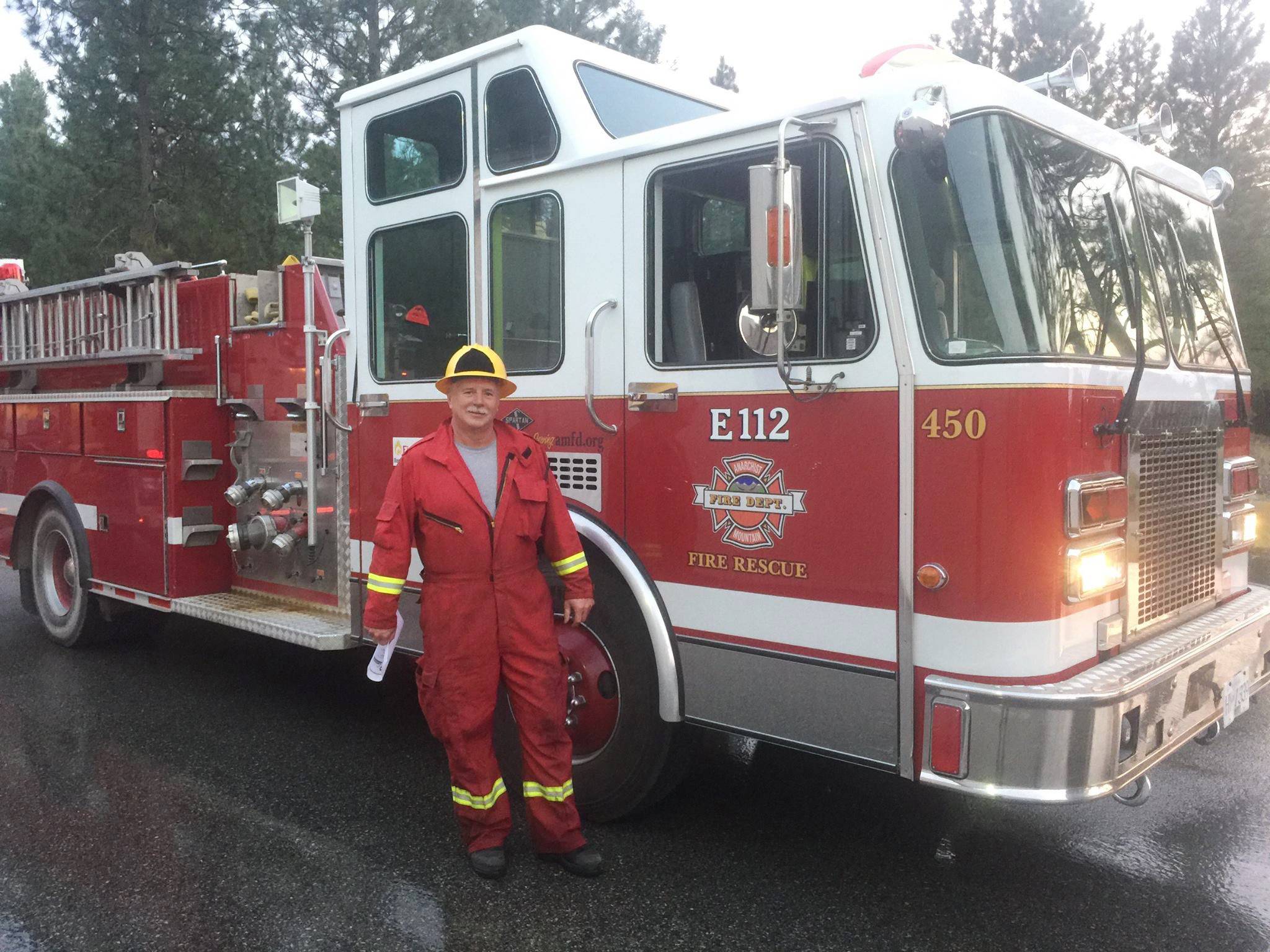
Wayne Jasper in wildland gear with the former Esquimalt fire truck with the number 450 call sign still on it. Contributed
Jasper explains that when fire trucks get retired it’s never known where exactly they go. “Yet sure enough here is this truck coming down the hill with the Anarchist labels on the side,” he chuckles.
Talking to the guys at the parade he learned they had just put the truck into service and there were “a lot of things on it they couldn’t quite figure out yet,” he says.
There used to be a decal on the side of the truck that said ‘Serving Canada’s Navy.’ Laughing, he adds: “They didn’t even take the ‘Serving’ off, they just took off ‘Canada’s Navy’ and added ‘Our Community.’ So it was pretty obvious where it came from!”
And with years spent training on the truck in his former job he told the Anarchist firefighters, “if you want some help give me a call.”
And soon enough that call came. “They called me up and said do you want to come up and show us?” He chuckles as he recalls what his wife told him as he was leaving the house: “Don’t come back with a helmet,”she said.
And how did that work out? “I went up and spent a practice night with them and by the time the night was over, I was on the department!A couple of weeks later I was their captain and training officer.”
“So that’s basically been my time here for almost five years with the department, pretty much bringing them up to standards of the day getting everybody trained and new equipment that’s up to standard,” he says.
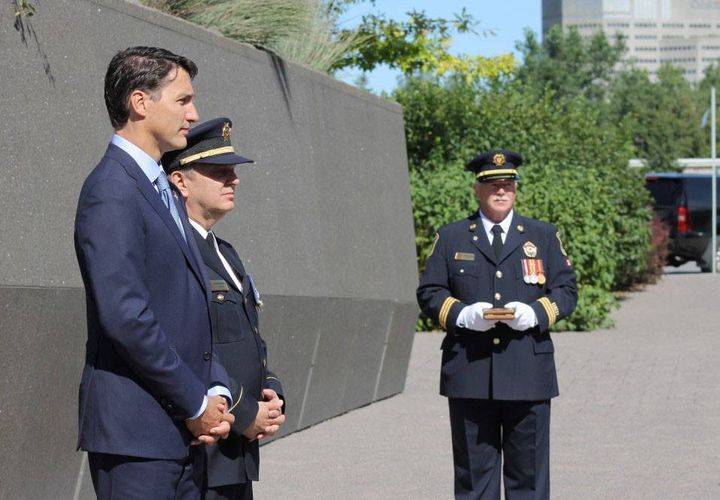
During his career Jasper also developed a sideline activity working with the Canadian Fallen Firefighters Foundation. The foundation honours and remembers firefighters who have been killed in the line of duty and supports their families.
Jasper was with the foundation for nearly 13 years including on the board of directors and was one of the team members responsible for establishing a national monument in Ottawa. “That is my most proud accomplishment,” he says, adding “we’ve got one of the nicest monuments in the world.”
But of his long and varied career one thing stands out and that was his time with the Anarchist Mountain Fire Department.
“I really enjoyed working up on Anarchist with the guys,” he says. “It has some unique challenges,” he laughs.
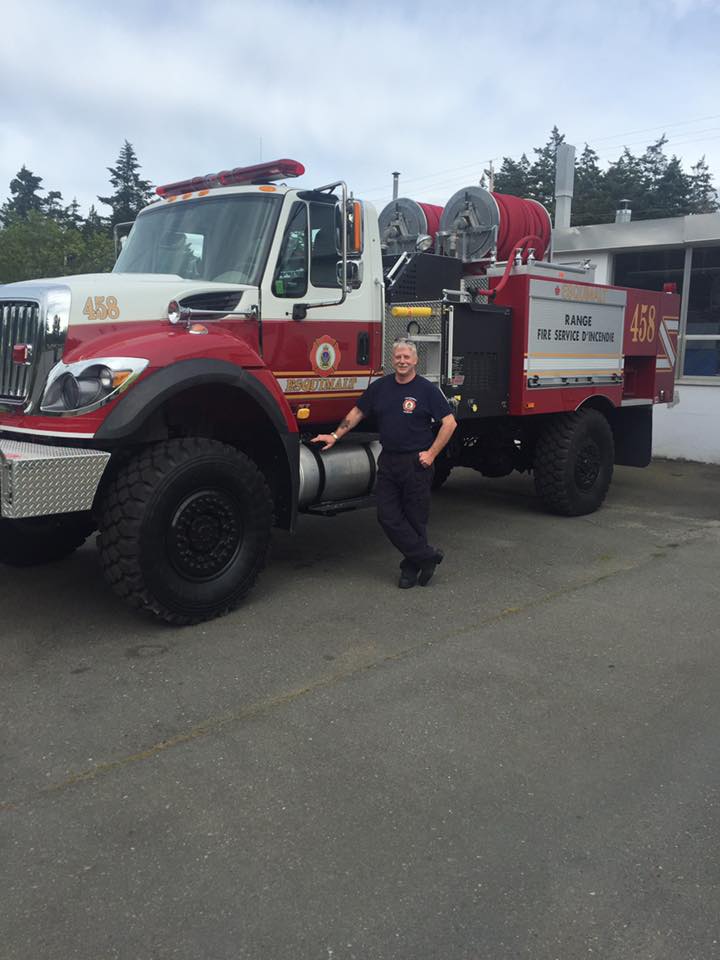
Wayne Jasper says so long to a long career.
Anarchist has no commercial businesses so unfortunately because of that it’s a very low tax base which makes it difficult financially to get adequate equipment.
“This past summer the donations that came from the community were fantastic and enabled us to get some additional pumps and fire hose, stuff like that. When you’re doing a wildland fire a lot of hoses get destroyed and there’s nothing you can do about that, it’s just the way it is.”
Other aspects of Anarchist involve what Jasper describes as the “unique highway system that runs through it with some pretty wicked corners.” Over the years he’s seen more than his fair share of semi-trailer rollovers alongside car and motorcycle accidents. For the fire department, this means they tend to play an outsized first responder role.
Unique again is the fact there aren’t a lot of structure fires in part because of a relatively sparse population and because a lot of the construction on the mountain is newer so it’s built to a little higher standard.
Wildland fires are a key factor on the mountain as last summer amply demonstrated. Jasper also points out that the Anarchist Mountain area is one of the largest areas covered by any fire department in the South Okanagan.
On the topic of last summer’s extreme fire situation, Jasper says it’s almost a 20-year cycle. “They get a fire of the same nature in the same area and the same size and that’s how long it takes to build back up and I think you’ll see that again in another 20 years.
“One thing that happens with these massive fires like we had last year is that these areas don’t burn the next year. You have to look at what goes on outside that area now.”
Another important sideline that Jasper has devoted significant time to is that of post-traumatic stress disorder (PTSD). For nearly a decade he’s been doing training all across the country after developing his own program.
He notes there’s nothing new about it, just the name and the awareness adding that during the world wars it was simply referred to as being ‘shell-shocked’ – same illness, different name.
But importantly Jasper underscores, “it doesn’t have to be something resulting from a dramatic event, it could be a divorce that can cause the same things. One fact that’s very interesting about it is that it doesn’t matter how you got it, whether it was from exposure to seeing traumatic stuff or dealing with traumatic stuff or the divorce thing it doesn’t matter – the symptoms are all the same.”
He says it’s interesting to see how awareness of PTSD has changed in as little as 10 years. “When I first started doing it, nobody wanted to talk about it and that’s really changed,” he says. “It used to be one of the things you never talk about, now it’s one of the first things you talk about.”
Jasper says he encourages the spouses of firefighters to attend along with their partners, “because they’re the first ones that notice when somebody’s changed so it’s good for them to understand it too.”
This is one aspect that he will continue with, and of course, he and his wife are looking forward to a bit of travel once the pandemic situation allows. And then there are all those things around the house that never quite get done. “No such thing as retirement,” he laughs.
The final word goes to AMFD’s Chief Urs Grob. “A person like Wayne when he joined our department after 30 plus years as a career firefighter in his belly, for us he did a lot – he’s dedicated, his big knowledge and his big network – he really brought our department to the next level . . . to over the next level,” he says.
“Wayne was a fantastic big help and I’m happy for him that he has the retirement now and hopefully time to travel.” And aside from the vast knowledge and experience that Jasper contributed, “he is a friend of mine now and the friendship is not ending with the end of employment, it’s definitely a good thing.
Grob adds: “He’s retired but he’s still in Osoyoos and if I need help, if I need to know something I can still call him. I still talk twice a week with him so he’s not gone, he’s just not carrying a pager anymore.”
Just as long as he doesn’t come home one day with another helmet we suspect his wife might add.