By Don Urquhart, Times Chronicle
In the wondrous realm of art, abstract painting occupies a unique, albeit often nebulous niche.
Consider the various descriptions of what constitutes abstract art: “the distancing of an idea from objective referents,” or “non-objective and non-representational”. My favourite is “a departure from reality”.
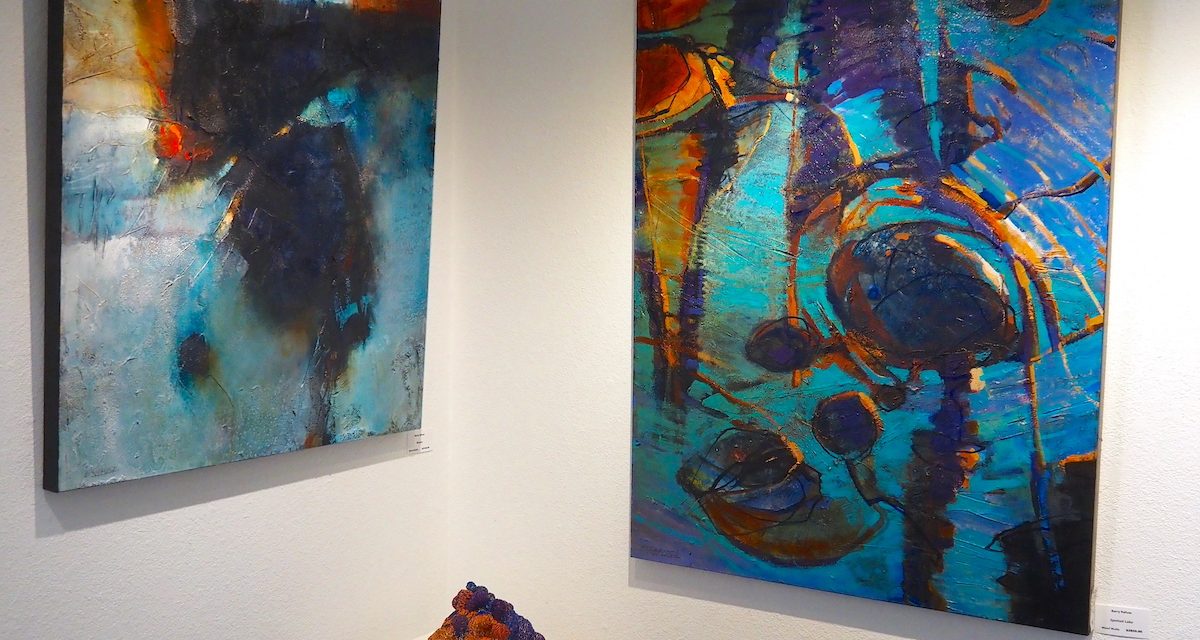
For the current show at the Osoyoos Art Gallery titled, “Vision and Variety”, the reality ship has clearly sailed. I hasten to add that this isn’t meant in a pejorative sense.
This show is unique in its combination of artists – Barry Rafuse with his rich mixed media abstractions that pull you in and jump-start your mind on a thoughtful journey – and Twyla Exner who creates extraordinary sculptures out of discarded electronic technologies, in this case, small gauge electrical wiring.
Exner, who is inspired by the “wonders of nature and the idea of electronic technologies gone awry,” offsets Rafuse’s abstractions with more concrete, yet equally mysterious sculptures that at once resemble bodily organs and yet maybe alien technology.
She describes her artwork as hybrids of technological structures and living organisms. The pieces are fascinating to look at and to look inside. Are the wires woven, are they knitted, or maybe crocheted? Their construction is exacting and one can only marvel at the time that must have gone into each piece.
Better yet, they are simply sympatico with Rafuse’s complex and deeply layered abstract works.
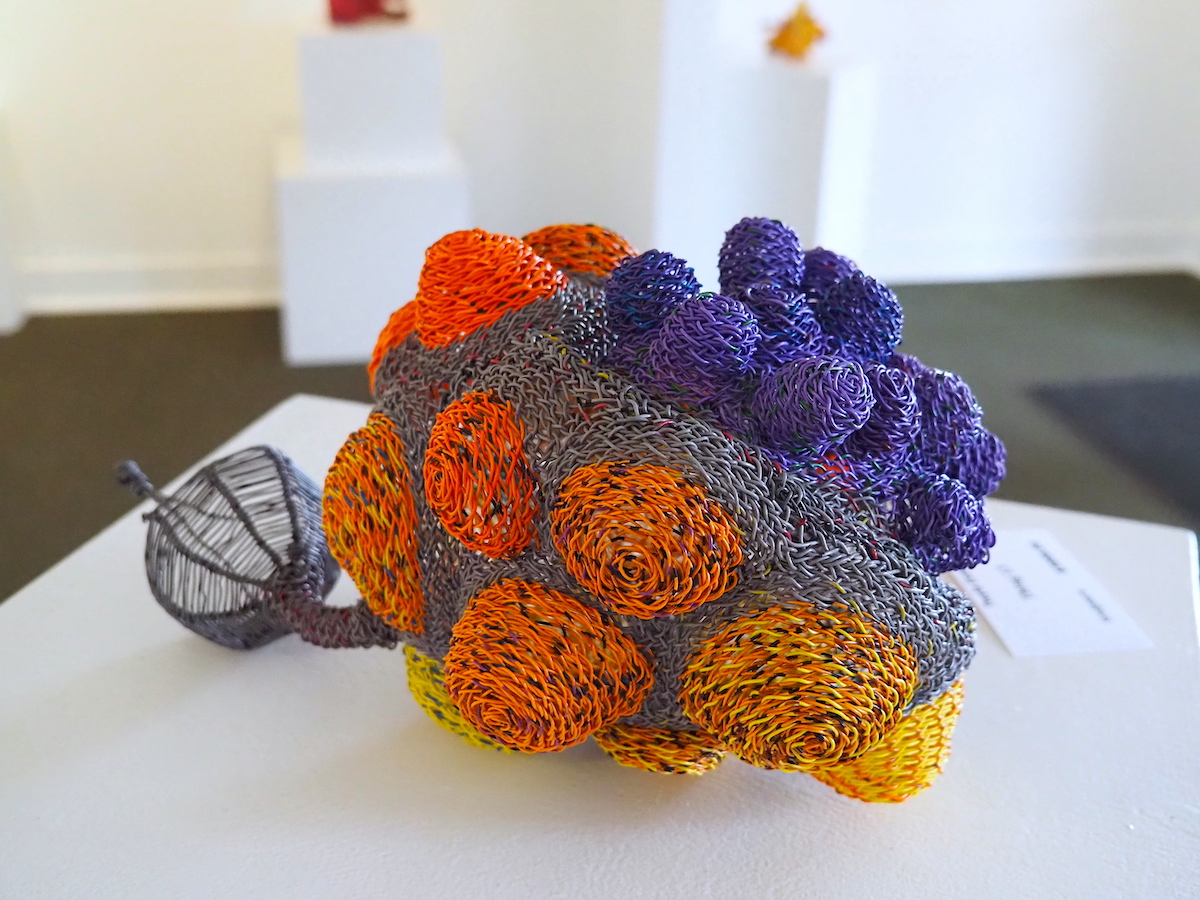
Twyla Exner is inspired by the “wonders of nature and the idea of electronic technologies gone awry.”
Rafuse has long been perfecting his art, having “puttered around” with drawing and painting since he was a teenager influenced by his artist-mother.
Retiring at 55 from a life-long career in Corrections, his spare time gave him the opportunity to fully dive into painting as a profession. It seems somewhat contradictory and one can only surmise that maybe it is the abstract painting’s yin to the Corrections’ yang.
“Perhaps I am still finding “freedom” from the governmental profession that required me to be so self-disciplined,” is Rafuse’s short answer.
But it’s in nature that he finds his most creative impulse. “I constantly notice the dramatic patterns found in cloud formations, water reflections, land erosion, decomposing wood, ice structures, foliage and the many other forces.” The four seasons, particularly winter time, are a robust source of inspiration, he says.
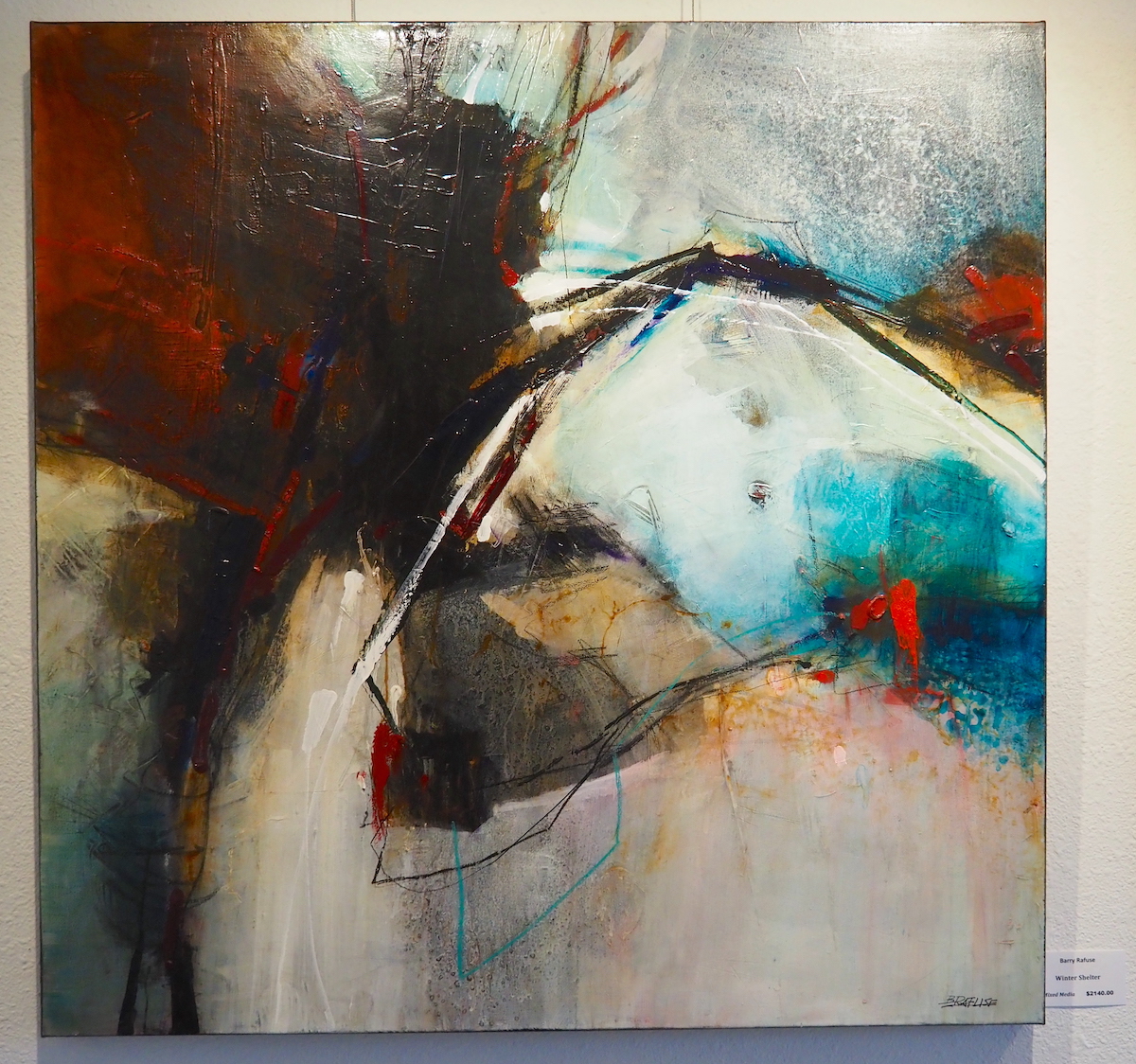
Winter Shelter by Barry Rafuse.
“These beautiful designs are unique and ever-changing. Look deeply into these paintings and find what you think I strived to capture,” he urges.
Rafuse provides a glimpse into the world of abstract painting when he says he avoids “predictable compositions”. He continues: “I do not start a painting with preconceived ideas or a desired end result. I trust the direction paint takes and I listen to what the painting wants to become.”
This has its pitfalls, however. “You can’t really plan you just go with it. Sometimes it’s frustrating. Sometimes it’s really exciting and sometimes it comes together really quickly. Sometimes it’s a battle for a couple of weeks working on the painting.”
He refers to it as “painting on the edge,” a process that often involves “taking a ton of risks,” he says. “In a sense, I am working with the unknown almost to the end. Eventually, a painting will evolve and this is what rewards me.”
The Vision and Variety show is on at the Osoyoos Art Gallery, 8713 Main St. Osoyoos from April 1-22.