By Sebastian Kanally, Times Chronicle
Initial budget numbers show a tale of two increases as Osoyoos will receive a 12.07 per cent tax increase, while Oliver will see a 4.9 per cent increase as part of their shares of the Regional District of the Okanagan-Similkameen’s (RDOS) 2025 budget.
Wayne Making, deputy chief financial officer, and Jim Zaffino chief administrative officer for the RDOS presented the first reading of the RDOS budget to both Oliver and Osoyoos town councils.
The 12.07 per cent and 4.9 per cent increases are before non-market growth (NMG), once that is taken into consideration it results in a 10.86 and 3.46 per cent change respectively.
The main factor contributing to Osoyoos’ larger tax increase is the need for repairs to the Sun Bowl Arena.
Mayor Sue McKortoff made sure to thank Making and Zaffino for the explanation during the meeting, noting that “the Osoyoos increase in taxes is higher than anyone else’s, it’s because of the need for the Sun Bowl repairs, we understand that.”
The budget includes Sun Bowl Arena roof and building upgrades that come with a price tag of $526,510, which will be funded through RDOS reserves and grants.
Osoyoos’ increase is higher than any of the six municipalities or nine electoral areas in the budget.
Osoyoos will have an overall tax requisition of $1,266,408. This is an increase of $136,421 from last year and results in a net tax increase of 10.86 per cent.
These numbers work out to about a $25 increase annually for the average residential property. The average for 2025 will be $220.15 compared to $194.92 in 2024.
Oliver’s overall tax requisition is higher at $1,940,679. This is an increase of $90,722 from last year and results in a net tax increase of 3.46 per cent.
Oliver’s numbers work out to be a change of about $27 increase annually. The average taxes per residential property will be $581.76 compared to $554.54 in 2024.
On a more general note, the RDOS in 2025 has an overall tax requisition of $27,745,266. This number is up $1,660,898 from 2024, which is a net tax increase of 4.88 per cent.
The total RDOS operational expenses is $51.55 million, municipal debt repayment is $8.19 million and total capital projects is $51.23 million with $13.34 million in capital projects being carried forward from 2024.
This means the total RDOS budget is $110.97 million, as compared to $87.74 million in 2024, and $73.81 million in 2023.
The RDOS has new capital requests for services that impact everyone, and everyone pays into, such as general government, 911, telecommunications etc.
The new capital requests for these general areas are all funded out of reserves and do not have tax implications for anyone.
The RDOS is planning to have the utilities department purchase replacement vehicles at a cost of $202,050.
A spot has been reserved for the 101 Martin Street head office addition at a cost of $8,527,226. Making explained that this is “not set-in-stone but is more of a placeholder . . . it’s not an actual expense yet because there are still options coming to the board.”
The Emergency Support Services (ESS) will be purchasing a one-ton truck to facilitate the towing of the ESS trailers, and for towing the newly approved Tiger Dam Trailers.
The Information Services department will also be purchasing around $160,000 worth of various equipment that needs to be upgraded, including infrastructure replacement, boardroom upgrades, workstation/laptop upgrades and data center equipment.
Two other programs that are in the general government section of the budget are a planned solid waste management plan with a price tag of $101,676 and a total of $146,296 spent on regional trails in the regional district.
The largest of the trail projects is the reopening of the Adra tunnel along the Kettle Valley Rail (KVR) trail in Naramata at a cost of $60,000.
When it comes to capital projects just impacting Oliver, there is $222,766 set aside for exterior cladding on the Oliver and District Arena.
New equipment for the Oliver Community Hall will equal $45,318.
Money is also earmarked for Oliver Parks, such as replacing the Kinsman Splash Park components at a cost of $50,000 and a dugout extension and covers for baseball diamond 3 at $15,000.
There are also two larger projects that are contingent on receiving grants. These are the Rotary Park improvement project and solar lighting in the Community Park at a cost of $300,000 and $200,000 respectively.
Lastly, $406,705 has been set aside for the Community Complex Parking Lot repaving.
One other point of note for Osoyoos is the increased cost for transit.
There are two separate sections of the budget for transit, “Regional transit” and “Transit – South Okanagan”.
The former comes at a cost of $32,872, which is up $16,104, almost double it was in 2024.
The “Transit – South Okanagan” comes at a cost of $66,986, which is up $14,639 from 2024.
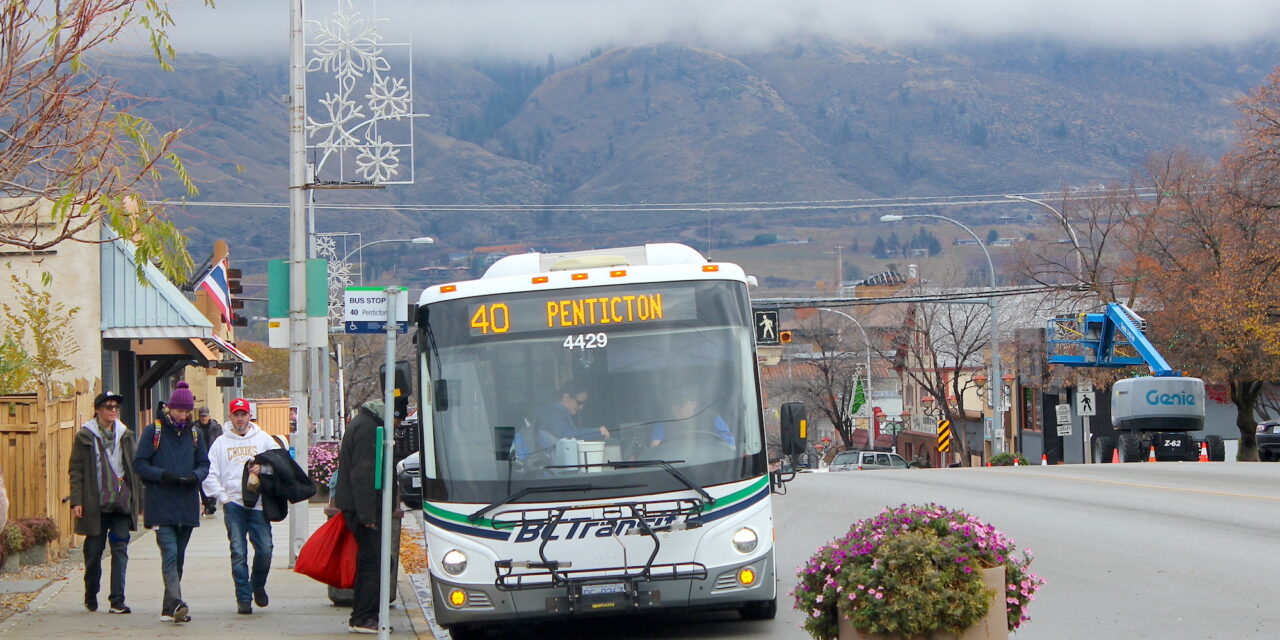
The two are related to the two different bus routes in Osoyoos. One is Route 40, Osoyoos to Penticton, and the other is Route 41 which makes multiple stops around Osoyoos.
McKortoff noted that “ridership is up 45 per cent, which is a good thing. Higher than anywhere else.”
She explained it was most likely because of increased routes and a new bus.
Zaffino did clarify that when it comes to transit, the RDOS board has no authority over the cost, BC Transit tells them what it costs and “they just have to go with it.”
These numbers will have to go through the public feedback process and can be subject to change. They must be adopted by the RDOS Board of Directors by March 31, 2025.
The RDOS is not a taxing authority. Once the budget is agreed upon by the board of directors, the requisition goes to the taxation authority through the province. The province then issues tax notices and then charges 5.25 per cent administrative fee on top of that to the electoral areas, explained Making.
Municipalities tax on behalf of the RDOS, regional districts do not tax municipalities.