By Dan Walton
The most politically engaged students of Oliver are especially passionate about tackling the issues of extreme poverty and mental illness.
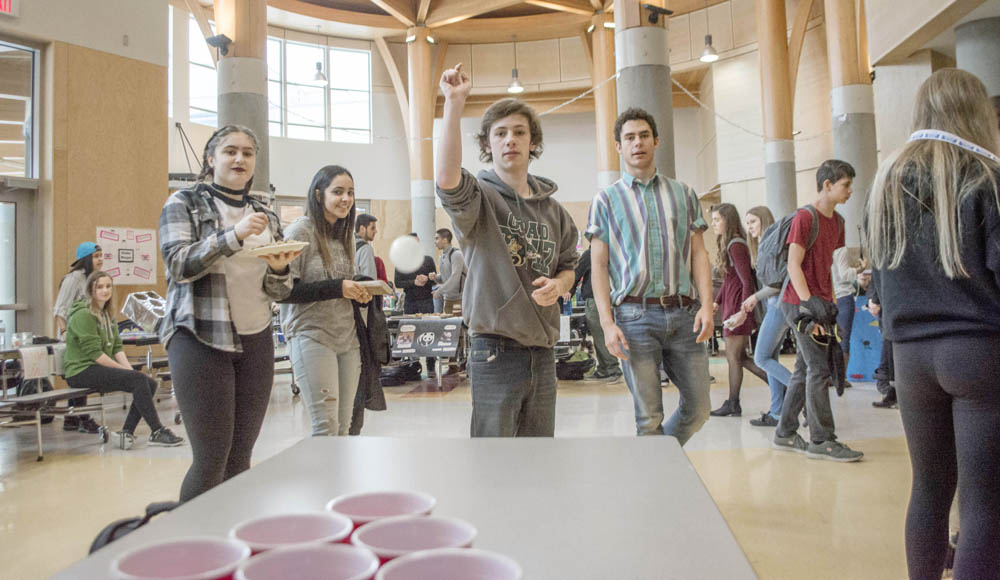
During lunch break recently at Southern Okanagan Secondary School, Grade 12 students in the Social Justice program held a fun fair. The cafeteria was full of info displays about their year-end projects, which were each based on a humanitarian undertaking of their choosing. There was a carnival-style game at each station, which was used to engage peers and raise money to make a difference.
Jacob Bollock decided to take on the issue of homelessness in the South Okanagan.
“We have no place for homeless people here in Oliver,” he said. “No place for them to go, nowhere to get taken care of. No place for them to be able to give back to the community.”
Whether it’s done as a public or private initiative, Bollock would like for a building or small lot of land in a central location to be donated to those without a home.
“They’d be able to give back easier because they’d be connected and they’d be near town so they’d be more visible instead of hiding behind the bridges or buildings,” he said.
Many residents of Oliver are homeless simply because it’s unaffordable, Bollock said, which has resulted in endemic couch surfing.
“We have absurd housing prices,” he said, adding that there’s a large discrepancy between average wages and average housing costs.
Shelby MacRae, who’s also in the program, addressed the homeless problem as well.
“Over the course of my life I’ve noticed that homelessness in the South Okanagan has gone up,” she said. “Me and my group decided that taking on homelessness would be a good idea because even if it helps just a few people, that’s the difference we want to make.”
Earlier in the semester, MacRae’s group ran a blanket drive and collected many warm fabrics for the Salvation Army Compass House in Penticton.
“They shelter homeless people over the winter and everybody donated what they could for blankets.”
One of the issues interwoven with homelessness is mental health, which was the focus of Brittaney Silberg’s project.
“I see a lot of people around me struggling with mental health and I struggle with it as well,” she said. “I want people to be made more aware – they don’t need to just self-diagnose, they can go get help and there’s a lot of support everywhere.”
Silberg said insecurities and the fear of exposing vulnerabilities prevent many people from addressing their mental illness, and a greater sense of awareness will break down those stigmas.
“Everybody is growing up too quickly and technology is introduced into our lives too soon. I want to give people a better understanding of what mental illness is and how it can be healed,” she said. “Anxiety is getting way bad for teenagers in Canada.”
The instructor for Social Justice, Sarah Riordan, said the program gives students the opportunity to show the greater community that they want to be an active part of it.
“People underestimate teenagers and often think of them as self-centred,” she said.
It was important for the year-end project to require students to engage their issue of choice with a hands-on approach.
“They can’t just write a report or something.”
One group of students this year included lobbying the government to increase funding for aboriginal education in isolated reserves, and another group raised money for World Wildlife Federation.
In years past, students raised money to set up a micro-financing account locally, and that continues to grow and gain momentum, Riordan said.
“They really do care about other people and issues in the community.”