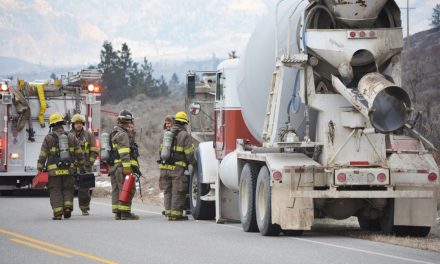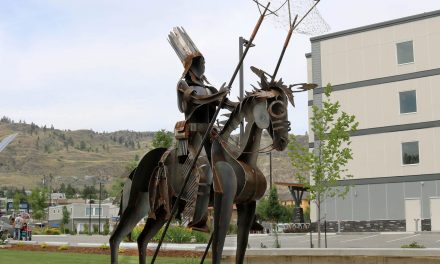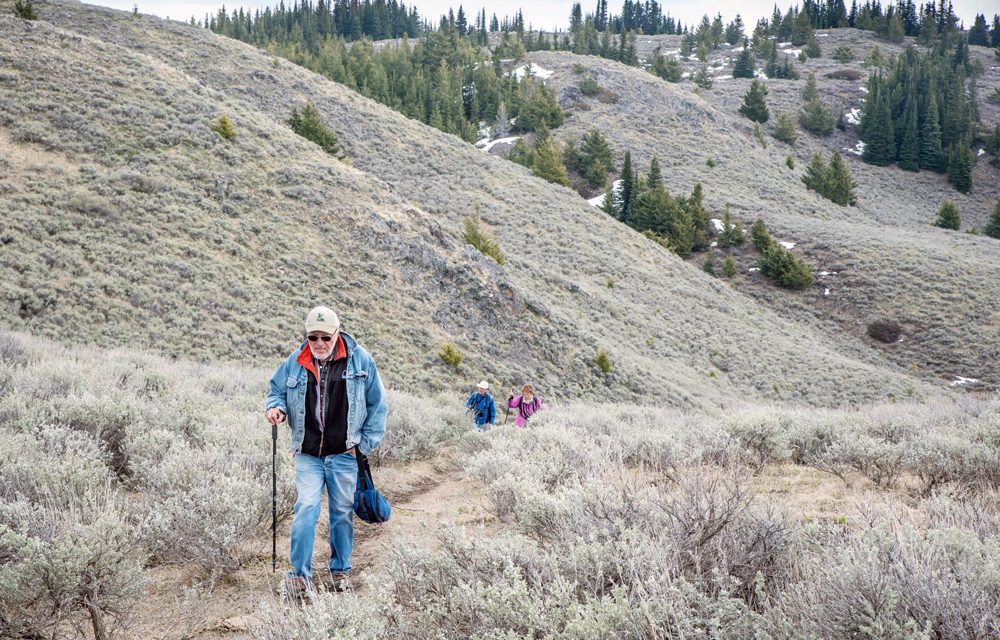

A Freedom of Information request failed to turn up a survey that BC Premier Christy Clark referred to in a television interview this summer, when she said the majority of people in the South Okanagan don’t want a national park. Here, hikers make a trip up to Mount Kobau. (Richard McGuire photo)
When Premier Christy Clark said in a television interview in July that a majority of people in the South Okanagan don’t want a national park and that surveys back her up, there was much scratching of heads.
Now, a Freedom of Information (FOI) request by the Osoyoos Times for information on the survey or polls Clark referred to has come up empty.
“Although a thorough search was conducted, no records were located in response to your request,” said a letter received last week from Cindy Elbahir, manager, Central Agency Team, Information Access Operations with the provincial government.
Clark made the claim in a July 12 interview with Rick Webber of Global Okanagan.
When Webber corrected the premier and pointed out that polls show a majority supports a national park reserve, Clark responded: “Well, there’s competing surveys.”
In fact, a poll by McAllister Opinion Research, released in April 2015, showed two-to-one support for a national park among residents of Boundary-Similkameen and three quarters support in Penticton.
The only other scientific poll on the subject was done by the same Vancouver-based polling firm in 2010 and showed a smaller majority supporting a national park.
The Osoyoos Times’ FOI request asked the premier’s office to provide tables and methodology of the survey or poll Clark was referring to in her response to Webber.
The request asked only about surveys or polls released after Jan. 1, 2011.
Although there was a 6,000-name petition opposing the park in 2005, the Osoyoos Times has not found any record of a scientific poll.
Asked if the premier was wrong in referring to “competing surveys,” park supporter Doreen Olson replied: “I think she’s probably misinformed.”
Clark’s office was invited last week to respond to this story. A statement from her office received Monday said:
“Premier Clark’s comments were referring to the extensive amount of community consultation, dialogue, media commentary, and public feedback on the South Okanagan National Park proposal that has taken place over the past few years. In particular, she was alluding to the fact much of this feedback has shown the issue to be extremely divisive within the region, with local residents split on the creation of a full national park in the area. Her comment was not intended to suggest government was relying on a single survey or poll to guide its actions on this issue.”
Olson, however, was surprised by Clark’s comments.
“When I heard the interview, I thought for sure she was looking at very old information,” said Olson, co-ordinator of the South Okanagan Similkameen National Park Network. “It doesn’t surprise me at all that there isn’t a survey that would show more people opposed than support.”
Peter Maser, a retired journalist now living in Penticton, was also taken aback by Clark’s comment in the interview with Webber.
He sent letters in August to several media outlets, including the Osoyoos Times questioning Clark’s claim.
“For those who follow this issue, the premier’s comments were a revelation,” Maser wrote. “A competing survey or surveys? Majority opposition to the park? To paraphrase Oliver Twist: please, madam, may we have some more – information that is.”
Maser wrote to Clark at the same time asking her for information on the “competing surveys.”
“What is the survey (or surveys) you referred to?” he asked the premier. “When was it conducted and by whom? What was the sample size, margin of error and methodology? Was the survey conducted with public monies? If so, why have the survey results not been made public?”
Clark did not respond to Maser, but instead Environment Minister Mary Polak responded on the premier’s behalf. Polak did not answer Maser’s questions, but only made a general statement.
“Through the feasibility assessment process for the proposed national park reserve that Parks Canada conducted in co-operation with the province in 2010, it became clear that, while there was support for the proposal, there were a significant number of people who were (and remain) opposed,” Polak wrote.
Maser wrote back to Polak saying he was disappointed she didn’t answer his direct questions. He again asked her if the polls exist. He has not received a reply.
Asked for his reaction to news that an FOI request failed to turn up a poll, Maser replied: “I’m not surprised because I do not believe that such a survey was ever taken. I think the premier was being creative, shall we say, in her comments about the existence of a public opinion survey and the existence of strong resistance to the creation of a national park.”
Olson noted that support for a park grew between the two surveys conducted by McAllister Opinion Research. She added that recent comments received in response to the government’s August 2015 Intentions Paper mirror the latest McAllister poll. Those comments also show strong support for the inclusion of the area surrounding Mount Kobau in a national park reserve.
Neither the comments received in response to the Intentions Paper, nor the 2005 petition opposing the park, are scientifically valid because respondents are not randomly chosen, but are self-selected.
By Richard McGuire