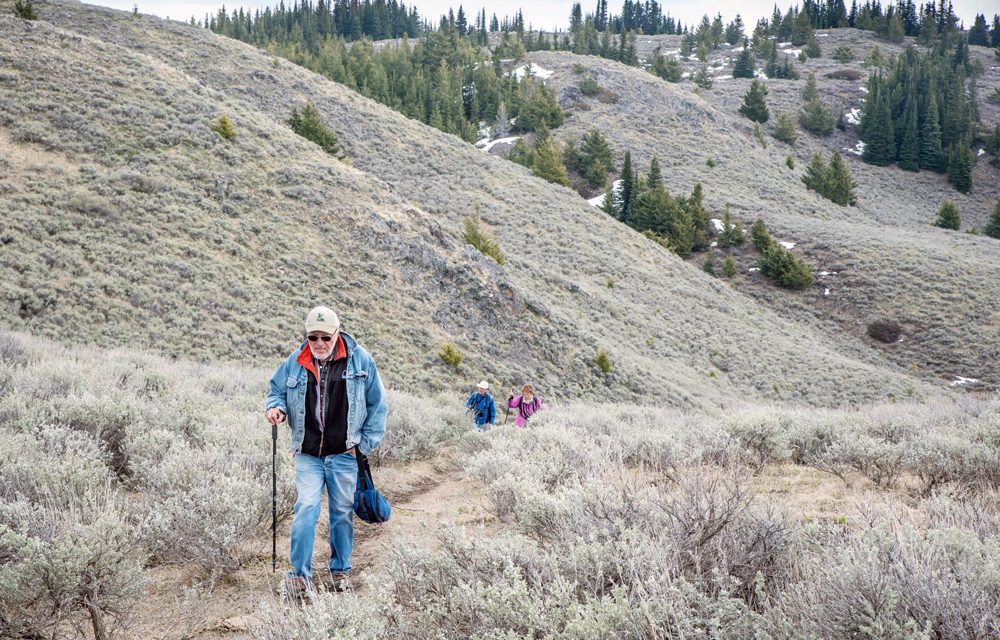

The proposed national park reserve is not just simply a walk in the park.
(Photo by Richard McGuire)
A cone of public silence dropped over Parks Canada officials in the two months following the B.C. government’s abrupt announcement in December 2011 that it was ending talks about a national park reserve in the South Okanagan.
At first federal officials sought to defend the park plan, while acknowledging that Parks Canada couldn’t proceed without provincial support.
But then a “change in direction” came down and media calls went unanswered, meetings with stakeholder groups were cancelled and messaging was sanitized on Parks Canada’s website to avoid any statements that might cause offence to the B.C. government.
This information came to light in hundreds of pages of federal and provincial documents obtained by the Osoyoos Times during a two-year investigation into the circumstances that derailed the national park proposal.
Some of the heavily redacted (censored) documents obtained from Parks Canada took almost a year and a half to release, in violation of the federal Access to Information Act.
The documents make clear that Parks Canada sought to protect the progress it was making on collaboration with First Nations, while at the same time treading gently so as not to damage its relationship with the B.C. government.
But it was also anxious to continue productive discussions with local ranchers aimed at addressing their concerns about grazing rights.
The B.C. cabinet decided in January 2011 not to proceed with a national park, but that decision was kept secret for nearly a year.
It was only revealed when Environment Minister Terry Lake replied to several stakeholder groups on Dec. 21, 2011, stating: “…the Province is not convinced there is enough local support to move forward with this proposal at this time.”
Parks Canada officials had been aware since February 2011 that a decision was “on hold,” but they continued talks with local First Nations and ranchers in the hopes that talks with the province would resume.
When Lake dropped his bombshell, Parks Canada officials scrambled to come up with a media strategy and respond to stakeholders.
“The status of the project with respect to the provincial government is now better understood,” said one media strategy document. “If community advocacy groups continue to push for answers, a public political response could risk an answer that would limit further options.”
Parks Canada officials suggested their objective was, “to strategically respond to media questions about the status of the project in a low-key manner that will not jeopardize (the) current relationship with (the) provincial government and First Nations and ongoing dialogue with the ranching community.”
But for more than three weeks, Parks Canada officials continued to state the benefits of a park before being muzzled.
“The proposed national park reserve in the South Okanagan/Lower Similkameen provides an invaluable opportunity to conserve and present one of Canada’s iconic natural landscapes,” say media lines drafted in early January 2012 to respond to Lyonel Doherty, editor of the Oliver Chronicle. “It would facilitate unique and inspiring visitor experiences and provide a living legacy for future generations.”
Doherty’s story, published Jan. 18, 2012, however, forced a senior Parks Canada official to do some damage control with the province.
Kevin McNamee, director of the park establishment branch, had to get on the phone to Lori Halls, an assistant deputy minister with the B.C. Ministry of Environment, to explain that the interview with the Oliver Chronicle was done before the change in communication direction.
McNamee also told Halls that Parks Canada had taken content down from its website and posted a new status notice about the park recognizing the B.C. decision.
He also raised the thorny issue of what the province thought of Parks Canada continuing with “contribution agreements” reached with Osoyoos Indian Band (OIB) and Lower Similkameen Indian Band (LSIB).
Those agreements, signed in August 2011 by Parks Canada and the band chiefs, provided each band with $200,000 “to develop and articulate a Syilx perspective, including a vision and concept, for a protected area.”
The assumption was that the protected area would be developed and managed co-operatively with Parks Canada.
The agreements were signed between the time the B.C. cabinet secretly decided not to move forward and when it made that decision public.
Parks Canada was concerned that ending those agreements would damage relations with First Nations, which had taken several years to rebuild.
“The First Nations could go to the media and use this as (an) example of the (Government of Canada) reneging on commitments it has made yet again,” says one document labelled “confidential.”
Fortunately for Parks Canada, OIB and LSIB, it appears the province supported continuation of the agreements, although heavy redaction of the documents hides most of what the province said.
“While the present circumstances reflect the province’s current political realities, folks in the provincial public service know how significant the breakthrough that we are achieving with goodwill from the (Okanagan Nation Alliance) really is,” says a note from Richard Carson, a senior Parks Canada official, to McNamee.
“This is an emerging relationship that they (the province) have sought for many years and had concluded would never be possible,” Carson continued.
Meanwhile, Parks Canada stopped responding to media inquiries.
“The media interview request for Penticton Western was declined due to potential escalation and risk of countering the provincial position,” said Bruno Delesalle, project manager for South Okanagan/Lower Similkameen. “We may take a few days of cooling before proceeding with additional responsive media requests.”
A planned joint press release by the ONA and Parks Canada was cancelled.
A longstanding commitment by Parks Canada officials to speak at a staff retreat of the Thompson-Okanagan Tourism Association (TOTA) also had to be cancelled.
Meanwhile, a media interview with Alex Atamanenko, former MP for B.C. Southern Interior, set off alarm bells when Atamanenko suggested he might challenge then federal Environment Minister Peter Kent to explain what was happening.
The story came about when the Penticton Western News noticed that Parks Canada has changed its website to say, “In order to respect the province’s perspective, Parks Canada will not publicly engage stakeholders on the proposal at this time.”
Atamanenko wondered whether this applied to First Nations, who are not considered stakeholders, but are full and equal partners in the parks plan.
“Does that mean that (Parks Canada) will not be meeting with stakeholders like business, ranchers and others, but are still meeting with First Nations…?” Atamanenko asked.
Parks Canada hurriedly prepared a question period “card” or scripted response for Minister Kent, but Atamanenko never asked the question in the House of Commons.
Atamanenko’s successor, Richard Cannings, the current NDP MP for South Okanagan-West Kootenay, also appeared in the Parks Canada documents. At that time, he was an environmental activist and national park supporter better known as “Dick Cannings.”
“Park opponents seem to be dominated by local hunters and all-terrain vehicle users,” Cannings wrote in an open letter to Premier Christy Clark, which still appears on his blog Birds and Books. “These groups have the entire valley to play in and will only suffer minor inconvenience if the park goes ahead in its present form, a form much reduced in size from previous plans.”
Cannings said he was disappointed Clark’s government “has chosen to listen to a small minority of constituents” in cancelling the park project.
McNamee and Delesalle emailed each other about Cannings’ letter and Delesalle agreed to phone Cannings.
“Appreciate that this is difficult, but you guys are doing a great job,” McNamee told Delesalle in an email that is otherwise censored.
By Richard McGuire