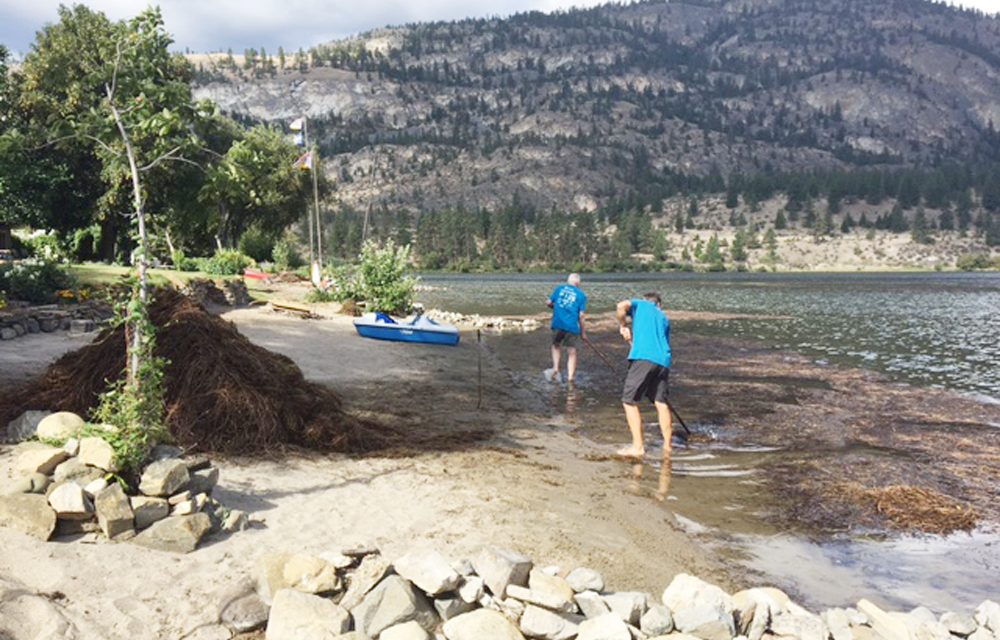

Vaseux Lake residents have been diligently trying to clean up the milfoil, but it’s a challenging task. Photo contributed
(This is the second of a two-part feature exploring the effects that the invasive seaweed known as milfoil is having on Vaseux Lake.)
Milfoil’s unfavourable effects have been most evident in Vaseux Lake, but it’s also present in other South Okanagan lakes including Skaha, Okanagan, Osoyoos and even Tucelnuit Lake in Oliver. But unlike Vaseux, the other lakes were all included under the jurisdiction of the Okanagan Basin Water Board, which monitors and treats excessive levels of milfoil.
Because Vaseux is in the middle of all those lakes, resident Norm Gaumont couldn’t rationalize why it’s not on the water board’s list of lakes.
“It’s such a small, shallow lake, milfoil is much more detrimental to it. And the temperature of water increased because milfoil stops circulation.”
“I’m really glad that Mr. Gaumont brought it to my attention,” said RDOS Area C director Terry Schafer in an email. “It’s incredible how much of the stuff the Sundial Road residents have had to deal with. It’s not good for them, it’s not good for the fish, not good for swimming or canoeing, not good for our tourism image and definitely not good for firetruck suction pumps, should they need to ever to be employed in an emergency.”
In response to a recommendation from the community, Schafer said he urged the RDOS to request Vaseux be added to the list of treated lakes.
“That was accomplished on Sept. 1 with a motion to that effect and passed by the board,” Schafer said.
However, there are still some logistical challenges in the way before any equipment can enter the lake to deal with the milfoil.
Projects manager James Littley with the water board said challenges include the lake not having an access point to launch the “very large” machinery, as well as red tape that restricts motors in the lake which requires comprehensive permits from many levels of bureaucracy.
Once those obstacles are overcome, Vaseux’s milfoil can be treated in two ways – harvesting it from above the root, and by rototilling it from under the root. Neither practice can permanently rid an ecosystem of milfoil, but Gaumont said the rototiller is much more effective.
“You’ll never eliminate it but you can reduce it,” he said. “In a small lake like ours it’s crucial to have good water flow.”
“The local folks are calling for the rototiller,” Littley said, adding that the soonest it could be administered is the fall of 2017
The other method for treatment, harvesting the milfoil, could be arranged a few months sooner than that, Littley said, as permits would be a little easier to obtain.
Littley said the water board used to treat the milfoil in Vaseux Lake about a decade ago, but things were a little easier then – they had access over private property to deploy the equipment, and fewer environmental restrictions were in place.
“It’s been a problem for a while but seems to have gotten increasingly worse over the last few years,” he said.
While rototilling the milfoil is a more effective solution, there are environmental concerns over the greater impact it has on the floor of the lake. But if the bottoms of B.C. lakes are preserved so strictly, greater milfoil infestations are anticipated. Littley said even without rototilling, the lake floor will still be affected anyway because of the sentiment it leaves on the lake floor as it decomposes. There’s no consensus among provincial scientists as to which is of higher priority, Littley said, and he wants them to come to a conclusion.
“Milfoil crowds out native weeds that actually provide oxygen,” he said. “A little bit of milfoil is good for bass, bad for our native fish and better for invasive fish. But once it’s as thick as it is in Vaseux it’s basically bad for everything.”
By Dan Walton