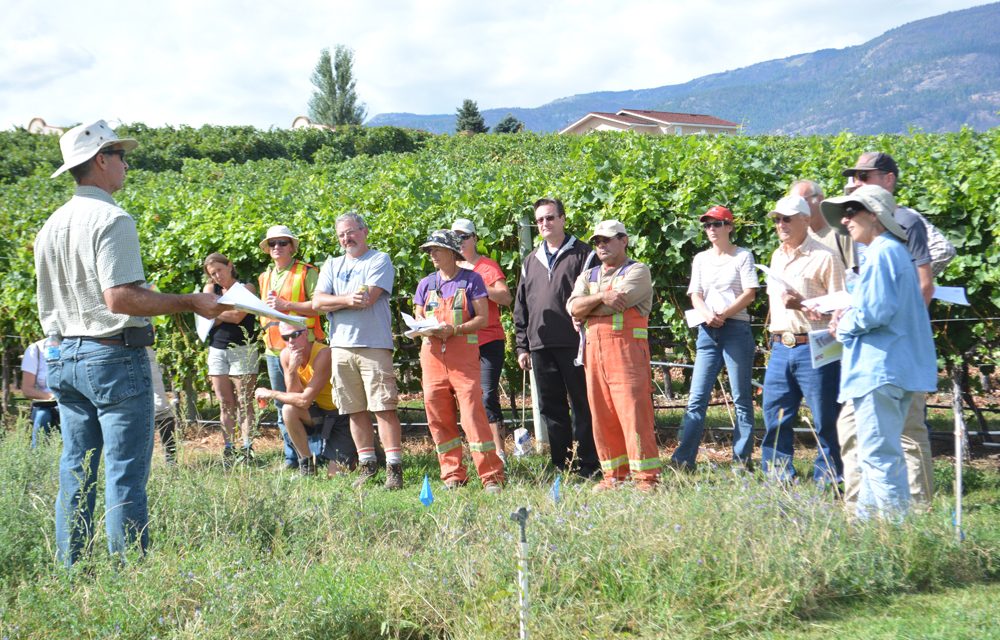

Pesticide specialist Ken Sapsford from the Ministry of Agriculture addresses a group of people during a field session on invasive species Thursday. Photo by Lyonel Doherty
Osoyoos Indian Band elder Jane Stelkia says people have to “go to war” on puncturevine in order to control the invasive weed running rampant in the South Okanagan.
“It’s the same as drugs . . . it’s all over now; I don’t know how we’re going to stop it,” she said during an agricultural field session at Quinta Ferreira Estate Winery on Black Sage Road on Thursday.
Both Stelkia (rancher) and John Ferreira (winery owner) have been participating in research trials conducted by the Okanagan and Similkameen Invasive Species Society (OASISS). They were on hand Thursday to hear program manager Lisa Scott and Ministry of Agriculture pesticide specialist Ken Sapsford talk about the trials.
The program involves test garden plots of puncturevine and longspine sandbur on Black Sage Road. Various chemical treatments have been applied and their results recorded, with the objective of finding effective control methods via herbicides.
For example, the herbicide Prism is doing a good job in controlling the two weeds, Sapsford told the group during the tour. However, it was continually stated that herbicides (such as Roundup) do not affect puncturevine seeds, only the green part of the plant.
To physically control this noxious weed, OASISS recommends that the first plants found in an area should be removed before seedpods begin to form. If seedpods are already present, the plants should be disposed of by burning or burial at the landfill.
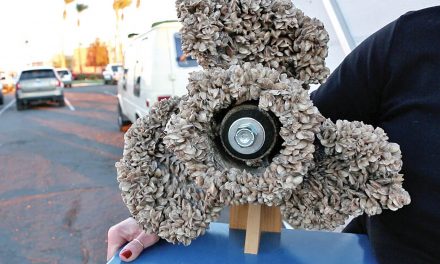
Prevention methods include removing seedpods from vehicle and machinery tires before leaving puncturevine infested areas. And do not move contaminated soil, gravel or mulch to a new area.
Scott said these invasive weeds are costing people at lot of time, money and stress.
“These plants are impacting a variety of industries and stakeholders,” she stated, adding they are creeping into rangeland, ground crops and parks.
Ferreira said if people don’t get rid of these plants now, they will have a significant impact on the grape growing industry.
Personally, he uses Roundup to control puncturevine on his property.
But he recalled an Osoyoos farmer who attempted to get rid of puncturevine four years ago by burning his field. The following year the field was full of the weed, Ferreira said.
Stelkia said much of the puncturevine appears to start on the roadside, and mowing operations seem to be spreading the seed.
Gerry Mansiere, OASISS crew supervisor, said they are controlling puncturevine on Black Sage Road and Highway 97, but not eliminating it. They too use Roundup as a method of control.
Scott said the point she wants to get across is that everyone has to work together. “Cooperation is the key.”
During the field session, talk shifted to longspine sandbur, a grass that has prickly spines that easily attach to pant legs and machinery.
Scott said sandbur can cause ulcers in animals’ mouths.
There are currently no biological control agents approved for this grass in Canada, but it can easily be controlled by shallow tillage, hoeing and hand pulling. Repeated mowing every three weeks in the spring and summer will manage seed production.
Prevention includes cleaning equipment, clothing and pets prior to leaving infested areas.
Did you know?
Puncturevine seeds can be viable for seven to eight years in soil, and the weed itself (extract) is known as a sex drive enhancer.
By Lyonel Doherty