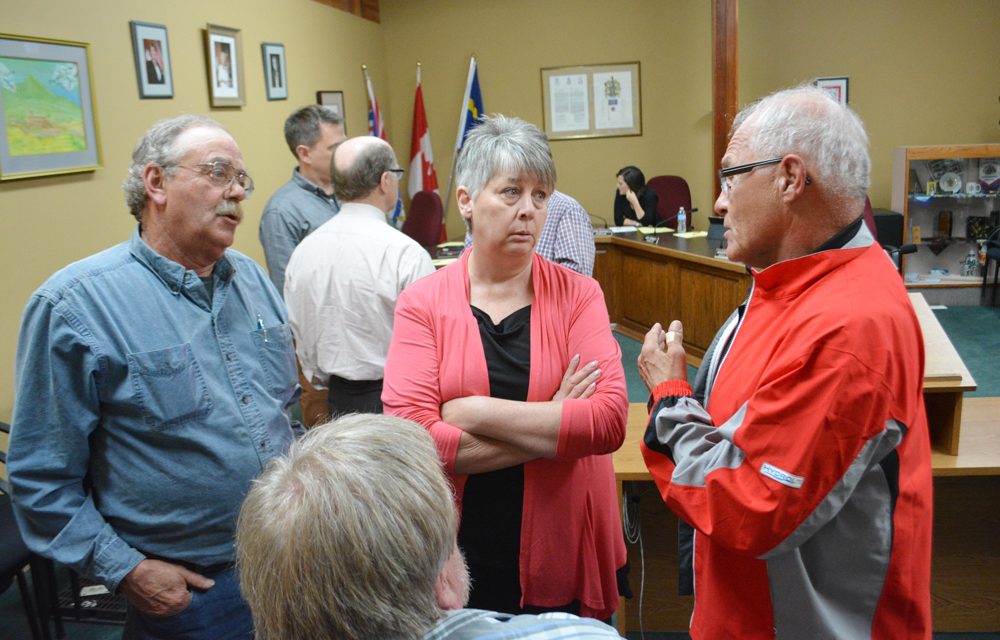

Town Councillor Maureen Doerr speaks with Agricultural Land Commission director Greg Norton (left) and vice-chair Gerry Zimmermann during a delegation in council chambers last week.
Photo by Lyonel Doherty
The Town of Oliver has the gavel when it comes to approving or denying applications that impact farmland, says the Agricultural Land Commission (ALC).
Last week council hosted a delegation from the ALC, which gave a presentation on the agency’s mandate and objectives. It was attended by commissioners Greg Norton, Jim Johnson, Gerry Zimmermann (vice-chair) and ALC staff.
Executive director Kim Grout said the primary goal of the ALC is to preserve agricultural land and encourage farming in the process.
She pointed out that only five per cent of BC’s land base is inside the Agricultural Land Reserve (ALR). And there is only 1.1 per cent of prime agricultural land in the ALR.
Grout said the Okanagan region has 224,977 hectares of ALR area, representing five per cent of BC.
She noted that Bill 24 (ALC Act changes) came into force in 2014, splitting the ALR into two zones (Zone 1 and Zone 2). It also legislated six independent panels. Zone 1 represents the South Coast, Island and the Okanagan, while Zone 2 represents the Kootenays, the Interior and the North.
The executive committee is responsible for deciding applications referred by the chair and by a regional panel.
The commission itself recommends legislative or regulatory changes to government, determines ALR boundaries, and ensures local government land use planning is compatible with the ALR.
Grout said the government amended the regulations in 2015 to include: medical marijuana production, farm retail and processing permitted by a co-operative association, breweries and distilleries, and the ability to lease a portion of a farm for farm purposes.
Grout noted that local governments are partners in agricultural land preservation, adding that 75 per cent of the ALR is under local government jurisdiction.
Grout told council that it has the authority to support or deny an application, adding that the Town doesn’t have to send the application to the ALC.
“If it’s something that the community doesn’t support, what are the chances that the ALC will support it?”
Councillor Jack Bennest said in the case of a land rezoning application, the Town doesn’t want its position to interfere with the ALC’s process.
Grout reiterated that the process ends at the municipal council table.
Norton said the commission is always interested in local input, noting it’s important for council to comment on an application.
“We want to know as much as we can (to help us fill in the gap),” Norton said.
Grout said the ALC has received a $1.1 million budget increase to support programs such as compliance and enforcement.
She also noted that application fees have increased to $1,500 in Zone 1 and $900 in Zone 2. In addition, there are new service fees for approved applications. For example, it costs $150 to review a document, and $350 for a site inspection. And $500 to $2,000 annually in monitoring fees.
Grout said one of the ALC’s performance targets is to make decisions (on applications) within 60 business days.
By Lyonel Doherty