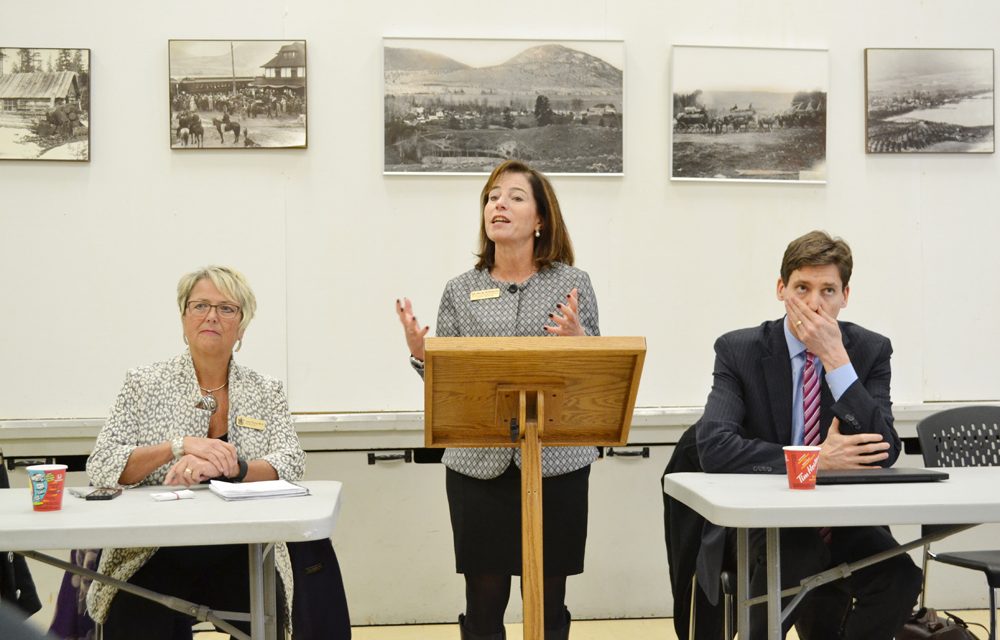

From left, NDP spokesperson for health Judy Darcy, spokesperson for seniors, local government and sports, Selina Robinson, and spokesperson for housing, David Eby heard from more than 30 people at a seniors forum in Penticton Feb. 4. Photo by Trevor Nichols
If the crowd that gathered in the Penticton Museum and Archives auditorium Feb. 4 is any indication, British Columbia is struggling to give its seniors the medical support they need.
About 40 people attended an NDP-sponsored seniors forum last week, which provided a venue for local seniors, politicians and health care workers to sound off on the issues affecting the province’s oldest residents.
The forum lasted more than two hours, and again and again speakers returned to one common theme: residential care is failing in BC.
Natalie Mark, a mental health advocate with the BC Nurses Union, told the crowd that across the province residential care nurses are struggling to provide their clients with proper care because of packed schedules and overwork.
Residential care is used to keep patients out of hospitals by having nurses visit them in their homes. But often, Mark said, nurses have only a few minutes each day with their clients, which is barely enough time to treat their medical needs, and doesn’t even begin to address emotional ones.
“Nurses from all over the province are crying because they just don’t have the time to spend with their clients and give the care that they want: somebody to talk to, being able to sit and talk to clients.
“If you’re rushing around with your med cart, because you’ve got to get your meds out [and] you’ve got to get your treatment done you can’t develop the relationship you want to have with the clients you’re caring for. It breaks my heart,” she said.
Oliver senior Joy Vangen has experienced overworked home care workers first hand. Not long ago she was injured and needed help cooking and bathing at home. She said her care came from a constantly changing cast of nurses, whom she typically saw for about 15 minutes, twice a day.
Vangen said she never knew who was coming to her house, or how much they would be able or willing to help her do in the short time they were there.
“From the seniors point of view, I want somebody I know, I can call by name: they’ve been here before, they know my kitchen, they’re not going to waste time looking around,” she said.
Lynn Kelsey, a community advocate who works at a women’s shelter in Penticton, said at the forum she used to coordinate home care, and recalled when caregivers had much more time to spend with clients.
“My staff were allowed to sit and have tea. They had time to vacuum and give a bath and make a meal and sit and enjoy the meal with the person. They were there three times a week,” she said.
“Those days are so gone, we’re not supporting people in their home, when that’s so much more reasonable.”
And while the over-taxed residential care system has worrying consequences for the patients it is reaching, its inability to help all the patients who could potentially access it is potentially costing the province a lot of money.
Judy Darcy, one of the NDP MLAs hosting the forum, said that caring for a patient in their home instead of hospital can potentially save as much as $1,000 a day.
“We need to be investing more in our seniors by investing in residential care beds and home support and home care, so people can maintain their dignity and live happier and healthier for longer,” she said.
Several speakers at the forum echoed Darcy’s concerns, telling stories of friends and loved ones who spent days or weeks in hospital when they could have been cared for at home.
“I think it’s a disgrace that these types of things are happening with our tax dollars. We want our seniors to be comfortable in their latter years, so instead of all this processing that’s going on … let’s see something happen,” one retired nurse said.
Others told tales of taking huge pay cuts and spending large amounts of time and money caring for loved ones at the end of their lives.
Selina Robinson, another NDP MLA, pointed out that “there’s a whole industry of people caring for their loved ones that goes unacknowledged,” and that those people should be helped by the government as well.
By Trevor Nichols