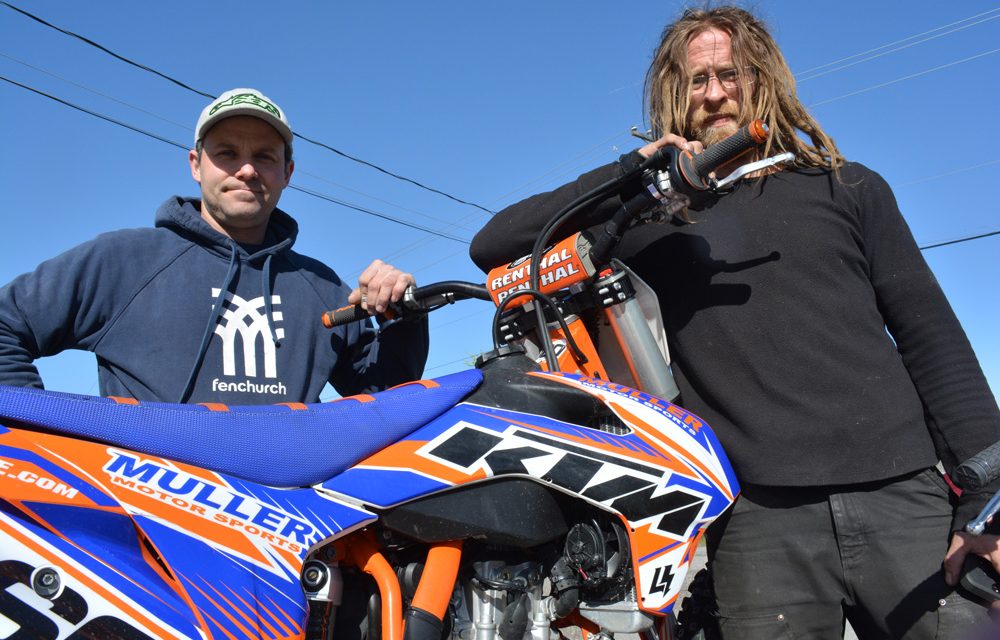

Jeff Muller (left) from Muller Motor Sports in Oliver says the new registration rules for off-road vehicles is nothing more than a cash grab. He noted that registering a vehicle purchased from a private individual will be complicated and expensive. Muller is shown here with Shyvano Joly. File photo
On November 1 new regulations requiring all off-road vehicles in BC to be registered and insured officially took effect.
The changes have been in the works since 2009, when the provincial government launched its Off-Road Vehicle Management Framework to establish comprehensive rules for off-road vehicle use in British Columbia.
Those rules are now officially on the books and the South Okanagan’s off-road vehicle (ORV) community is not happy about them.
The frustration with the new rules appears widespread, with members of the community upset for a number of reasons.
For Nathan Ondrus, the president of the South Okanagan Off-Road Club, the new rules mean paying thousands of dollars in back-dated taxes for his fleet of ORVs.
Ondrus has a wife and four kids, all of whom own multiple ORVs. Under the new regulations, every off-road vehicle purchased less than five years ago will be taxed when registered with the province.
ORVs don’t need to be registered if they are staying on private property, but if Ondrus wants to do any serious driving with his family he will have to pay back taxes on more than a dozen vehicles.
“When we purchase these bikes we purchase them knowing we didn’t have to pay taxes on them. Now all of a sudden I have to pay taxes on 15 bikes and snow machines for my family. That’s going to be thousands of dollars.”
Jeff Muller, who owns Muller Motorsports in Oliver, agrees.
“It’s just a cash grab,” he said of the new set of registration rules.
Along with paying back taxes, Muller pointed out that the process of registering an ORV bought from a private individual (the way he says most people get their vehicles), is complicated and expensive.
First, you have to do an official VIN search on the vehicle. Next, you need to get that search signed by a notary. After that, it’s a trip to the insurance office, where you pay taxes on the declared value of the vehicle, along with the $48 registration fee.
“When a person has a family, and they have two or three machines, plus their wife’s machine and their machine; holy cow,” Muller said. “For somebody who has a fleet of vehicles – that’s crazy money.
“A lot of people also don’t have a lot of money. And if you have a $500 motorcycle and you just want to get out, it’s going to cost you two to three hundred dollars just to use that motorcycle.”
“Most of my stuff I just bought from some guy out of his backyard. I don’t have a receipt, I don’t have a name. I found him on the web and I went to his house and that was it; a one-day deal. Going through the notary process is a huge deal,” Ondrus added.
Along with the extra cost, ORV enthusiasts are furious that the new rules might severely limit young riders.
Both Muller and Ondrus expressed deep frustration with their understanding that their kids wouldn’t be able to legally drive on Crown land.
The problem, according to Ondrus, is that the new rules will make it illegal to drive on Crown forest service roads without liability insurance, but ICBC won’t give liability insurance to kids under 16.
It is still legal for them to drive on Crown land, but as Muller points out, finding land appropriate for driving that’s not a road, or accessed by a road is difficult.
“You basically got to tell your kid is you can’t leave the house unless you want to go on some closed course somewhere,” he said.
“Parents will throw their hands in the air and say ‘screw it, we’re going to go play soccer, because it will be such a hassle for kids to ride their bikes.’ It’s going to have a huge impact on kids getting into the sport.”
ICBC spokesperson Michelle Hargrave could not answer any questions clarifying the rules, writing in an email that “The Ministry of Forests, Lands and Natural Resource Operations is handling all media enquiries on this topic.”
The ministry did not provide a spokesperson to the Chronicle. Instead, ministry spokesperson Greig Bethel directed all questions to a series of online resources.
None of the information on any of the web pages specified whether children under 16 would be given liability insurance. After being made aware of this, Bethel again directed questions to the same online resources.
When told a second time ICBC had directed questions to his office, he wrote, “Highlighted questions are for ICBC. Unsure why they’re directing you to contact us.”
ICBC’s online FAQ about off-road vehicles does state that “if you operate an ORV on forest service roads, you’ll need $200,000 in third party liability insurance.”
In a different section, it also states that “You’ll need a valid driver’s licence to operate an ORV on public roads, highways and on forest service roads.”
Considered together these two pieces of information seem to indicate that anyone under 16 won’t be able to drive on forest service roads, but without clarification from either ICBC or the ministry the truth remains unclear.
The Chronicle also asked to speak to someone about the cost structure and revenue of the new ORV rules. Bethel, after a lengthy email exchange, stated that all revenue questions should be directed to the Ministry of Finance. But the ministry could not be reached for comment by deadline.
By Trevor Nichols