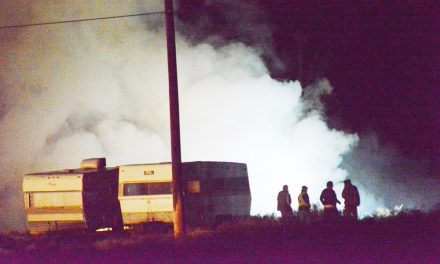
There’s a fire more than twice the size of the town of Oliver gobbling up trees in the forest south of Lytton.
Since it was discovered June 11 the Cisco Road Wildfire has troubled fire management teams and prompted evacuation alerts for the Lytton First Nation and the Thompson-Nicola Regional District.
The blaze is still only 20 per cent contained and more than 135 personnel are battling it—using heavy machinery, helicopters and feet on the ground to preemptively burn sections of forest to try and contain the blaze.
Kayla Pepper of the Kamloops Fire Centre says that firefighting operations are “going as they should,” but admits that crews will likely be on the ground for weeks before the fire is completely under control.
“There’s lots of work to do yet,” she says, but “it’s doing a lot of good right now, and we’re just hoping that the weather conditions will stay the same.”
Although the blaze is almost 300 kilometres from Oliver, fire information officers in the Kamloops Fire Area are reminding everyone to keep safe and be smart during the hottest months of the year.
Melissa Klassen is one of those officers.
June 16 she explained that fire danger ranges from “moderate” to “high” across the Okanagan Valley, with Category 2 and 3 fires banned across the whole centre.
This means any fire larger than a campfire (which the BC Ministry of Lands, Forests and Natural Resource Operations’ Wildfire Management Branch defines as no larger than a half metre tall and wide) is not allowed. Burning more than two campfires at the same time is also banned, as well as burning any stubble or grass or lighting fireworks, sky lanterns or burning barrels.
Although Oliver still sits at a “moderate” danger level, Klassen explained that the region is in the middle of a warm and drying trend, and that will “most definitely” affect the rating as the season progresses.
She said that while there is currently no campfire ban in the area, how people comply with the open burning bans is taken into consideration—along with weather conditions—when the agency is making that decision.
Although lightning is the biggest arsonist every summer, Klassen said that humans do a fair amount of damage as well. She explained that people are often surprised at exactly what can cause a wildfire in especially dry conditions.
A chainsaw in the back country could spark and then start a fire, or an ATV’s exhaust that touches grass when moving through trials. Campfires in the middle of nowhere are a more obvious culprit, but Klassen said that still happen every year.
Last year 48 per cent of wildfires were caused by lightning. Thirteen per cent were the result of “improper fire use” during open burning and 10 per cent were from incendiaries like fireworks. Seven per cent were from campfires, but less than one per cent were caused by smokers.
Although a few “larger incident fires” have caused the total number of hectares burned by wildfires to spike compared to last year, Klassen says the Wildfire Management Branch has actually responded to a lower-than-average number of fires so far this year: 68 compared to last year’s 81.
And the percentage of fires caused by people has also dropped compared to last year as well, with only 63 per cent caused by people, compared to 68 in 2014.
She said that the number one thing people can do to protect themselves during wildfire season is protecting their homes. Make sure there’s no flammable materials on the side of your house, that brush and trees are clean and free of fire fuel and keep combustibles ten metres from your house.
“Those are the things that are the most risk,” Klassen said.
Aside from that, she urged forest users to have common sense and be cautious when using any heat source in the woods.
By Trevor Nichols